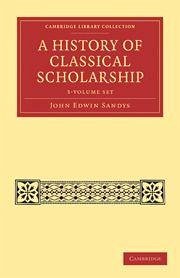
Sir John Edwin Sandys (1844-1922) was a leading Cambridge classicist and a Fellow of St. John's College. His most famous work is this three-volume History of Classical Scholarship, published between 1903 and 1908, which remains the only large-scale work on the subject to span the entire period from the sixth century BCE to the end of the nineteenth century. The history of classical studies was a popular topic during the nineteenth century, particularly in Germany, but Sandys stands out for the ambitious scope of his work, even though much of it was based on earlier scholarship. His…mehr
Sir John Edwin Sandys (1844-1922) was a leading Cambridge classicist and a Fellow of St. John's College. His most famous work is this three-volume History of Classical Scholarship, published between 1903 and 1908, which remains the only large-scale work on the subject to span the entire period from the sixth century BCE to the end of the nineteenth century. The history of classical studies was a popular topic during the nineteenth century, particularly in Germany, but Sandys stands out for the ambitious scope of his work, even though much of it was based on earlier scholarship. His chronological account is subdivided by genre and region, with some chapters devoted to particularly influential individuals. Volume 1 covers the Classical period, Byzantine scholarship, and the medieval West to 1350, Volume 2 the period from the Renaissance to the eighteenth century, and Volume 3 the eighteenth and nineteenth centuries.
Volume 1: Preface List of illustrations Titles of certain works of reference Abbreviations Addenda and corrigenda 1. Definition of 'scholar' and 'scholarship' Book I. The Athenian Age, c.600-c.300 B.C.: 2. The study of epic poetry 3. The study of lyric poetry 4. The study and criticism of dramatic poetry 5. The theory of poetry in Homer, Democritus, Plato and Aristotle 6. The rise of rhetoric, and the study of prose 7. The beginnings of grammar and etymology Book II. The Alexandrian Age, c.300-1 B.C.: 8. The school of Alexandria 9. The Stoics and the school of Pergamon Book III. The Roman Age of Latin Scholarship, c.168 B.C.-c.530 A.D.: 10. Latin scholarship from the death of Ennius (169 B.C.) to the Augustan Age 11. Latin scholarship from the Augustan Age to 300 A.D. 12. Latin scholarship from 300 to 500 A.D. 13. Latin scholarship from 500 to 530 A.D. Book IV. The Roman Age of Greek Scholarship, c.1-c.530 A.D.: 14. Roman study of Greek between 164 B.C. and 143 A.D. 15. Greek literary criticism in the first century of the Empire 16. Verbal scholarship in the first century of the Empire 17. The literary revival at the end of the first century 18. Greek scholarship in the second century 19. Greek scholarship in the third century 20. Greek scholarship in the fourth century 21. Greek scholarship from 400 to 530 A.D. Book V. The Byzantine Age, c.530-c.1350 A.D.: 22. Byzantine scholarship from 529 to 1000 A.D. 23. Period III 850-1350 continued Book VI. The Middle Ages in the West c.530-c.1350 A.D.: 24. Gregory the Great 25. Charles the Great and Alcuin 26. The tenth century 27. The eleventh century 28. The twelfth century 29. The twelfth century continued 30. The thirteenth century 31. The thirteenth century and after 32. The mediaeval copyists and the classics Index Greek index. Volume 2: Preface List of illustrations Select bibliography Book I. The Revival of Learning in Italy, c.1321-c.1527 A.D.: 1. Introduction 2. The Villa Paradiso and San Spirito 3. The recovery of the Latin classics by Poggio, Landriani, Francesco Pizzolpasso, Enoch of Ascoli, Sannazaro, Politian, Giorgio Galbiate, Parrasio, and Fra Giocondo, and of the Greek classics by Guarino, Aurispa and Filelfo, Bessarion, Constantine and Janus Lascaris 4. The early Medicean age in Florence 5. The earlier Greek immigrants 6. The later Greek immigrants 7. The Academy of Florence - Landino, Ficino, Pico, Politian 8. The printing of the classics in Italy 9. Leo X and his patronage of learning Book II. The Sixteenth Century 10. Erasmus 11. Italy from 1527 to 1600 12. Spain 13. France from 1360 to 1600 14. The Netherlands from 1400 to the foundation of the university of Leyden, 1575 15. England from 1370 to 1600 16. Germany from 1350 to 1616 Book III. The Seventeenth Century 17. Italy in the seventeenth century 18. France in the seventeenth century 19. The Netherlands from the foundation of the university of Leyden (1575) to 1700 20. England in the seventeenth century 21. Germany in the seventeenth century Book IV. The Eighteenth Century 22. Italy in the eighteenth century 23. France in the eighteenth century 24. England in the eighteenth century 25. The Netherlands in the eighteenth century Index. Volume 3: List of illustrations Book IV. The Eighteenth Century continued: 26. Germany in the eighteenth century 27. Germany in the eighteenth century continued Book V. The Nineteenth Century 28. F. A. Wolf and his contemporaries 29. Hermann and Boeckh 30. Grammarians and textual critics, from Lobeck to Ritschl 31. Editors of Greek classics 32. Editors of Latin classics 33. Comparative philologists 34. Archaeologists 35. Italy in the nineteenth century 36. France in the nineteenth century 37. The Netherlands in the nineteenth century 38. Scandinavia 39. Greece, Russia, Hungary 40. England i
Volume 1: Preface List of illustrations Titles of certain works of reference Abbreviations Addenda and corrigenda 1. Definition of 'scholar' and 'scholarship' Book I. The Athenian Age, c.600-c.300 B.C.: 2. The study of epic poetry 3. The study of lyric poetry 4. The study and criticism of dramatic poetry 5. The theory of poetry in Homer, Democritus, Plato and Aristotle 6. The rise of rhetoric, and the study of prose 7. The beginnings of grammar and etymology Book II. The Alexandrian Age, c.300-1 B.C.: 8. The school of Alexandria 9. The Stoics and the school of Pergamon Book III. The Roman Age of Latin Scholarship, c.168 B.C.-c.530 A.D.: 10. Latin scholarship from the death of Ennius (169 B.C.) to the Augustan Age 11. Latin scholarship from the Augustan Age to 300 A.D. 12. Latin scholarship from 300 to 500 A.D. 13. Latin scholarship from 500 to 530 A.D. Book IV. The Roman Age of Greek Scholarship, c.1-c.530 A.D.: 14. Roman study of Greek between 164 B.C. and 143 A.D. 15. Greek literary criticism in the first century of the Empire 16. Verbal scholarship in the first century of the Empire 17. The literary revival at the end of the first century 18. Greek scholarship in the second century 19. Greek scholarship in the third century 20. Greek scholarship in the fourth century 21. Greek scholarship from 400 to 530 A.D. Book V. The Byzantine Age, c.530-c.1350 A.D.: 22. Byzantine scholarship from 529 to 1000 A.D. 23. Period III 850-1350 continued Book VI. The Middle Ages in the West c.530-c.1350 A.D.: 24. Gregory the Great 25. Charles the Great and Alcuin 26. The tenth century 27. The eleventh century 28. The twelfth century 29. The twelfth century continued 30. The thirteenth century 31. The thirteenth century and after 32. The mediaeval copyists and the classics Index Greek index. Volume 2: Preface List of illustrations Select bibliography Book I. The Revival of Learning in Italy, c.1321-c.1527 A.D.: 1. Introduction 2. The Villa Paradiso and San Spirito 3. The recovery of the Latin classics by Poggio, Landriani, Francesco Pizzolpasso, Enoch of Ascoli, Sannazaro, Politian, Giorgio Galbiate, Parrasio, and Fra Giocondo, and of the Greek classics by Guarino, Aurispa and Filelfo, Bessarion, Constantine and Janus Lascaris 4. The early Medicean age in Florence 5. The earlier Greek immigrants 6. The later Greek immigrants 7. The Academy of Florence - Landino, Ficino, Pico, Politian 8. The printing of the classics in Italy 9. Leo X and his patronage of learning Book II. The Sixteenth Century 10. Erasmus 11. Italy from 1527 to 1600 12. Spain 13. France from 1360 to 1600 14. The Netherlands from 1400 to the foundation of the university of Leyden, 1575 15. England from 1370 to 1600 16. Germany from 1350 to 1616 Book III. The Seventeenth Century 17. Italy in the seventeenth century 18. France in the seventeenth century 19. The Netherlands from the foundation of the university of Leyden (1575) to 1700 20. England in the seventeenth century 21. Germany in the seventeenth century Book IV. The Eighteenth Century 22. Italy in the eighteenth century 23. France in the eighteenth century 24. England in the eighteenth century 25. The Netherlands in the eighteenth century Index. Volume 3: List of illustrations Book IV. The Eighteenth Century continued: 26. Germany in the eighteenth century 27. Germany in the eighteenth century continued Book V. The Nineteenth Century 28. F. A. Wolf and his contemporaries 29. Hermann and Boeckh 30. Grammarians and textual critics, from Lobeck to Ritschl 31. Editors of Greek classics 32. Editors of Latin classics 33. Comparative philologists 34. Archaeologists 35. Italy in the nineteenth century 36. France in the nineteenth century 37. The Netherlands in the nineteenth century 38. Scandinavia 39. Greece, Russia, Hungary 40. England i
Es gelten unsere Allgemeinen Geschäftsbedingungen: www.buecher.de/agb
Impressum
www.buecher.de ist ein Internetauftritt der buecher.de internetstores GmbH
Geschäftsführung: Monica Sawhney | Roland Kölbl | Günter Hilger
Sitz der Gesellschaft: Batheyer Straße 115 - 117, 58099 Hagen
Postanschrift: Bürgermeister-Wegele-Str. 12, 86167 Augsburg
Amtsgericht Hagen HRB 13257
Steuernummer: 321/5800/1497
USt-IdNr: DE450055826