
Andere Kunden interessierten sich auch für
 A Muslim Response to Evil167,99 €
 Zengi and the Muslim Response to the Crusades196,99 €
 Icon of Evil196,99 €
 'Terror to Evil-Doers'115,99 €
 The Social Evil With Special Reference to Conditions Existing in the City of New York: A Report30,99 €
 An Introduction to Said Nursi63,99 €
 Gender and Sexuality in Muslim Cultures67,99 €





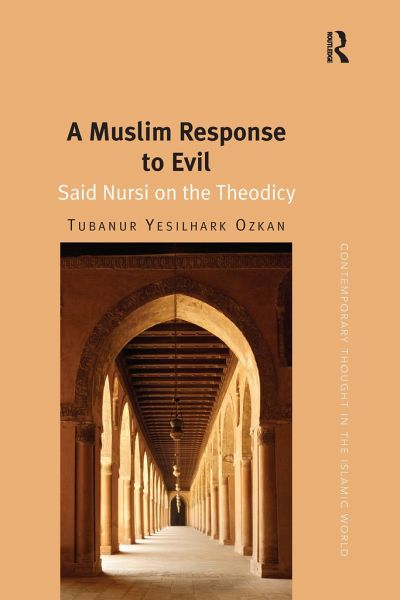
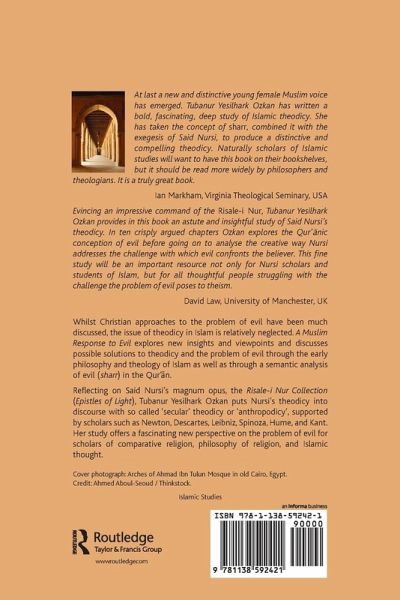
While Christian approaches to the problem of evil have been much discussed, the issue of theodicy in Islam is relatively neglected. A Muslim Response to Evil explores new insights and viewpoints and discusses possible solutions to theodicy and the problem of evil through the early philosophy and theology ofIslam as well as through a semantic analysis of evil (sharr) in the Qur'Ä?n. Reflecting on Said Nursi's magnum opus, the Risale-i Nur Collection (Epistles of Light), Tubanur Yesilhark Ozkan puts Nursi's theodicy into discourse with so called 'secular' theodicy or 'anthropodicy', supported by scholars such as Newton, Descartes, Leibniz, Spinoza, Hume, and Kant. Her study offers a fascinating new perspective on the problem of evil for scholars of comparative religion, philosophy of religion, and Islamic thought.
'At last a new and distinctive young female Muslim voice has emerged. Tubanur Yesilhark Ozkan has written a bold, fascinating, deep study of Islamic theodicy. She has taken the concept of sharr, combined it with the exegesis of Said Nursi, to produce a distinctive and compelling theodicy. Naturally scholars of Islamic studies will want to have this book on their bookshelves, but it should be read more widely by philosophers and theologians. It is a truly great book.' Ian Markham, Virginia Theological Seminary, USA 'Evincing an impressive command of the Risale-i Nur, Tubanur Yesilhark Ozkan provides in this book an astute and insightful study of Said Nursi's theodicy. In ten crisply argued chapters Ozkan explores the Qur'Ä?nic conception of evil before going on to analyse the creative way Nursi addresses the challenge with which evil confronts the believer. This fine study will be an important resource not only for Nursi scholars and students of Islam, but for all thoughtful people struggling with the challenge the problem of evil poses to theism.' David Law, University of Manchester, UK