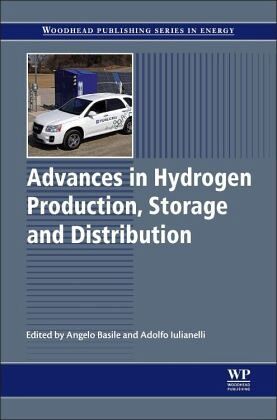
Advances in Hydrogen Production, Storage and Distribution reviews recent developments in this key component of the emerging "hydrogen economy," an energy infrastructure based on hydrogen. Since hydrogen can be produced without using fossil fuels, a move to such an economy has the potential to reduce greenhouse gas emissions and improve energy security. However, such a move also requires the advanced production, storage and usage techniques discussed in this book. Part one introduces the fundamentals of hydrogen production, storage, and distribution, including an overview of the development…mehr
Advances in Hydrogen Production, Storage and Distribution reviews recent developments in this key component of the emerging "hydrogen economy," an energy infrastructure based on hydrogen. Since hydrogen can be produced without using fossil fuels, a move to such an economy has the potential to reduce greenhouse gas emissions and improve energy security. However, such a move also requires the advanced production, storage and usage techniques discussed in this book.
Part one introduces the fundamentals of hydrogen production, storage, and distribution, including an overview of the development of the necessary infrastructure, an analysis of the potential environmental benefits, and a review of some important hydrogen production technologies in conventional, bio-based, and nuclear power plants. Part two focuses on hydrogen production from renewable resources, and includes chapters outlining the production of hydrogen through water electrolysis, photocatalysis, and bioengineered algae. Finally, part three covers hydrogen production using inorganic membrane reactors, the storage of hydrogen, fuel cell technology, and the potential of hydrogen as a fuel for transportation.
Advances in Hydrogen Production, Storage and Distribution provides a detailed overview of the components and challenges of a hydrogen economy. This book is an invaluable resource for research and development professionals in the energy industry, as well as academics with an interest in this important subject.
Die Herstellerinformationen sind derzeit nicht verfügbar.
Autorenporträt
Adolfo Iulianelli, Degree in Chemical Engineering in 2002 at University of Calabria (Italy), obtained his PhD Degree in Chemical and Materials Engineering in 2006 at University of Calabria (Italy). Nowadays, he is working at the Institute on Membrane Technology of the National Research Council of Italy (CNR-ITM). He is author or co-author of more than 50 international articles (ISI), 1 patent, more than 50 contributes as oral and poster presentations in national and international conferences, more than 20 book chapters. Furthermore, he is Reviewer of more than 20 international ICI journals, Invited Speaker in more than 5 international conferences, training school, etc. Subject Editor of the Scientific World Journal, Guest Editor for the International Journal of Hydrogen Energy (ICI) and Journal of Membrane Science and Technology and Associate Editor of International Journal of Membrane Science and Technology. His research interests are membrane reactors, fuel cells, gas separation
, hydrogen production from reforming reactions of renewable sources through inorganic membrane reactors and membrane operations. His h-index is 22 (source: www.scoupus.com). Angelo Basile, a Chemical Engineer with a Ph.D. in Technical Physics, was a senior Researcher at the ITM-CNR as a responsible for the research related to both ultra-pure hydrogen production and CO2 capture using Pd-based Membrane Reactors. He is a reviewer for 165 int. journals, an editor/author of more than 50 scientific books and 140 chapters on international books on membrane science and technology; with various patens (7 Italian, 2 European, and 1 worldwide). He is a referee of 1more than 150 international scientific journals and a Member of the Editorial Board of more than 20 of them. Basile is also an associate editor of the: Int. J. Hydrogen Energy; Asia-Pacific Journal of Chemical Eng.; journal Frontiers in Membrane Science and Technology; and co-Editor-in-chief of the Int. J. Membrane Science & Technol.
Inhaltsangabe
Contributor contact details
Woodhead Publishing Series in Energy
Dedication
Preface
Part I: Fundamentals of hydrogen production
1. Key challenges in the development of an infrastructure for hydrogen production, delivery, storage and use
Abstract:
1.1 Introduction
1.2 The hydrogen infrastructure
1.3 Building an infrastructure for the hydrogen economy
1.4 National planning for hydrogen infrastructure building
1.5 Conclusion: outlook for the hydrogen economy
1.6 Summary
1.7 Sources of further information and advice
1.8 References
1.9 Appendix: acronyms
2. Assessing the environmental impact of hydrogen energy production
Abstract:
2.1 Introduction
2.2 Self-regulating energy systems and materials circulation
2.3 An ideal energy system based on materials circulation
2.4 The environmental impact factor (EIF) of carbon and hydrogen
2.5 Local environmental impact factors for hydrogen and carbon in Japan
2.6 A green hydrogen energy system
2.7 Conclusions
2.8 References
2.9 Appendix: list of symbols and acronyms
3. Hydrogen production from fossil fuel and biomass feedstocks
Abstract:
3.1 Introduction: hydrogen from coal and natural gas
3.2 Partial oxidation (POX) technology
3.3 Steam reforming of natural gas and naphtha
3.4 Steam reforming and steam gasification of bio-feedstock
3.5 Economics and CO2 emissions of biomass gasification
3.6 Traditional feedstock purification: catalyst poison removal
3.7 Synthesis gas processing
3.8 Future trends and conclusions
3.9 References
3.10 Appendix: nomenclature
4. Hydrogen production in conventional, bio-based and nuclear power plants
Abstract:
4.1 Introduction
4.2 Hydrogen production in conventional and bio-based power plants
4.3 Combined carbon capture and storage (CCS)
4.4 Hydrogen production in nuclear power plants
4.5 Conclusions
4.6 References
4.7 Appendix: list of symbols and acronyms
5. Portable and small-scale stationary hydrogen production from micro-reactor systems
Abstract:
5.1 Introduction
5.2 Portable and small-scale hydrogen production
5.3 Microfluidic devices for process intensification
5.4 Feedstocks and technologies for hydrogen production in micro-reactors
5.5 Micro-reactor design: key issues for hydrogen production
5.6 Industrial scale-up and improvement of technology uptake
5.7 Process analysis and the business case
5.8 Future trends
5.9 Conclusions
5.11 Acknowledgments
5.10 Sources of further information and advice
5.12 References
5.13 Appendix: abbreviations
Part II: Hydrogen production from renewable sources
6. Hydrogen production by water electrolysis
Abstract:
6.1 Introduction
6.2 Electrolytic hydrogen production
6.3 Types of electrolyzers
6.4 Water electrolysis thermodynamics
6.5 Kinetics of water splitting
6.6 Electrolyzer current-voltage (I-V) curves
6.7 High-pressure water electrolysis
6.8 Coupling electrolyzers with solar energy for vehicle hydrogen fueling
6.9 Educational aspects of water electrolysis
6.10 Major issues facing the use of water electrolysis for hydrogen production