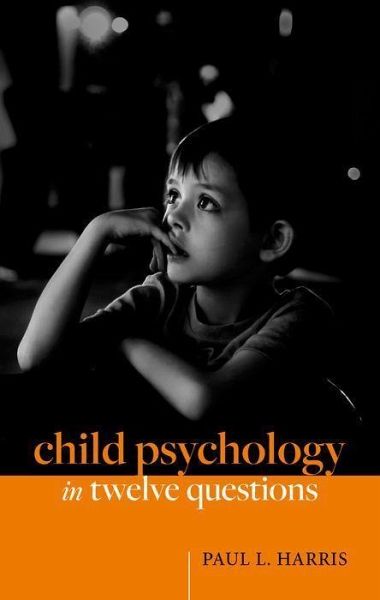
This book explores some of the enduring questions in developmental psychology. Paul Harris shows why these questions are important, proposes likely answers, and explains the uncertainties that persist.
This book explores some of the enduring questions in developmental psychology. Paul Harris shows why these questions are important, proposes likely answers, and explains the uncertainties that persist.
Paul L. Harris is a developmental psychologist with interests in the development of cognition, emotion, and imagination. After studying psychology at Sussex and Oxford, he taught at the University of Lancaster, the Free University of Amsterdam, and the London School of Economics. In 1980, he moved to Oxford where he became Professor of Developmental Psychology and Fellow of St John's College. In 2001, he migrated to Harvard University where he teaches developmental psychology in the Graduate School of Education. He is a fellow of the British Academy and the American Academy of Arts and Sciences. His book Trusting What You're Told: How Children Learn from Others (Harvard University Press, 2012) won the Cognitive Development Society Book Award in 2013 and the Eleanor Maccoby Book Award from the American Psychological Association in 2014.
Inhaltsangabe
* 1: Where does love come from? Attachment theory * 2: How do children learn words? Universality and variation * 3: Does language change how children think? The contested relation between language and thought * 4: Do children live in a fantasy world? Pretending and the origins of the imagination * 5: Are children natural psychologists? One or two early theories of mind * 6: Can we trust children's memory? The vulnerable eyewitness * 7: Do children understand emotion? Children's insight into their inner lives * 8: How do children tell right from wrong? The origins of morality * 9: Do children trust what they are told? The role of trust in cognitive development * 10: Do children believe in magic? Magic and miracles * 11: Is developmental psychology ethnocentric? Cross-cultural differences in ways of thinking * 12: What have we learned? Children's minds
* 1: Where does love come from? Attachment theory * 2: How do children learn words? Universality and variation * 3: Does language change how children think? The contested relation between language and thought * 4: Do children live in a fantasy world? Pretending and the origins of the imagination * 5: Are children natural psychologists? One or two early theories of mind * 6: Can we trust children's memory? The vulnerable eyewitness * 7: Do children understand emotion? Children's insight into their inner lives * 8: How do children tell right from wrong? The origins of morality * 9: Do children trust what they are told? The role of trust in cognitive development * 10: Do children believe in magic? Magic and miracles * 11: Is developmental psychology ethnocentric? Cross-cultural differences in ways of thinking * 12: What have we learned? Children's minds
Es gelten unsere Allgemeinen Geschäftsbedingungen: www.buecher.de/agb
Impressum
www.buecher.de ist ein Internetauftritt der buecher.de internetstores GmbH
Geschäftsführung: Monica Sawhney | Roland Kölbl | Günter Hilger
Sitz der Gesellschaft: Batheyer Straße 115 - 117, 58099 Hagen
Postanschrift: Bürgermeister-Wegele-Str. 12, 86167 Augsburg
Amtsgericht Hagen HRB 13257
Steuernummer: 321/5800/1497
USt-IdNr: DE450055826