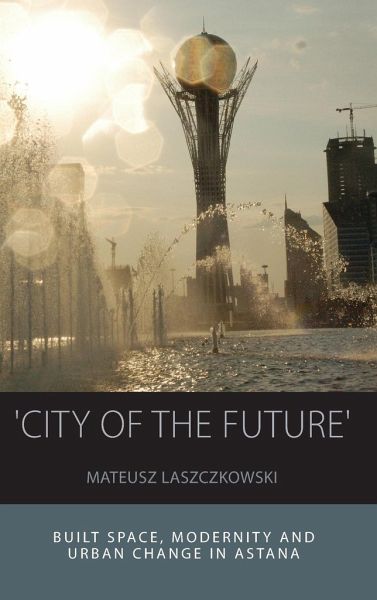
First ethnographic monograph of Astana; Bringing together a focus on the materiality of the built environment with attention to the workings of discourses and representations; hence, combining materialist and ideationalist (‘social-constructivist’) approaches to place and space in social science; Critically reading a range of heterogeneous literatures (urban anthropology, geography, political science, area studies, sociology, phenomenology) through the lens of detailed ethnography; Exploring a diversity of situated perspectives on Astana – juxtaposing the experience of migrants (rural as well…mehr
First ethnographic monograph of Astana; Bringing together a focus on the materiality of the built environment with attention to the workings of discourses and representations; hence, combining materialist and ideationalist (‘social-constructivist’) approaches to place and space in social science; Critically reading a range of heterogeneous literatures (urban anthropology, geography, political science, area studies, sociology, phenomenology) through the lens of detailed ethnography; Exploring a diversity of situated perspectives on Astana – juxtaposing the experience of migrants (rural as well as trans-urban), lifelong residents, and planners, across boundaries of ethnicity and class.
Mateusz Laszczkowski is Assistant Professor at the Institute of Ethnology and Cultural Anthropology, at the University of Warsaw, Poland. In 2007-2012 he conducted his doctoral research at the Max Planck Institute for Social Anthropology in Halle/Saale, Germany.
Inhaltsangabe
List of Maps, Figures and Tables Acknowledgments Note on Transliteration and Translation Introduction: Pathways into the 'City of the Future' * Astana, Kazakhstan and the Global Lives of Modernist Urbanism * Anthropology's Space * Space and Time * Theorizing the City Anthropologically * Fieldwork in the 'City of the Future' Chapter 1. Materializing the Future: Images and Practices * Deconstruction, Reconstruction * The Cityscape of the Future * Becoming 'Contemporary' * The Roots of Disenchantment, and Its Limits Chapter 2. Performing Urbanity: Migrants, the City and Collective Identification 1. Identities beyond Representation 2. Urbanity and Rurality in Kazakhstan 3. Migration to Astana 4. Migrants' Stories * Kumano: A Pioneer Settles Down * Kirill and Gisele: Love on the Move * Bakytgul: Caught Up in Deferrals * Aynura: The Girl Who Played the Accordion * Madiyar: The Struggling Southerner 5. Embodying Identity Chapter 3. Tselinograd: The Past in the 'City of the Future' * Building Tselinograd * Nostalgia and Spatial Intimacy * Walking in Tselinograd * Tselinograd's Glory Chapter 4. Celebration and the City: Belonging in Public Space 6. What Is Public Space? 7. The Setting: City Squares 8. Public Holiday Celebrations * ...in Late-Soviet Tselinograd * ...in Astana 9. Whose Celebration, Whose City? 10. Public Space Reopened Chapter 5. Fixing the Courtyard: Mundane Place-Making * Shifting Frameworks * Material Place-Making in the Dvor * Digression: Things Make a Difference * The KSK Takeover Chapter 6. Playing with the City: 'Encounter' in Astana * What is 'Encounter'? * Game Types * 'Encounter' as Play * Play or Politics: Carnival, Stiob and 'Encounter' * 'Encounter's Creativity' * Creasing Space Conclusion References Index
List of Maps, Figures and Tables Acknowledgments Note on Transliteration and Translation Introduction: Pathways into the 'City of the Future' * Astana, Kazakhstan and the Global Lives of Modernist Urbanism * Anthropology's Space * Space and Time * Theorizing the City Anthropologically * Fieldwork in the 'City of the Future' Chapter 1. Materializing the Future: Images and Practices * Deconstruction, Reconstruction * The Cityscape of the Future * Becoming 'Contemporary' * The Roots of Disenchantment, and Its Limits Chapter 2. Performing Urbanity: Migrants, the City and Collective Identification 1. Identities beyond Representation 2. Urbanity and Rurality in Kazakhstan 3. Migration to Astana 4. Migrants' Stories * Kumano: A Pioneer Settles Down * Kirill and Gisele: Love on the Move * Bakytgul: Caught Up in Deferrals * Aynura: The Girl Who Played the Accordion * Madiyar: The Struggling Southerner 5. Embodying Identity Chapter 3. Tselinograd: The Past in the 'City of the Future' * Building Tselinograd * Nostalgia and Spatial Intimacy * Walking in Tselinograd * Tselinograd's Glory Chapter 4. Celebration and the City: Belonging in Public Space 6. What Is Public Space? 7. The Setting: City Squares 8. Public Holiday Celebrations * ...in Late-Soviet Tselinograd * ...in Astana 9. Whose Celebration, Whose City? 10. Public Space Reopened Chapter 5. Fixing the Courtyard: Mundane Place-Making * Shifting Frameworks * Material Place-Making in the Dvor * Digression: Things Make a Difference * The KSK Takeover Chapter 6. Playing with the City: 'Encounter' in Astana * What is 'Encounter'? * Game Types * 'Encounter' as Play * Play or Politics: Carnival, Stiob and 'Encounter' * 'Encounter's Creativity' * Creasing Space Conclusion References Index
Es gelten unsere Allgemeinen Geschäftsbedingungen: www.buecher.de/agb
Impressum
www.buecher.de ist ein Internetauftritt der buecher.de internetstores GmbH
Geschäftsführung: Monica Sawhney | Roland Kölbl | Günter Hilger
Sitz der Gesellschaft: Batheyer Straße 115 - 117, 58099 Hagen
Postanschrift: Bürgermeister-Wegele-Str. 12, 86167 Augsburg
Amtsgericht Hagen HRB 13257
Steuernummer: 321/5800/1497
USt-IdNr: DE450055826