
- Broschiertes Buch
- Merkliste
- Auf die Merkliste
- Bewerten Bewerten
- Teilen
- Produkt teilen
- Produkterinnerung
- Produkterinnerung
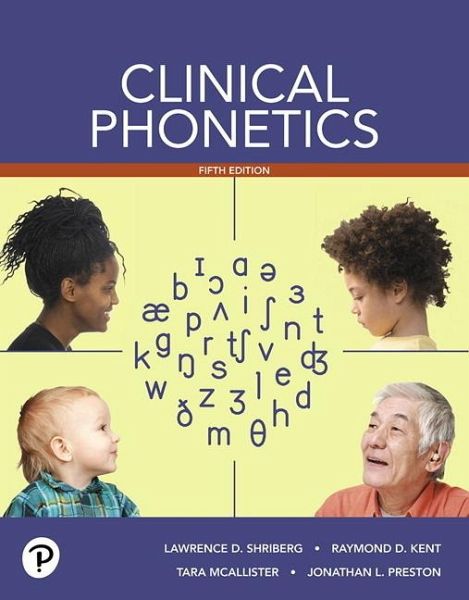
A comprehensive introduction to the art and science of applying phonetics to clinical transcription Clinical Phonetics was written specifically for readers who need to know phonetic knowledge and skills for clinical purposes in speech-language pathology. It covers the basic aspects of the phonetics of American English, including phonetic symbols, articulatory descriptions, and acoustic correlates, but it is unique in offering clinically relevant experience with authentic articulatory descriptions and speech samples from children and adults who have speech disorders or who use regional…mehr
Andere Kunden interessierten sich auch für
 Analysing Interactions in Childhood68,99 €
 A. FergusonResearching Communication Disorders38,99 €
 Mark TathamSpeech Production and Perception159,99 €
 The Handbook of Clinical Linguistics175,99 €
 John Hart / Michael A. Kraut (eds.)Neural Basis of Semantic Memory124,99 €
 Tabea ThiesTongue Body Kinematics in Parkinson's Disease59,95 €
 K. RichardsonInternet Discourse and Health Debates38,99 €
-
-
-



A comprehensive introduction to the art and science of applying phonetics to clinical transcription
Clinical Phonetics was written specifically for readers who need to know phonetic knowledge and skills for clinical purposes in speech-language pathology. It covers the basic aspects of the phonetics of American English, including phonetic symbols, articulatory descriptions, and acoustic correlates, but it is unique in offering clinically relevant experience with authentic articulatory descriptions and speech samples from children and adults who have speech disorders or who use regional dialects. A wealth of clinically relevant topics further aids readers in preparing for their own transcription experiences as professionals.
Now featuring the insights and expertise of two new co-authors, the 5th Edition retains its focus on clinical applications while offering more opportunities for clinical transcription, significantly updated content, and an improved organization to maximize clarity and ease of learning.
Also available with the Enhanced Pearson eText_
The Enhanced Pearson eText provides a rich, interactive learning environment designed to improve student mastery of content with embedded video, authentic audio samples, and multiple-choice quizzes with feedback.
_The Enhanced eText features are only available in the Pearson eText format. They are not available in third-party eTexts or downloads.
__The Pearson eText App is available on Google Play and in the App Store. It requires Android OS 3.1-4, a 7 or 10 tablet, or iPad iOS 5.0 or later.
NOTE: You are purchasing a standalone product; the Enhanced Pearson eText does not come packaged with this content. Students, if interested in purchasing this title with the Enhanced Pearson eText, ask your instructor to confirm the correct package ISBN and Course ID. Instructors, contact your Pearson rep for more information.
If you would like to purchase both the physical text and the Enhanced Pearson eText, search for:
0134683250 / 9780134683256 Clinical Phonetics with Enhanced Pearson eText - Access Card Package
Package consists of:
0134695585 / 9780134695587 Clinical Phonetics -- Enhanced Pearson eText -- Access Card 0134746147 / 9780134746142 Clinical Phonetics
Clinical Phonetics was written specifically for readers who need to know phonetic knowledge and skills for clinical purposes in speech-language pathology. It covers the basic aspects of the phonetics of American English, including phonetic symbols, articulatory descriptions, and acoustic correlates, but it is unique in offering clinically relevant experience with authentic articulatory descriptions and speech samples from children and adults who have speech disorders or who use regional dialects. A wealth of clinically relevant topics further aids readers in preparing for their own transcription experiences as professionals.
Now featuring the insights and expertise of two new co-authors, the 5th Edition retains its focus on clinical applications while offering more opportunities for clinical transcription, significantly updated content, and an improved organization to maximize clarity and ease of learning.
Also available with the Enhanced Pearson eText_
The Enhanced Pearson eText provides a rich, interactive learning environment designed to improve student mastery of content with embedded video, authentic audio samples, and multiple-choice quizzes with feedback.
_The Enhanced eText features are only available in the Pearson eText format. They are not available in third-party eTexts or downloads.
__The Pearson eText App is available on Google Play and in the App Store. It requires Android OS 3.1-4, a 7 or 10 tablet, or iPad iOS 5.0 or later.
NOTE: You are purchasing a standalone product; the Enhanced Pearson eText does not come packaged with this content. Students, if interested in purchasing this title with the Enhanced Pearson eText, ask your instructor to confirm the correct package ISBN and Course ID. Instructors, contact your Pearson rep for more information.
If you would like to purchase both the physical text and the Enhanced Pearson eText, search for:
0134683250 / 9780134683256 Clinical Phonetics with Enhanced Pearson eText - Access Card Package
Package consists of:
0134695585 / 9780134695587 Clinical Phonetics -- Enhanced Pearson eText -- Access Card 0134746147 / 9780134746142 Clinical Phonetics
Produktdetails
- Produktdetails
- Verlag: Pearson
- 5. Aufl.
- Seitenzahl: 384
- Erscheinungstermin: 5. Februar 2018
- Englisch
- Abmessung: 274mm x 218mm x 15mm
- Gewicht: 680g
- ISBN-13: 9780134746142
- ISBN-10: 0134746147
- Artikelnr.: 57884076
- Herstellerkennzeichnung
- Libri GmbH
- Europaallee 1
- 36244 Bad Hersfeld
- gpsr@libri.de
- Verlag: Pearson
- 5. Aufl.
- Seitenzahl: 384
- Erscheinungstermin: 5. Februar 2018
- Englisch
- Abmessung: 274mm x 218mm x 15mm
- Gewicht: 680g
- ISBN-13: 9780134746142
- ISBN-10: 0134746147
- Artikelnr.: 57884076
- Herstellerkennzeichnung
- Libri GmbH
- Europaallee 1
- 36244 Bad Hersfeld
- gpsr@libri.de
About our authors Lawrence D. Shriberg, PhD, is Professor Emeritus of Communicative Sciences and Disorders, University of Wisconsin, Madison. He is Principal Investigator of the Phonology Project, Communicative and Cognitive Sciences Unit, Waisman Center, University of Wisconsin, Madison. Dr. Shriberg's research is centered on genetic and other origins of pediatric speech sound disorders. Goals of the research using a framework termed the Speech Disorders Classification System are to develop behavioral markers that can be used to identify biomarkers and explicate the causal pathways of pediatric speech sound disorders. Recent emphasis has been on children with speech motor delay and children with apraxia of speech. Raymond D. Kent, PhD, is Professor Emeritus of Communicative Sciences and Disorders at the University of Wisconsin-Madison. He has authored or edited 19 books, including The Acoustic Analysis of Speech (with Charles Read), Reference Manual for Communicative Sciences and Disorders: Handbook of Voice Quality Measurement (with Martin J. Ball), The MIT Encyclopedia of Communication Disorders, and The Speech Sciences. He served as editor of the Journal of Speech and Hearing Research, associate founding editor of Clinical Linguistics and Phonetics, and associate editor of Folia Phoniatrica et Logopaedica. He currently conducts research on typical and atypical speech development with a clinical focus on children who have cerebral palsy or Down syndrome. Tara McAllister, PhD, is Assistant Professor of Communicative Sciences and Disorders at New York University. She has published more than 30 peer-reviewed articles spanning the disciplines of linguistics and speech-language pathology. Her research aims to understand how articulatory and perceptual factors shape phonological development and disorders. She also directs the Biofeedback Intervention Technology for Speech (BITS) Lab at NYU, which develops and tests tools to provide visual biofeedback for persistent speech sound errors in children. Jonathan L. Preston, PhD, is Associate Professor of Communication Sciences and Disorders at Syracuse University. He has coauthored more than 35 peer-reviewed publications, primarily focusing on phonetic, phonological, and neurobiological characteristics of children with speech sound disorders. In his current position, he teaches course-work on speech sound disorders, and he conducts research on assessment and treatment of speech sound disorders, including childhood apraxia of speech.
* About the Authors
* Preface
Chapter 1 Overview of Clinical Phonetics
1. Welcome
2. Clinical Phonetics
* The Knowledge Domain of Clinical Phonetics
* The Skill-Based Domain of Clinical Phonetics
* Conclusion
3. Chapter Summary Exercises
Chapter 2 Linguistic Phonetics
* Language, Speech, and Dialect
* The Morpheme
* The Phoneme
* Spelling versus Phonetic Transcription
* The International Phonetic Alphabet (IPA)
* Phonemes and Allophones
* Phonetics and Phonology
* The Syllable
* Positional and Contextual Terminology for Phonetic Descriptions
* Conclusion
* Chapter Summary Exercises
Chapter 3 The Three Systems of Speech Production
4. The Respiratory System
5. The Laryngeal System
6. The Supralaryngeal System
* Velopharynx: Velum and Pharyngeal Walls
* Jaw
* Tongue
* Lips
7. Technologies for the Study of Phonetics
* X-ray Imaging
* Magnetic Resonance Imaging (MRI)
* Electromagnetic Articulography
* Ultrasound
* Electropalatography
* Fiberoptic Endoscopy
* Aerodynamic Analysis
* Acoustic Analysis
8. Conclusion
9. Chapter Summary Exercises
Chapter 4 Vowels: Monophthongs and Diphthongs
10. Vowel Articulation
* Tongue Height
* Tongue Advancement (the FrontBack Dimension of Tongue Position)
* Tenseness or Length
* Lip Configuration
* Vowel Description: Tongue Height, Tongue Advancement, Tenseness, and
Lip Rounding
11. The Front Vowels
* Vowel /i/ (He)
* Vowel /8/ (Hid)
* Vowel /3/ (ChaoticFirst Syllable)
* Vowel /2/ (Head)
* Vowel /q/ (Had)
12. The Back Vowels
* Vowel /u/ (Who)
* Vowel /7/ (Hook)
* Vowel /o/ (Hoe)
* Vowel /9/ (Hall)
* Vowel /e/ (Hot)
13. The Central Vowels
* Vowel /4/ (Hub)
* Vowel /1/ (Above, Sometimes Called Schwa)
* Vowel /6/ (Her)
* Vowel /5/ (Mother, Sometimes Called Schwar)
14. Diphthong Articulation
* Diphthong /e]/ (Bye)
* Diphthong /9]/ (Boy)
* Diphthong /e[/ (Bough)
* Diphthong /3]/ (Bay)
* Diphthong /o[/ (Bow)
15. R-colored Vowels
* R-colored Vowel /e r/ (Far)
* R-colored Vowel /9 r/ (Four)
* R-colored Vowel /8 r/ (Fear)
* R-colored Vowel /2 r/ (Fair)
16. Special Notes on the Phonetic Properties of Vowels
* Some Cautions about Vowel Terminology
* Tongue and Jaw Interaction
* Lip and Jaw Interaction
17. Some Common Articulatory Modifications of English Vowels
* Nasalization
* Reduction
* Other Modifications
18. Allographs of English Vowels
19. Frequency of Occurrence for English Vowels
20. Vowels around the World
21. The Acoustic Properties of Vowels
* The Vocal Tract as a Resonator
* Primary Acoustic Properties of Vowels
22. Conclusion
23. Chapter Summary Exercises
Chapter 5 Consonants
24. Manner of Articulation
* Stops
* Fricatives
* Affricates
* Nasals
* Liquids
* Glides
25. Place of Articulation
* Bilabials
* Labiodentals
* Interdentals (or Dentals)
* Alveolars
* Palatals
* Velars
* Glottals
26. The Voicing Contrast
27. Summary of Manner, Place, and Voicing
* Manner of Articulation
* Place of Articulation and Voicing
28. Allographs of the Consonant Phonemes of English
29. Frequency of Occurrence and Place of Articulation
30. Summary Classification of Consonants
31. Consonant Acoustics
* Acoustic Features of Consonant Classes
* Sounds in Sequence
32. Conclusion
33. Chapter Summary Exercises
Chapter 6 Suprasegmentals and Prosody
34. The Units of Prosody
* Syllables
35. The Prosodic Foot
* The Intonational Phrase
* Intonation
36. Stress
* Lexical Stress
* Stress beyond the Word Level
37. Timing
* Tempo
* Pause (Juncture)
* Boundary or Edge Effects
38. Timing, Juncture, and Intonation Symbols
* Lengthened [s iQ]
* Shortened [w i W]
* Close Juncture [e] d 8 d 8 t]
* Open Juncture [1 n e] s + m q n] versus [1 n + e] s m q n]
* Internal Open Juncture [l 2 t s h 2 l p R j 3] n]
* Falling Terminal Juncture [t 7 d 3] T]
* Rising Terminal Juncture [t 7 d 3] Y]
* Checked or Held Juncture [t 7 d 3] U]
* Selected Extensions to the International Phonetic Alphabet
39. Paralinguistics
40. Examples of Prosodic Variations
* Motherese
* Clear Speech
* Other Prosodic Variations
41. Role of Prosody in Typical and Atypical Development of Speech and Language
42. Clinical Assessment of Suprasegmentals
* Prosody Profile (PROP)
* Prosody-Voice Screening Profile (PVSP)
43. Profiling Elements of Prosodic SystemsChild Version (PEPS-C)
44. Conclusion
45. Chapter Summary Exercises
Chapter 7 Narrow Transcription
46. Coarticulation
47. Uses of Narrow Transcription
48. Conventions for Diacritic Marks in This Text
49. Onglide and Offglide Symbols
50. Nasal Symbols
* Nasalized [b q! d]
* Nasal Emission [s@ m e] l]
* Denasalized [r q# n]
51. Lip Symbols
* Rounded (or Protruded) Vowel [s w i$ t]
* Unrounded (or Unprotruded) Vowel [h u% ]
* Labialized Consonant [k^ w i n]
* Nonlabialized Consonant [w& i d]
* Inverted Lip [b* i n]
52. Tongue Symbols
* Dentalized [w 8 dI ']
* Palatalized [sO i l]
* Lateralized [sP l i p]
* Retroflex (or Rhotacized) [h e r c{ 5]
* Velarized [f i l}]
* Fronted or Advanced [p e E t]
* Retracted [b qA t]
* Raised [b 2F d]
* Lowered [h 2G d]
* Derhotacized [rK 2 d]
53. Sound Source Symbols
* Partially Voiced [q b sL 1 n t]
* Partially Devoiced [d 9 g:]
* Glottalized (or Creaky Voice) [b e" k s]
* Breathy (or Murmured) [p l 3Z] 8 a]
* Whistled (or Hissed) [sC i]
* Trilled [th rV e]]
54. Syllabic Symbol
55. Stop Release Symbols
* Aspirated [t( e p]
* Unaspirated [s t) e p]
* Unreleased [l q p_]
* Frictionalized (or Spirantized) [s tX e p]
56. Other Symbols
* Synchronic Tie [d+z u]
* Unintelligible Syllable [\]
* Questionable Segment e or =
57. Conclusion
58. Chapter Summary Exercises
Chapter 8 Practicing Broad and Narrow Phonetic Transcription of Childrens
Speech
59. Part A: Transcription of Vowel Sound Changes
60. Background Information
61. Training Modules
* Vowels Module 1: Vowel Substitutions
* Vowels Module 2: Vowel Modifications
* Vowels Module 3: Central Vowels
62. Vowels Module 4: Vowel Substitutions, Modifications, and Central Vowels
63. Vowels Module 5: Vowel Additions
64. Vowels Module 6: Vowel Lengthening
65. Vowels Module 7: Vowel Nasalization
66. Vowels Module 8: Summary Quiz
67. Part B: Transcription of Stop Sound Changes
68. Background Information
* Description of Stops
69. Training Modules
* Stops Module 1: Stop Substitutions
* Stops Module 2: Voicing of Voiceless Stops
* Stops Module 3: Devoicing of Voiced Stops
* Stops Module 4: Glottal Stop Substitutions
* Stops Module 5: Stop Deletions
* Stops Module 6: Frictionalized Stops
* Stops Module 7: Summary Quiz
70. Part C: Transcription of Nasal Sound Changes
71. Background Information
* Description and Distribution of Nasals
72. Training Modules
* Nasals Module 1: Nasal Deletions
* Nasals Module 2: Summary Quiz
73. Part D: Transcription of Fricative and Affricate Sound Changes
74. Background Information
* Description of Fricatives
* Distribution and Frequency of Occurrence of Fricatives
75. Training Modules
* Overview
* Fricatives and Affricates Module 1: /f/ and /v/ Changes
* Fricatives and Affricates Module 2: /h/ Deletions
* Fricatives and Affricates Module 3: Voiceless and Voiced Interdental
Changes
* Fricatives and Affricates Module 4: Fricative and Affricate Voicing
Changes
* Fricatives and Affricates Module 5: Fricative and Affricate
Substitutions
* Fricatives and Affricates Module 6: Dentalized Sibilants
* Fricatives and Affricates Module 7: Lateralized Sibilants
* Fricatives and Affricates Module 8: Retroflexed and Palatalized
Sibilants
* Fricatives and Affricates Module 9: Sibilants Quiz
* Fricatives and Affricates Module 10: Summary Quiz
76. Part E: Transcription of Glide and Liquid Sound Changes
77. Background Information
* Description of Glides and Liquids
* Distribution and Frequency
78. Training Modules
* Glides and Liquids Module 1: Glide Changes
* Glides and Liquids Module 2: /l/ Substitutions
* Glides and Liquids Module 3: Velarized /l/
* Glides and Liquids Module 4: Derhotacized /r/, /6/, /5/
* Glides and Liquids Module 5: /r/ Quiz
* Glides and Liquids Module 6: Velarized /r/
* Glides and Liquids Module 7: Summary Quiz
79. Grand Quiz
Chapter 9 Preparing to Collect and Transcribe Clinical Speech Samples
80. Eliciting and Recording Speech Samples
* Eliciting the Sample
* The Recording Environment
* Recording Equipment
81. Factors that Influence Scoring and Transcription
* Client Factors
* Task Factors
82. Approaches to Clinical Transcription and Scoring
* Transcription and Scoring Systems
* What Level of Detail Should Be Represented?
83. The Process of Scoring or Transcription
* Should I Use Video Recording?
* Should I Use Headphones?
* Should I Preview the Recording?
* What if Im Not Sure What Im Hearing?
* How Many Times Should I Listen?
* What Are Some Strategies for Difficult Words?
* Some Final Suggestions
84. Conclusion
Chapter 10 Phonetics in the Clinical Setting
85. Single-Word Tests of Articulation and Phonology
86. Transcribing Nonwords
87. Two-Way Scoring and Deep Testing
88. Two-Way Scoring in Larger Speech Samples
* Scoring /s/ in Continuous Speech
* Scoring Rhotics in Continuous Speech
89. Transcription in Larger Speech Samples
* Transcribing Imitated Phrases
* Transcribing Read Sentences
* Transcribing All Sounds in Continuous Speech
90. Transcribing Children with Motor Speech Disorders
91. Motor Speech Disorders: Imitated Single Words
* Motor Speech Disorders: Imitated Words in Phrases
* Motor Speech Disorders: Imitated Sentences
* Motor Speech Disorders: Conversational Speech
92. Conclusion
Chapter 11 Phonetic Variation
93. Part A: Phonetic Aspects of Dialect Variation
94. What is Phonetic Variation?
95. Dialect as a Source of Phonetic Variation
* Studying Dialect
* Is There a Standard Dialect?
* Why Do Dialects Differ?
* Difference versus Disorder
96. Part B: Regional Dialects of American English
97. Southern Dialect Region
* Location
* Major Features
98. Western Dialect Region
* Location
* Major Features
99. Midlands Dialect Region
* Location
* Major Feature
100. Northern Dialect Regions
* Location
* Major Features
101. Dialects of the Northeastern United States
* Location
* Major Features
102. Practice Discriminating Regional Variation in Vowels
103. Regional Variation in Consonants
104. International Englishes
105. Part C: Beyond Regional Dialects
106. African American English
* Origins of AAE
* Features of AAE
107. L1-Influenced English
* Working with Speakers from Unfamiliar Language Backgrounds
* Spanish-Influenced English
* Features of Spanish-Influenced English
108. Conclusion
109. Further Reading
110. Other Resources
* Transcription Exercises
APPENDICDES
111. Phonetics Symbols and Terms
112. Distributional, Structural, and Proportional Occurrence Data for American
English Sounds, Syllables, and Words
GlossaryAnswers to ExercisesReferencesIndex
* Preface
Chapter 1 Overview of Clinical Phonetics
1. Welcome
2. Clinical Phonetics
* The Knowledge Domain of Clinical Phonetics
* The Skill-Based Domain of Clinical Phonetics
* Conclusion
3. Chapter Summary Exercises
Chapter 2 Linguistic Phonetics
* Language, Speech, and Dialect
* The Morpheme
* The Phoneme
* Spelling versus Phonetic Transcription
* The International Phonetic Alphabet (IPA)
* Phonemes and Allophones
* Phonetics and Phonology
* The Syllable
* Positional and Contextual Terminology for Phonetic Descriptions
* Conclusion
* Chapter Summary Exercises
Chapter 3 The Three Systems of Speech Production
4. The Respiratory System
5. The Laryngeal System
6. The Supralaryngeal System
* Velopharynx: Velum and Pharyngeal Walls
* Jaw
* Tongue
* Lips
7. Technologies for the Study of Phonetics
* X-ray Imaging
* Magnetic Resonance Imaging (MRI)
* Electromagnetic Articulography
* Ultrasound
* Electropalatography
* Fiberoptic Endoscopy
* Aerodynamic Analysis
* Acoustic Analysis
8. Conclusion
9. Chapter Summary Exercises
Chapter 4 Vowels: Monophthongs and Diphthongs
10. Vowel Articulation
* Tongue Height
* Tongue Advancement (the FrontBack Dimension of Tongue Position)
* Tenseness or Length
* Lip Configuration
* Vowel Description: Tongue Height, Tongue Advancement, Tenseness, and
Lip Rounding
11. The Front Vowels
* Vowel /i/ (He)
* Vowel /8/ (Hid)
* Vowel /3/ (ChaoticFirst Syllable)
* Vowel /2/ (Head)
* Vowel /q/ (Had)
12. The Back Vowels
* Vowel /u/ (Who)
* Vowel /7/ (Hook)
* Vowel /o/ (Hoe)
* Vowel /9/ (Hall)
* Vowel /e/ (Hot)
13. The Central Vowels
* Vowel /4/ (Hub)
* Vowel /1/ (Above, Sometimes Called Schwa)
* Vowel /6/ (Her)
* Vowel /5/ (Mother, Sometimes Called Schwar)
14. Diphthong Articulation
* Diphthong /e]/ (Bye)
* Diphthong /9]/ (Boy)
* Diphthong /e[/ (Bough)
* Diphthong /3]/ (Bay)
* Diphthong /o[/ (Bow)
15. R-colored Vowels
* R-colored Vowel /e r/ (Far)
* R-colored Vowel /9 r/ (Four)
* R-colored Vowel /8 r/ (Fear)
* R-colored Vowel /2 r/ (Fair)
16. Special Notes on the Phonetic Properties of Vowels
* Some Cautions about Vowel Terminology
* Tongue and Jaw Interaction
* Lip and Jaw Interaction
17. Some Common Articulatory Modifications of English Vowels
* Nasalization
* Reduction
* Other Modifications
18. Allographs of English Vowels
19. Frequency of Occurrence for English Vowels
20. Vowels around the World
21. The Acoustic Properties of Vowels
* The Vocal Tract as a Resonator
* Primary Acoustic Properties of Vowels
22. Conclusion
23. Chapter Summary Exercises
Chapter 5 Consonants
24. Manner of Articulation
* Stops
* Fricatives
* Affricates
* Nasals
* Liquids
* Glides
25. Place of Articulation
* Bilabials
* Labiodentals
* Interdentals (or Dentals)
* Alveolars
* Palatals
* Velars
* Glottals
26. The Voicing Contrast
27. Summary of Manner, Place, and Voicing
* Manner of Articulation
* Place of Articulation and Voicing
28. Allographs of the Consonant Phonemes of English
29. Frequency of Occurrence and Place of Articulation
30. Summary Classification of Consonants
31. Consonant Acoustics
* Acoustic Features of Consonant Classes
* Sounds in Sequence
32. Conclusion
33. Chapter Summary Exercises
Chapter 6 Suprasegmentals and Prosody
34. The Units of Prosody
* Syllables
35. The Prosodic Foot
* The Intonational Phrase
* Intonation
36. Stress
* Lexical Stress
* Stress beyond the Word Level
37. Timing
* Tempo
* Pause (Juncture)
* Boundary or Edge Effects
38. Timing, Juncture, and Intonation Symbols
* Lengthened [s iQ]
* Shortened [w i W]
* Close Juncture [e] d 8 d 8 t]
* Open Juncture [1 n e] s + m q n] versus [1 n + e] s m q n]
* Internal Open Juncture [l 2 t s h 2 l p R j 3] n]
* Falling Terminal Juncture [t 7 d 3] T]
* Rising Terminal Juncture [t 7 d 3] Y]
* Checked or Held Juncture [t 7 d 3] U]
* Selected Extensions to the International Phonetic Alphabet
39. Paralinguistics
40. Examples of Prosodic Variations
* Motherese
* Clear Speech
* Other Prosodic Variations
41. Role of Prosody in Typical and Atypical Development of Speech and Language
42. Clinical Assessment of Suprasegmentals
* Prosody Profile (PROP)
* Prosody-Voice Screening Profile (PVSP)
43. Profiling Elements of Prosodic SystemsChild Version (PEPS-C)
44. Conclusion
45. Chapter Summary Exercises
Chapter 7 Narrow Transcription
46. Coarticulation
47. Uses of Narrow Transcription
48. Conventions for Diacritic Marks in This Text
49. Onglide and Offglide Symbols
50. Nasal Symbols
* Nasalized [b q! d]
* Nasal Emission [s@ m e] l]
* Denasalized [r q# n]
51. Lip Symbols
* Rounded (or Protruded) Vowel [s w i$ t]
* Unrounded (or Unprotruded) Vowel [h u% ]
* Labialized Consonant [k^ w i n]
* Nonlabialized Consonant [w& i d]
* Inverted Lip [b* i n]
52. Tongue Symbols
* Dentalized [w 8 dI ']
* Palatalized [sO i l]
* Lateralized [sP l i p]
* Retroflex (or Rhotacized) [h e r c{ 5]
* Velarized [f i l}]
* Fronted or Advanced [p e E t]
* Retracted [b qA t]
* Raised [b 2F d]
* Lowered [h 2G d]
* Derhotacized [rK 2 d]
53. Sound Source Symbols
* Partially Voiced [q b sL 1 n t]
* Partially Devoiced [d 9 g:]
* Glottalized (or Creaky Voice) [b e" k s]
* Breathy (or Murmured) [p l 3Z] 8 a]
* Whistled (or Hissed) [sC i]
* Trilled [th rV e]]
54. Syllabic Symbol
55. Stop Release Symbols
* Aspirated [t( e p]
* Unaspirated [s t) e p]
* Unreleased [l q p_]
* Frictionalized (or Spirantized) [s tX e p]
56. Other Symbols
* Synchronic Tie [d+z u]
* Unintelligible Syllable [\]
* Questionable Segment e or =
57. Conclusion
58. Chapter Summary Exercises
Chapter 8 Practicing Broad and Narrow Phonetic Transcription of Childrens
Speech
59. Part A: Transcription of Vowel Sound Changes
60. Background Information
61. Training Modules
* Vowels Module 1: Vowel Substitutions
* Vowels Module 2: Vowel Modifications
* Vowels Module 3: Central Vowels
62. Vowels Module 4: Vowel Substitutions, Modifications, and Central Vowels
63. Vowels Module 5: Vowel Additions
64. Vowels Module 6: Vowel Lengthening
65. Vowels Module 7: Vowel Nasalization
66. Vowels Module 8: Summary Quiz
67. Part B: Transcription of Stop Sound Changes
68. Background Information
* Description of Stops
69. Training Modules
* Stops Module 1: Stop Substitutions
* Stops Module 2: Voicing of Voiceless Stops
* Stops Module 3: Devoicing of Voiced Stops
* Stops Module 4: Glottal Stop Substitutions
* Stops Module 5: Stop Deletions
* Stops Module 6: Frictionalized Stops
* Stops Module 7: Summary Quiz
70. Part C: Transcription of Nasal Sound Changes
71. Background Information
* Description and Distribution of Nasals
72. Training Modules
* Nasals Module 1: Nasal Deletions
* Nasals Module 2: Summary Quiz
73. Part D: Transcription of Fricative and Affricate Sound Changes
74. Background Information
* Description of Fricatives
* Distribution and Frequency of Occurrence of Fricatives
75. Training Modules
* Overview
* Fricatives and Affricates Module 1: /f/ and /v/ Changes
* Fricatives and Affricates Module 2: /h/ Deletions
* Fricatives and Affricates Module 3: Voiceless and Voiced Interdental
Changes
* Fricatives and Affricates Module 4: Fricative and Affricate Voicing
Changes
* Fricatives and Affricates Module 5: Fricative and Affricate
Substitutions
* Fricatives and Affricates Module 6: Dentalized Sibilants
* Fricatives and Affricates Module 7: Lateralized Sibilants
* Fricatives and Affricates Module 8: Retroflexed and Palatalized
Sibilants
* Fricatives and Affricates Module 9: Sibilants Quiz
* Fricatives and Affricates Module 10: Summary Quiz
76. Part E: Transcription of Glide and Liquid Sound Changes
77. Background Information
* Description of Glides and Liquids
* Distribution and Frequency
78. Training Modules
* Glides and Liquids Module 1: Glide Changes
* Glides and Liquids Module 2: /l/ Substitutions
* Glides and Liquids Module 3: Velarized /l/
* Glides and Liquids Module 4: Derhotacized /r/, /6/, /5/
* Glides and Liquids Module 5: /r/ Quiz
* Glides and Liquids Module 6: Velarized /r/
* Glides and Liquids Module 7: Summary Quiz
79. Grand Quiz
Chapter 9 Preparing to Collect and Transcribe Clinical Speech Samples
80. Eliciting and Recording Speech Samples
* Eliciting the Sample
* The Recording Environment
* Recording Equipment
81. Factors that Influence Scoring and Transcription
* Client Factors
* Task Factors
82. Approaches to Clinical Transcription and Scoring
* Transcription and Scoring Systems
* What Level of Detail Should Be Represented?
83. The Process of Scoring or Transcription
* Should I Use Video Recording?
* Should I Use Headphones?
* Should I Preview the Recording?
* What if Im Not Sure What Im Hearing?
* How Many Times Should I Listen?
* What Are Some Strategies for Difficult Words?
* Some Final Suggestions
84. Conclusion
Chapter 10 Phonetics in the Clinical Setting
85. Single-Word Tests of Articulation and Phonology
86. Transcribing Nonwords
87. Two-Way Scoring and Deep Testing
88. Two-Way Scoring in Larger Speech Samples
* Scoring /s/ in Continuous Speech
* Scoring Rhotics in Continuous Speech
89. Transcription in Larger Speech Samples
* Transcribing Imitated Phrases
* Transcribing Read Sentences
* Transcribing All Sounds in Continuous Speech
90. Transcribing Children with Motor Speech Disorders
91. Motor Speech Disorders: Imitated Single Words
* Motor Speech Disorders: Imitated Words in Phrases
* Motor Speech Disorders: Imitated Sentences
* Motor Speech Disorders: Conversational Speech
92. Conclusion
Chapter 11 Phonetic Variation
93. Part A: Phonetic Aspects of Dialect Variation
94. What is Phonetic Variation?
95. Dialect as a Source of Phonetic Variation
* Studying Dialect
* Is There a Standard Dialect?
* Why Do Dialects Differ?
* Difference versus Disorder
96. Part B: Regional Dialects of American English
97. Southern Dialect Region
* Location
* Major Features
98. Western Dialect Region
* Location
* Major Features
99. Midlands Dialect Region
* Location
* Major Feature
100. Northern Dialect Regions
* Location
* Major Features
101. Dialects of the Northeastern United States
* Location
* Major Features
102. Practice Discriminating Regional Variation in Vowels
103. Regional Variation in Consonants
104. International Englishes
105. Part C: Beyond Regional Dialects
106. African American English
* Origins of AAE
* Features of AAE
107. L1-Influenced English
* Working with Speakers from Unfamiliar Language Backgrounds
* Spanish-Influenced English
* Features of Spanish-Influenced English
108. Conclusion
109. Further Reading
110. Other Resources
* Transcription Exercises
APPENDICDES
111. Phonetics Symbols and Terms
112. Distributional, Structural, and Proportional Occurrence Data for American
English Sounds, Syllables, and Words
GlossaryAnswers to ExercisesReferencesIndex
* About the Authors
* Preface
Chapter 1 Overview of Clinical Phonetics
1. Welcome
2. Clinical Phonetics
* The Knowledge Domain of Clinical Phonetics
* The Skill-Based Domain of Clinical Phonetics
* Conclusion
3. Chapter Summary Exercises
Chapter 2 Linguistic Phonetics
* Language, Speech, and Dialect
* The Morpheme
* The Phoneme
* Spelling versus Phonetic Transcription
* The International Phonetic Alphabet (IPA)
* Phonemes and Allophones
* Phonetics and Phonology
* The Syllable
* Positional and Contextual Terminology for Phonetic Descriptions
* Conclusion
* Chapter Summary Exercises
Chapter 3 The Three Systems of Speech Production
4. The Respiratory System
5. The Laryngeal System
6. The Supralaryngeal System
* Velopharynx: Velum and Pharyngeal Walls
* Jaw
* Tongue
* Lips
7. Technologies for the Study of Phonetics
* X-ray Imaging
* Magnetic Resonance Imaging (MRI)
* Electromagnetic Articulography
* Ultrasound
* Electropalatography
* Fiberoptic Endoscopy
* Aerodynamic Analysis
* Acoustic Analysis
8. Conclusion
9. Chapter Summary Exercises
Chapter 4 Vowels: Monophthongs and Diphthongs
10. Vowel Articulation
* Tongue Height
* Tongue Advancement (the FrontBack Dimension of Tongue Position)
* Tenseness or Length
* Lip Configuration
* Vowel Description: Tongue Height, Tongue Advancement, Tenseness, and
Lip Rounding
11. The Front Vowels
* Vowel /i/ (He)
* Vowel /8/ (Hid)
* Vowel /3/ (ChaoticFirst Syllable)
* Vowel /2/ (Head)
* Vowel /q/ (Had)
12. The Back Vowels
* Vowel /u/ (Who)
* Vowel /7/ (Hook)
* Vowel /o/ (Hoe)
* Vowel /9/ (Hall)
* Vowel /e/ (Hot)
13. The Central Vowels
* Vowel /4/ (Hub)
* Vowel /1/ (Above, Sometimes Called Schwa)
* Vowel /6/ (Her)
* Vowel /5/ (Mother, Sometimes Called Schwar)
14. Diphthong Articulation
* Diphthong /e]/ (Bye)
* Diphthong /9]/ (Boy)
* Diphthong /e[/ (Bough)
* Diphthong /3]/ (Bay)
* Diphthong /o[/ (Bow)
15. R-colored Vowels
* R-colored Vowel /e r/ (Far)
* R-colored Vowel /9 r/ (Four)
* R-colored Vowel /8 r/ (Fear)
* R-colored Vowel /2 r/ (Fair)
16. Special Notes on the Phonetic Properties of Vowels
* Some Cautions about Vowel Terminology
* Tongue and Jaw Interaction
* Lip and Jaw Interaction
17. Some Common Articulatory Modifications of English Vowels
* Nasalization
* Reduction
* Other Modifications
18. Allographs of English Vowels
19. Frequency of Occurrence for English Vowels
20. Vowels around the World
21. The Acoustic Properties of Vowels
* The Vocal Tract as a Resonator
* Primary Acoustic Properties of Vowels
22. Conclusion
23. Chapter Summary Exercises
Chapter 5 Consonants
24. Manner of Articulation
* Stops
* Fricatives
* Affricates
* Nasals
* Liquids
* Glides
25. Place of Articulation
* Bilabials
* Labiodentals
* Interdentals (or Dentals)
* Alveolars
* Palatals
* Velars
* Glottals
26. The Voicing Contrast
27. Summary of Manner, Place, and Voicing
* Manner of Articulation
* Place of Articulation and Voicing
28. Allographs of the Consonant Phonemes of English
29. Frequency of Occurrence and Place of Articulation
30. Summary Classification of Consonants
31. Consonant Acoustics
* Acoustic Features of Consonant Classes
* Sounds in Sequence
32. Conclusion
33. Chapter Summary Exercises
Chapter 6 Suprasegmentals and Prosody
34. The Units of Prosody
* Syllables
35. The Prosodic Foot
* The Intonational Phrase
* Intonation
36. Stress
* Lexical Stress
* Stress beyond the Word Level
37. Timing
* Tempo
* Pause (Juncture)
* Boundary or Edge Effects
38. Timing, Juncture, and Intonation Symbols
* Lengthened [s iQ]
* Shortened [w i W]
* Close Juncture [e] d 8 d 8 t]
* Open Juncture [1 n e] s + m q n] versus [1 n + e] s m q n]
* Internal Open Juncture [l 2 t s h 2 l p R j 3] n]
* Falling Terminal Juncture [t 7 d 3] T]
* Rising Terminal Juncture [t 7 d 3] Y]
* Checked or Held Juncture [t 7 d 3] U]
* Selected Extensions to the International Phonetic Alphabet
39. Paralinguistics
40. Examples of Prosodic Variations
* Motherese
* Clear Speech
* Other Prosodic Variations
41. Role of Prosody in Typical and Atypical Development of Speech and Language
42. Clinical Assessment of Suprasegmentals
* Prosody Profile (PROP)
* Prosody-Voice Screening Profile (PVSP)
43. Profiling Elements of Prosodic SystemsChild Version (PEPS-C)
44. Conclusion
45. Chapter Summary Exercises
Chapter 7 Narrow Transcription
46. Coarticulation
47. Uses of Narrow Transcription
48. Conventions for Diacritic Marks in This Text
49. Onglide and Offglide Symbols
50. Nasal Symbols
* Nasalized [b q! d]
* Nasal Emission [s@ m e] l]
* Denasalized [r q# n]
51. Lip Symbols
* Rounded (or Protruded) Vowel [s w i$ t]
* Unrounded (or Unprotruded) Vowel [h u% ]
* Labialized Consonant [k^ w i n]
* Nonlabialized Consonant [w& i d]
* Inverted Lip [b* i n]
52. Tongue Symbols
* Dentalized [w 8 dI ']
* Palatalized [sO i l]
* Lateralized [sP l i p]
* Retroflex (or Rhotacized) [h e r c{ 5]
* Velarized [f i l}]
* Fronted or Advanced [p e E t]
* Retracted [b qA t]
* Raised [b 2F d]
* Lowered [h 2G d]
* Derhotacized [rK 2 d]
53. Sound Source Symbols
* Partially Voiced [q b sL 1 n t]
* Partially Devoiced [d 9 g:]
* Glottalized (or Creaky Voice) [b e" k s]
* Breathy (or Murmured) [p l 3Z] 8 a]
* Whistled (or Hissed) [sC i]
* Trilled [th rV e]]
54. Syllabic Symbol
55. Stop Release Symbols
* Aspirated [t( e p]
* Unaspirated [s t) e p]
* Unreleased [l q p_]
* Frictionalized (or Spirantized) [s tX e p]
56. Other Symbols
* Synchronic Tie [d+z u]
* Unintelligible Syllable [\]
* Questionable Segment e or =
57. Conclusion
58. Chapter Summary Exercises
Chapter 8 Practicing Broad and Narrow Phonetic Transcription of Childrens
Speech
59. Part A: Transcription of Vowel Sound Changes
60. Background Information
61. Training Modules
* Vowels Module 1: Vowel Substitutions
* Vowels Module 2: Vowel Modifications
* Vowels Module 3: Central Vowels
62. Vowels Module 4: Vowel Substitutions, Modifications, and Central Vowels
63. Vowels Module 5: Vowel Additions
64. Vowels Module 6: Vowel Lengthening
65. Vowels Module 7: Vowel Nasalization
66. Vowels Module 8: Summary Quiz
67. Part B: Transcription of Stop Sound Changes
68. Background Information
* Description of Stops
69. Training Modules
* Stops Module 1: Stop Substitutions
* Stops Module 2: Voicing of Voiceless Stops
* Stops Module 3: Devoicing of Voiced Stops
* Stops Module 4: Glottal Stop Substitutions
* Stops Module 5: Stop Deletions
* Stops Module 6: Frictionalized Stops
* Stops Module 7: Summary Quiz
70. Part C: Transcription of Nasal Sound Changes
71. Background Information
* Description and Distribution of Nasals
72. Training Modules
* Nasals Module 1: Nasal Deletions
* Nasals Module 2: Summary Quiz
73. Part D: Transcription of Fricative and Affricate Sound Changes
74. Background Information
* Description of Fricatives
* Distribution and Frequency of Occurrence of Fricatives
75. Training Modules
* Overview
* Fricatives and Affricates Module 1: /f/ and /v/ Changes
* Fricatives and Affricates Module 2: /h/ Deletions
* Fricatives and Affricates Module 3: Voiceless and Voiced Interdental
Changes
* Fricatives and Affricates Module 4: Fricative and Affricate Voicing
Changes
* Fricatives and Affricates Module 5: Fricative and Affricate
Substitutions
* Fricatives and Affricates Module 6: Dentalized Sibilants
* Fricatives and Affricates Module 7: Lateralized Sibilants
* Fricatives and Affricates Module 8: Retroflexed and Palatalized
Sibilants
* Fricatives and Affricates Module 9: Sibilants Quiz
* Fricatives and Affricates Module 10: Summary Quiz
76. Part E: Transcription of Glide and Liquid Sound Changes
77. Background Information
* Description of Glides and Liquids
* Distribution and Frequency
78. Training Modules
* Glides and Liquids Module 1: Glide Changes
* Glides and Liquids Module 2: /l/ Substitutions
* Glides and Liquids Module 3: Velarized /l/
* Glides and Liquids Module 4: Derhotacized /r/, /6/, /5/
* Glides and Liquids Module 5: /r/ Quiz
* Glides and Liquids Module 6: Velarized /r/
* Glides and Liquids Module 7: Summary Quiz
79. Grand Quiz
Chapter 9 Preparing to Collect and Transcribe Clinical Speech Samples
80. Eliciting and Recording Speech Samples
* Eliciting the Sample
* The Recording Environment
* Recording Equipment
81. Factors that Influence Scoring and Transcription
* Client Factors
* Task Factors
82. Approaches to Clinical Transcription and Scoring
* Transcription and Scoring Systems
* What Level of Detail Should Be Represented?
83. The Process of Scoring or Transcription
* Should I Use Video Recording?
* Should I Use Headphones?
* Should I Preview the Recording?
* What if Im Not Sure What Im Hearing?
* How Many Times Should I Listen?
* What Are Some Strategies for Difficult Words?
* Some Final Suggestions
84. Conclusion
Chapter 10 Phonetics in the Clinical Setting
85. Single-Word Tests of Articulation and Phonology
86. Transcribing Nonwords
87. Two-Way Scoring and Deep Testing
88. Two-Way Scoring in Larger Speech Samples
* Scoring /s/ in Continuous Speech
* Scoring Rhotics in Continuous Speech
89. Transcription in Larger Speech Samples
* Transcribing Imitated Phrases
* Transcribing Read Sentences
* Transcribing All Sounds in Continuous Speech
90. Transcribing Children with Motor Speech Disorders
91. Motor Speech Disorders: Imitated Single Words
* Motor Speech Disorders: Imitated Words in Phrases
* Motor Speech Disorders: Imitated Sentences
* Motor Speech Disorders: Conversational Speech
92. Conclusion
Chapter 11 Phonetic Variation
93. Part A: Phonetic Aspects of Dialect Variation
94. What is Phonetic Variation?
95. Dialect as a Source of Phonetic Variation
* Studying Dialect
* Is There a Standard Dialect?
* Why Do Dialects Differ?
* Difference versus Disorder
96. Part B: Regional Dialects of American English
97. Southern Dialect Region
* Location
* Major Features
98. Western Dialect Region
* Location
* Major Features
99. Midlands Dialect Region
* Location
* Major Feature
100. Northern Dialect Regions
* Location
* Major Features
101. Dialects of the Northeastern United States
* Location
* Major Features
102. Practice Discriminating Regional Variation in Vowels
103. Regional Variation in Consonants
104. International Englishes
105. Part C: Beyond Regional Dialects
106. African American English
* Origins of AAE
* Features of AAE
107. L1-Influenced English
* Working with Speakers from Unfamiliar Language Backgrounds
* Spanish-Influenced English
* Features of Spanish-Influenced English
108. Conclusion
109. Further Reading
110. Other Resources
* Transcription Exercises
APPENDICDES
111. Phonetics Symbols and Terms
112. Distributional, Structural, and Proportional Occurrence Data for American
English Sounds, Syllables, and Words
GlossaryAnswers to ExercisesReferencesIndex
* Preface
Chapter 1 Overview of Clinical Phonetics
1. Welcome
2. Clinical Phonetics
* The Knowledge Domain of Clinical Phonetics
* The Skill-Based Domain of Clinical Phonetics
* Conclusion
3. Chapter Summary Exercises
Chapter 2 Linguistic Phonetics
* Language, Speech, and Dialect
* The Morpheme
* The Phoneme
* Spelling versus Phonetic Transcription
* The International Phonetic Alphabet (IPA)
* Phonemes and Allophones
* Phonetics and Phonology
* The Syllable
* Positional and Contextual Terminology for Phonetic Descriptions
* Conclusion
* Chapter Summary Exercises
Chapter 3 The Three Systems of Speech Production
4. The Respiratory System
5. The Laryngeal System
6. The Supralaryngeal System
* Velopharynx: Velum and Pharyngeal Walls
* Jaw
* Tongue
* Lips
7. Technologies for the Study of Phonetics
* X-ray Imaging
* Magnetic Resonance Imaging (MRI)
* Electromagnetic Articulography
* Ultrasound
* Electropalatography
* Fiberoptic Endoscopy
* Aerodynamic Analysis
* Acoustic Analysis
8. Conclusion
9. Chapter Summary Exercises
Chapter 4 Vowels: Monophthongs and Diphthongs
10. Vowel Articulation
* Tongue Height
* Tongue Advancement (the FrontBack Dimension of Tongue Position)
* Tenseness or Length
* Lip Configuration
* Vowel Description: Tongue Height, Tongue Advancement, Tenseness, and
Lip Rounding
11. The Front Vowels
* Vowel /i/ (He)
* Vowel /8/ (Hid)
* Vowel /3/ (ChaoticFirst Syllable)
* Vowel /2/ (Head)
* Vowel /q/ (Had)
12. The Back Vowels
* Vowel /u/ (Who)
* Vowel /7/ (Hook)
* Vowel /o/ (Hoe)
* Vowel /9/ (Hall)
* Vowel /e/ (Hot)
13. The Central Vowels
* Vowel /4/ (Hub)
* Vowel /1/ (Above, Sometimes Called Schwa)
* Vowel /6/ (Her)
* Vowel /5/ (Mother, Sometimes Called Schwar)
14. Diphthong Articulation
* Diphthong /e]/ (Bye)
* Diphthong /9]/ (Boy)
* Diphthong /e[/ (Bough)
* Diphthong /3]/ (Bay)
* Diphthong /o[/ (Bow)
15. R-colored Vowels
* R-colored Vowel /e r/ (Far)
* R-colored Vowel /9 r/ (Four)
* R-colored Vowel /8 r/ (Fear)
* R-colored Vowel /2 r/ (Fair)
16. Special Notes on the Phonetic Properties of Vowels
* Some Cautions about Vowel Terminology
* Tongue and Jaw Interaction
* Lip and Jaw Interaction
17. Some Common Articulatory Modifications of English Vowels
* Nasalization
* Reduction
* Other Modifications
18. Allographs of English Vowels
19. Frequency of Occurrence for English Vowels
20. Vowels around the World
21. The Acoustic Properties of Vowels
* The Vocal Tract as a Resonator
* Primary Acoustic Properties of Vowels
22. Conclusion
23. Chapter Summary Exercises
Chapter 5 Consonants
24. Manner of Articulation
* Stops
* Fricatives
* Affricates
* Nasals
* Liquids
* Glides
25. Place of Articulation
* Bilabials
* Labiodentals
* Interdentals (or Dentals)
* Alveolars
* Palatals
* Velars
* Glottals
26. The Voicing Contrast
27. Summary of Manner, Place, and Voicing
* Manner of Articulation
* Place of Articulation and Voicing
28. Allographs of the Consonant Phonemes of English
29. Frequency of Occurrence and Place of Articulation
30. Summary Classification of Consonants
31. Consonant Acoustics
* Acoustic Features of Consonant Classes
* Sounds in Sequence
32. Conclusion
33. Chapter Summary Exercises
Chapter 6 Suprasegmentals and Prosody
34. The Units of Prosody
* Syllables
35. The Prosodic Foot
* The Intonational Phrase
* Intonation
36. Stress
* Lexical Stress
* Stress beyond the Word Level
37. Timing
* Tempo
* Pause (Juncture)
* Boundary or Edge Effects
38. Timing, Juncture, and Intonation Symbols
* Lengthened [s iQ]
* Shortened [w i W]
* Close Juncture [e] d 8 d 8 t]
* Open Juncture [1 n e] s + m q n] versus [1 n + e] s m q n]
* Internal Open Juncture [l 2 t s h 2 l p R j 3] n]
* Falling Terminal Juncture [t 7 d 3] T]
* Rising Terminal Juncture [t 7 d 3] Y]
* Checked or Held Juncture [t 7 d 3] U]
* Selected Extensions to the International Phonetic Alphabet
39. Paralinguistics
40. Examples of Prosodic Variations
* Motherese
* Clear Speech
* Other Prosodic Variations
41. Role of Prosody in Typical and Atypical Development of Speech and Language
42. Clinical Assessment of Suprasegmentals
* Prosody Profile (PROP)
* Prosody-Voice Screening Profile (PVSP)
43. Profiling Elements of Prosodic SystemsChild Version (PEPS-C)
44. Conclusion
45. Chapter Summary Exercises
Chapter 7 Narrow Transcription
46. Coarticulation
47. Uses of Narrow Transcription
48. Conventions for Diacritic Marks in This Text
49. Onglide and Offglide Symbols
50. Nasal Symbols
* Nasalized [b q! d]
* Nasal Emission [s@ m e] l]
* Denasalized [r q# n]
51. Lip Symbols
* Rounded (or Protruded) Vowel [s w i$ t]
* Unrounded (or Unprotruded) Vowel [h u% ]
* Labialized Consonant [k^ w i n]
* Nonlabialized Consonant [w& i d]
* Inverted Lip [b* i n]
52. Tongue Symbols
* Dentalized [w 8 dI ']
* Palatalized [sO i l]
* Lateralized [sP l i p]
* Retroflex (or Rhotacized) [h e r c{ 5]
* Velarized [f i l}]
* Fronted or Advanced [p e E t]
* Retracted [b qA t]
* Raised [b 2F d]
* Lowered [h 2G d]
* Derhotacized [rK 2 d]
53. Sound Source Symbols
* Partially Voiced [q b sL 1 n t]
* Partially Devoiced [d 9 g:]
* Glottalized (or Creaky Voice) [b e" k s]
* Breathy (or Murmured) [p l 3Z] 8 a]
* Whistled (or Hissed) [sC i]
* Trilled [th rV e]]
54. Syllabic Symbol
55. Stop Release Symbols
* Aspirated [t( e p]
* Unaspirated [s t) e p]
* Unreleased [l q p_]
* Frictionalized (or Spirantized) [s tX e p]
56. Other Symbols
* Synchronic Tie [d+z u]
* Unintelligible Syllable [\]
* Questionable Segment e or =
57. Conclusion
58. Chapter Summary Exercises
Chapter 8 Practicing Broad and Narrow Phonetic Transcription of Childrens
Speech
59. Part A: Transcription of Vowel Sound Changes
60. Background Information
61. Training Modules
* Vowels Module 1: Vowel Substitutions
* Vowels Module 2: Vowel Modifications
* Vowels Module 3: Central Vowels
62. Vowels Module 4: Vowel Substitutions, Modifications, and Central Vowels
63. Vowels Module 5: Vowel Additions
64. Vowels Module 6: Vowel Lengthening
65. Vowels Module 7: Vowel Nasalization
66. Vowels Module 8: Summary Quiz
67. Part B: Transcription of Stop Sound Changes
68. Background Information
* Description of Stops
69. Training Modules
* Stops Module 1: Stop Substitutions
* Stops Module 2: Voicing of Voiceless Stops
* Stops Module 3: Devoicing of Voiced Stops
* Stops Module 4: Glottal Stop Substitutions
* Stops Module 5: Stop Deletions
* Stops Module 6: Frictionalized Stops
* Stops Module 7: Summary Quiz
70. Part C: Transcription of Nasal Sound Changes
71. Background Information
* Description and Distribution of Nasals
72. Training Modules
* Nasals Module 1: Nasal Deletions
* Nasals Module 2: Summary Quiz
73. Part D: Transcription of Fricative and Affricate Sound Changes
74. Background Information
* Description of Fricatives
* Distribution and Frequency of Occurrence of Fricatives
75. Training Modules
* Overview
* Fricatives and Affricates Module 1: /f/ and /v/ Changes
* Fricatives and Affricates Module 2: /h/ Deletions
* Fricatives and Affricates Module 3: Voiceless and Voiced Interdental
Changes
* Fricatives and Affricates Module 4: Fricative and Affricate Voicing
Changes
* Fricatives and Affricates Module 5: Fricative and Affricate
Substitutions
* Fricatives and Affricates Module 6: Dentalized Sibilants
* Fricatives and Affricates Module 7: Lateralized Sibilants
* Fricatives and Affricates Module 8: Retroflexed and Palatalized
Sibilants
* Fricatives and Affricates Module 9: Sibilants Quiz
* Fricatives and Affricates Module 10: Summary Quiz
76. Part E: Transcription of Glide and Liquid Sound Changes
77. Background Information
* Description of Glides and Liquids
* Distribution and Frequency
78. Training Modules
* Glides and Liquids Module 1: Glide Changes
* Glides and Liquids Module 2: /l/ Substitutions
* Glides and Liquids Module 3: Velarized /l/
* Glides and Liquids Module 4: Derhotacized /r/, /6/, /5/
* Glides and Liquids Module 5: /r/ Quiz
* Glides and Liquids Module 6: Velarized /r/
* Glides and Liquids Module 7: Summary Quiz
79. Grand Quiz
Chapter 9 Preparing to Collect and Transcribe Clinical Speech Samples
80. Eliciting and Recording Speech Samples
* Eliciting the Sample
* The Recording Environment
* Recording Equipment
81. Factors that Influence Scoring and Transcription
* Client Factors
* Task Factors
82. Approaches to Clinical Transcription and Scoring
* Transcription and Scoring Systems
* What Level of Detail Should Be Represented?
83. The Process of Scoring or Transcription
* Should I Use Video Recording?
* Should I Use Headphones?
* Should I Preview the Recording?
* What if Im Not Sure What Im Hearing?
* How Many Times Should I Listen?
* What Are Some Strategies for Difficult Words?
* Some Final Suggestions
84. Conclusion
Chapter 10 Phonetics in the Clinical Setting
85. Single-Word Tests of Articulation and Phonology
86. Transcribing Nonwords
87. Two-Way Scoring and Deep Testing
88. Two-Way Scoring in Larger Speech Samples
* Scoring /s/ in Continuous Speech
* Scoring Rhotics in Continuous Speech
89. Transcription in Larger Speech Samples
* Transcribing Imitated Phrases
* Transcribing Read Sentences
* Transcribing All Sounds in Continuous Speech
90. Transcribing Children with Motor Speech Disorders
91. Motor Speech Disorders: Imitated Single Words
* Motor Speech Disorders: Imitated Words in Phrases
* Motor Speech Disorders: Imitated Sentences
* Motor Speech Disorders: Conversational Speech
92. Conclusion
Chapter 11 Phonetic Variation
93. Part A: Phonetic Aspects of Dialect Variation
94. What is Phonetic Variation?
95. Dialect as a Source of Phonetic Variation
* Studying Dialect
* Is There a Standard Dialect?
* Why Do Dialects Differ?
* Difference versus Disorder
96. Part B: Regional Dialects of American English
97. Southern Dialect Region
* Location
* Major Features
98. Western Dialect Region
* Location
* Major Features
99. Midlands Dialect Region
* Location
* Major Feature
100. Northern Dialect Regions
* Location
* Major Features
101. Dialects of the Northeastern United States
* Location
* Major Features
102. Practice Discriminating Regional Variation in Vowels
103. Regional Variation in Consonants
104. International Englishes
105. Part C: Beyond Regional Dialects
106. African American English
* Origins of AAE
* Features of AAE
107. L1-Influenced English
* Working with Speakers from Unfamiliar Language Backgrounds
* Spanish-Influenced English
* Features of Spanish-Influenced English
108. Conclusion
109. Further Reading
110. Other Resources
* Transcription Exercises
APPENDICDES
111. Phonetics Symbols and Terms
112. Distributional, Structural, and Proportional Occurrence Data for American
English Sounds, Syllables, and Words
GlossaryAnswers to ExercisesReferencesIndex