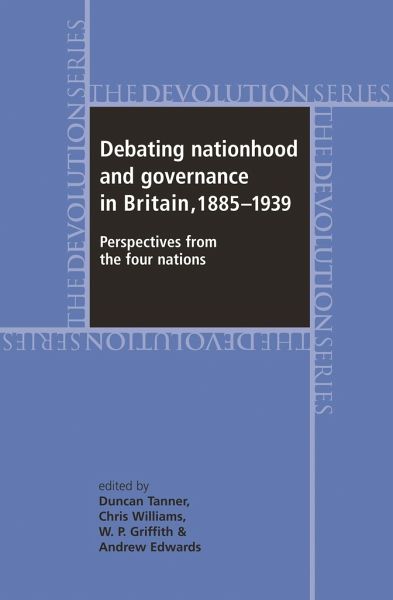
This book is the first in-depth study of the debates over devolution in the four nations of the UK in the period up to 1939. It explores divergent trends and attitudes towards the principle of devolution at both local and national (UK) levels, explains the limitations of devolution as a political ideal and the inherent contradictions in the debates over devolution which were unresolvable in the period under study. The book also demonstrates the enduring potency of an all-British context and of the influence and power of those who wished to defend the status quo. It investigates the role of…mehr
This book is the first in-depth study of the debates over devolution in the four nations of the UK in the period up to 1939. It explores divergent trends and attitudes towards the principle of devolution at both local and national (UK) levels, explains the limitations of devolution as a political ideal and the inherent contradictions in the debates over devolution which were unresolvable in the period under study. The book also demonstrates the enduring potency of an all-British context and of the influence and power of those who wished to defend the status quo. It investigates the role of national - and Imperial - identities in the debates over devolution, highlighting the continuing value and importance of 'Britishness' and British identity as vital factors in moulding popular opinion and support for established systems of governance. In so doing, the book offers fresh perspectives on the development of nationalisms in the 'Celtic fringe' during this period and demonstrates the problems and limitations of such identities as ways of mobilizing political opposition.
The late Duncan Tanner was Professor of History at University of Wales, Bangor, and Director of the Welsh Institute for Social and Cultural Affairs Chris Williams is Professor of History and Head of the School of History, Archaeology and Religion at Cardiff University Andrew Edwards is Senior Lecturer in History and Dean of Arts and Humanities at Bangor University W. P. Griffith is Senior Lecturer in Welsh History at University of Wales, Bangor
Inhaltsangabe
Introduction: Devolution, identity and British politics Duncan Tanner PART I: IMPERFECT EXAMPLES: IRELAND, SCOTLAND AND DEVOLVED GOVERNANCE 1. Scotland and Devolution, 1880 1945 Richard J. Finlay 2. A Place Apart? Ulster, Britain and Devolution, 1886 1939 D. George Boyce 3. Irish Home Rule as devolutionary paradigm, 1914 39 Deirdre McMahon PART II: UNFINISHED BUSINESS: DEVOLUTION IN WALES 1885 1945 4. Devolutionist Tendencies in Wales, 1885 1914 Wil Griffith 5. Some Conceptions of Welsh National Identity and Governance, 1918 39 Andrew Edwards and Wil Griffith 6. The Dilemmas of Nation and Class in Wales, 1914 45 Chris Williams PART III: OPPOSITION AND ALTERNATIVES: BRITAIN, THE EMPIRE AND THE CONSTITUTION 7. Devolution, Federalism and Imperial Circuitry: Ireland, South Africa and India James McConnel and Matthew Kelly 8. Conservatives, 'Englishness' and 'Civic Nationalism' between the Wars Matthew Cragoe 9. The Government of London John Davis 10. How Devolution Died: The British Labour party's constitutional agenda 1900 45 Duncan Tanner
Es gelten unsere Allgemeinen Geschäftsbedingungen: www.buecher.de/agb
Impressum
www.buecher.de ist ein Internetauftritt der buecher.de internetstores GmbH
Geschäftsführung: Monica Sawhney | Roland Kölbl | Günter Hilger
Sitz der Gesellschaft: Batheyer Straße 115 - 117, 58099 Hagen
Postanschrift: Bürgermeister-Wegele-Str. 12, 86167 Augsburg
Amtsgericht Hagen HRB 13257
Steuernummer: 321/5800/1497
USt-IdNr: DE450055826