46,99 €
inkl. MwSt.
Versandkostenfrei*Erscheint vorauss. Mai 2026
Melden Sie sich
hier
hier
für den Produktalarm an, um über die Verfügbarkeit des Produkts informiert zu werden.

23 °P sammeln
Andere Kunden interessierten sich auch für
 Teaching the Entrepreneurial Mindset Across the University38,99 €
 Teaching the Entrepreneurial Mindset to Engineers68,99 €
 Teaching the Entrepreneurial Mindset Across the University53,99 €
 The Innovator's Mindset33,99 €
 Whither online education? Auditing the entrepreneurial university52,99 €
 Shifting the Mindset61,99 €
 The impact of entrepreneurship education and personality traits on Entrepreneurial Intentions of University Students in Oman15,95 €





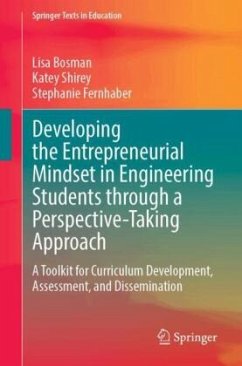
This book reminds university engineering faculty, staff, and administration of the compelling need to better prepare engineering education students for the workforce by developing an entrepreneurial mindset. To meet the need, this book provides an evidence-based approach to transform engineering education using an integrative and perspectives-taking approach, coupling the entrepreneurial mindset with bio-inspired design and arts integration, to improve engineering retention, completion, and job placement rates. As efforts continue to expand participation in STEM, particularly within engineering, it has become increasingly clear that faculty must teach in ways that foster engagement and inclusion. Yet many engineering educators receive limited pedagogical and scholarly preparation, making it difficult to implement evidence-based practices that support diverse learners and strengthen pathways into engineering. This gap underscores why an integrative, perspectives-taking approach is needed to deeply engage students in learning the entrepreneurial mindset.
This book provides engineering faculty with a peer mentoring toolkit (including six tools) that can be used to develop new perspectives-based curriculum enhancing students entrepreneurial mindset, implement and assess the curriculum, and disseminate findings via the scholarship of teaching and learning. Ideally, improved teaching by engineering faculty impacts engineering undergraduates to stay in engineering education longer and embed more of the entrepreneurial mindset in their engineering careers, thereby increasing the quality of the future engineering workforce. The work has a direct impact on engineering education faculty members (who now have the tools to transform their classroom), graduate teaching assistants (who are supervised by the educators), and undergraduate students / future engineering workforce (who gain access to new curriculum).
This book provides engineering faculty with a peer mentoring toolkit (including six tools) that can be used to develop new perspectives-based curriculum enhancing students entrepreneurial mindset, implement and assess the curriculum, and disseminate findings via the scholarship of teaching and learning. Ideally, improved teaching by engineering faculty impacts engineering undergraduates to stay in engineering education longer and embed more of the entrepreneurial mindset in their engineering careers, thereby increasing the quality of the future engineering workforce. The work has a direct impact on engineering education faculty members (who now have the tools to transform their classroom), graduate teaching assistants (who are supervised by the educators), and undergraduate students / future engineering workforce (who gain access to new curriculum).