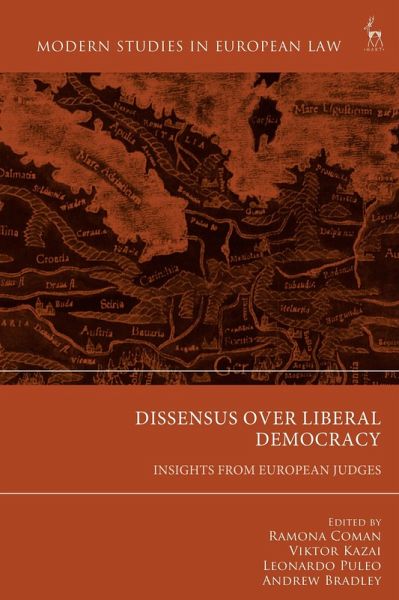
This book explores what judges do and how they perceive their roles in the context of growing dissensus over liberal democracy. Focusing on the European landscape, it asks eighteen judges how they perceive their roles when judicial independence and democracy are under pressure. The book features interviews with judges from various EU and non-EU Member States and courts, complemented by a series of academic commentaries discussing the relationship between law and politics in times of dissensus over liberal democracy. Each narrative reveals unique personal experiences and reflections, shedding…mehr
This book explores what judges do and how they perceive their roles in the context of growing dissensus over liberal democracy. Focusing on the European landscape, it asks eighteen judges how they perceive their roles when judicial independence and democracy are under pressure. The book features interviews with judges from various EU and non-EU Member States and courts, complemented by a series of academic commentaries discussing the relationship between law and politics in times of dissensus over liberal democracy. Each narrative reveals unique personal experiences and reflections, shedding light on the role of the judiciary and the rule of law in the face of contemporary challenges. While the book engages with these issues through European narratives, its findings contribute to broader debates beyond Europe and the EU.
Ramona Coman is Professor of Political Science at the Université Libre de Bruxelles, Belgium. Viktor Kazai is Post-Doctoral Researcher at the Université Libre de Bruxelles, Belgium. Leonardo Puleo is Post-Doctoral Researcher at the University College Dublin, Ireland. Andrew Bradley is a member of the IEE-ULB RED-SPINEL Project Management Team at the Institut d'études européennes, Belgium.
Inhaltsangabe
1. How do Judges Conceive their Roles in a Context of Growing Dissensus Over Liberal Democracy-And Why do Narratives Matter?, Ramona Coman (Université Libre de Bruxelles, Belgium) 2. Illiberalism on Trial: Ideational Boundaries, Institutional Practices, and Public Diffusion, Leonardo Puleo (University College Dublin, Republic of Ireland) 3. The Essence of Judicial Independence: The Autonomous Interpretation of the Law, Viktor Kazai (Université Libre de Bruxelles, Belgium) Part I: Insights from Western and Northern European Judges 4. We Can Aim to be Part of the Solution Rather than Being Part of the Problem, Lars Bay Larsen (Court of Justice of the European Union, Luxembourg) 5. Activism is a Responsibility that Every Magistrate Bears, Manuela Cadelli (Namur Court of First Instance, Belgium) 6...It is, to a Large Extent, a Matter of the Cultural Preconditions of Constitutionalism, Dieter Grimm (Federal Constitutional Court of Germany) 7. High Level of Trust in the Judiciary is the Best Protection you can Have, Kees Sterk (District Court of Breda, the Netherlands) 8. We Cannot Divorce the Application of the Law from its Origins and Moral Implications, Andrea Titz (Traunstein Regional Court, Germany) 9. How Can Courts and Legislators Co-Exist?, Christopher Vajda (Court of Justice of the European Union, Luxembourg) Part II: Insights from Southern European Judges 10. The Independence of the Judiciary is Not the Privilege of a Group of Professionals, Mariarosaria Guglielmi (MEDEL European Delegated Prosecutor, Italy) 11. We Must Decide With our Conscience, With the Sole Comfort of the Law, José Igreja Matos (Court of Appeal of Porto, Portugal) 12. Judges Can be a Big Obstacle for Authoritarian Regimes, Luca Perilli ( Trento Migration Court, Italy) 13. We Can Best Uphold Democracy and Defend the Rule of Law by Listening to Citizens, Javier Hernández García (Supreme Court of Spain) Part III: Insights from Central and Eastern European Judges 14. The Judiciary [...] has Power over the Meaning of the Law, András Baka (Supreme Court of Hungary) 15. The European Commission Abandoned the Honest Judges, Drago? Calin ( Bucharest Court of Appeals, Romania) 16. Judges Cannot Speak Only Through Their Judgments, Monika Frackowiak ( District Court in Poznan, Poland) 17. The Very Status of a Judge Requires Deep Reflection, Malgorzata Maria Gersdorf (University of Warsaw, Poland) 18. Constitutional Courts are not the Sole Guardians of Liberal Democracy, Zdenek Kühn (Czech Constitutional Court, Czechia) 19. When Your Independence and Integrity are Called into Question, you Must be Prepared to Respond, Tamás Matusik (National Judicial Council, Hungary) Part IV: Insights from Neighbouring European Countries 20. I Went to Bed as a Judge and Woke up a Terrorist, Yavuz Aydin 21. I Am Not Confident That the EU Genuinely Prioritises Judicial Independence in the Serbian Case, Dragana Boljevic (Supreme Court of Serbia) Part V: Academic Debates 22. Liberal Democracy and its Discontents: Normative Insights from European Judges and Recent Academic Debates, Lisa Conant (University of Denver, USA) 23. Judges' Resilience in the Face of Attacks on Judicial Independence: Some Reflections on the German, Italian, and Hungarian Contexts, Gábor Halmai (European University Institute, Italy) 24. Activism and the Evolving Role of European Judges: Defending Rights in an Age of Democratic Dissensus, Agnieszka Kubal (Green Templeton College, UK) 25. The Fertile Fear of the Abyss: Or, How the Rule of Law Crisis Spurred Judges to Mobilize European Law, Tommaso Pavone (University of Toronto, Canada) 26. The Twilight of Resilience? Reflections on the Limits of Judicial Activism in the Face of Democratic Decline, Katarína Sipulová (Masaryk University, Czechia) 27. Law, Politics and Society: Europeanisation Amid Dissensus over Liberal Democracy, Institutions and Values, Ramona Coman (Université Libre de Bruxelles, Belgium) 28. Learning from Judges: Looking Forward, Andrew Bradley (Institut d'Etudes européennes, Belgium) Bibliography Index
1. How do Judges Conceive their Roles in a Context of Growing Dissensus Over Liberal Democracy-And Why do Narratives Matter?, Ramona Coman (Université Libre de Bruxelles, Belgium) 2. Illiberalism on Trial: Ideational Boundaries, Institutional Practices, and Public Diffusion, Leonardo Puleo (University College Dublin, Republic of Ireland) 3. The Essence of Judicial Independence: The Autonomous Interpretation of the Law, Viktor Kazai (Université Libre de Bruxelles, Belgium) Part I: Insights from Western and Northern European Judges 4. We Can Aim to be Part of the Solution Rather than Being Part of the Problem, Lars Bay Larsen (Court of Justice of the European Union, Luxembourg) 5. Activism is a Responsibility that Every Magistrate Bears, Manuela Cadelli (Namur Court of First Instance, Belgium) 6...It is, to a Large Extent, a Matter of the Cultural Preconditions of Constitutionalism, Dieter Grimm (Federal Constitutional Court of Germany) 7. High Level of Trust in the Judiciary is the Best Protection you can Have, Kees Sterk (District Court of Breda, the Netherlands) 8. We Cannot Divorce the Application of the Law from its Origins and Moral Implications, Andrea Titz (Traunstein Regional Court, Germany) 9. How Can Courts and Legislators Co-Exist?, Christopher Vajda (Court of Justice of the European Union, Luxembourg) Part II: Insights from Southern European Judges 10. The Independence of the Judiciary is Not the Privilege of a Group of Professionals, Mariarosaria Guglielmi (MEDEL European Delegated Prosecutor, Italy) 11. We Must Decide With our Conscience, With the Sole Comfort of the Law, José Igreja Matos (Court of Appeal of Porto, Portugal) 12. Judges Can be a Big Obstacle for Authoritarian Regimes, Luca Perilli ( Trento Migration Court, Italy) 13. We Can Best Uphold Democracy and Defend the Rule of Law by Listening to Citizens, Javier Hernández García (Supreme Court of Spain) Part III: Insights from Central and Eastern European Judges 14. The Judiciary [...] has Power over the Meaning of the Law, András Baka (Supreme Court of Hungary) 15. The European Commission Abandoned the Honest Judges, Drago? Calin ( Bucharest Court of Appeals, Romania) 16. Judges Cannot Speak Only Through Their Judgments, Monika Frackowiak ( District Court in Poznan, Poland) 17. The Very Status of a Judge Requires Deep Reflection, Malgorzata Maria Gersdorf (University of Warsaw, Poland) 18. Constitutional Courts are not the Sole Guardians of Liberal Democracy, Zdenek Kühn (Czech Constitutional Court, Czechia) 19. When Your Independence and Integrity are Called into Question, you Must be Prepared to Respond, Tamás Matusik (National Judicial Council, Hungary) Part IV: Insights from Neighbouring European Countries 20. I Went to Bed as a Judge and Woke up a Terrorist, Yavuz Aydin 21. I Am Not Confident That the EU Genuinely Prioritises Judicial Independence in the Serbian Case, Dragana Boljevic (Supreme Court of Serbia) Part V: Academic Debates 22. Liberal Democracy and its Discontents: Normative Insights from European Judges and Recent Academic Debates, Lisa Conant (University of Denver, USA) 23. Judges' Resilience in the Face of Attacks on Judicial Independence: Some Reflections on the German, Italian, and Hungarian Contexts, Gábor Halmai (European University Institute, Italy) 24. Activism and the Evolving Role of European Judges: Defending Rights in an Age of Democratic Dissensus, Agnieszka Kubal (Green Templeton College, UK) 25. The Fertile Fear of the Abyss: Or, How the Rule of Law Crisis Spurred Judges to Mobilize European Law, Tommaso Pavone (University of Toronto, Canada) 26. The Twilight of Resilience? Reflections on the Limits of Judicial Activism in the Face of Democratic Decline, Katarína Sipulová (Masaryk University, Czechia) 27. Law, Politics and Society: Europeanisation Amid Dissensus over Liberal Democracy, Institutions and Values, Ramona Coman (Université Libre de Bruxelles, Belgium) 28. Learning from Judges: Looking Forward, Andrew Bradley (Institut d'Etudes européennes, Belgium) Bibliography Index
Es gelten unsere Allgemeinen Geschäftsbedingungen: www.buecher.de/agb
Impressum
www.buecher.de ist ein Internetauftritt der buecher.de internetstores GmbH
Geschäftsführung: Monica Sawhney | Roland Kölbl | Günter Hilger
Sitz der Gesellschaft: Batheyer Straße 115 - 117, 58099 Hagen
Postanschrift: Bürgermeister-Wegele-Str. 12, 86167 Augsburg
Amtsgericht Hagen HRB 13257
Steuernummer: 321/5800/1497
USt-IdNr: DE450055826