
Andere Kunden interessierten sich auch für
 Impact of price fluctuation on small scale farmers livelihood27,99 €
 Effects of Location and Processing on Heavy Metal Contents in Fish45,99 €
 Effect of fertilizers on the Leaf folder and Brown plant hopper insect47,99 €
 Genotype by location interaction of bread wheat in Northern Ethiopia32,99 €
 Factors Influencing Choice of Fishing Location in Nankumba Peninsula40,99 €
 Botanical Management of Cabbage Aphid27,99 €
 Isolation of Trichoderma spp from different location of Bangladesh36,99 €





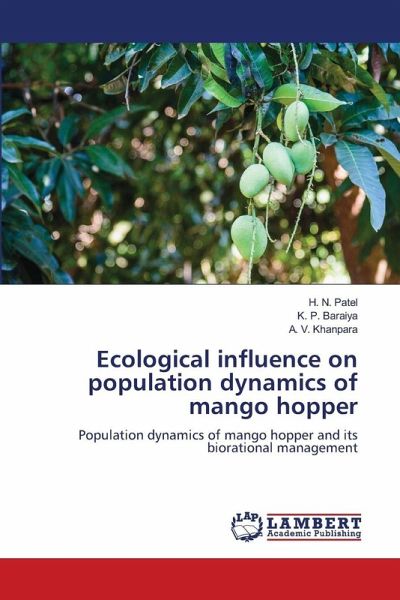
The investigation on "Ecological influence on population dynamics of mango hopper" was carried out at JAU research stations and farmer orchards in Junagadh, Mendarda and Dhari during 2021-23. Hopper populations peaked on inflorescences in the 9th SMW and on trunks around 44th-48th SMW, with canopy peaks varying across varieties. Alphonso recorded the highest infestation, followed by Kesar and Rajapuri, with Junagadh showing maximum hopper populations, Mendarda moderate and Dhari least. Correlation studies revealed hopper incidence was positively linked with sunshine hours, humidity fluctuation, GDD and negatively with temperature and evaporation. GDD analysis showed higher cumulative heat units accelerated hopper build-up, with distinct varietal responses. Screening indicated Alphonso most susceptible, Rajapuri least. For management, azadirachtin 1EC @0.005% proved superior, recording lowest hopper population (3.04/inflorescence) and highest yield (90.87 q/ha). Yield increase over control was highest with azadirachtin (63.49%), while maximum ICBR was with azadirachtin @0.003% (1:7.89), followed by Lecanicilliumlecanii (1:7.58), highlighting potential of biorationals for management.