
Andere Kunden interessierten sich auch für
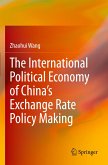
 The International Political Economy of China's Exchange Rate Policy Making91,99 €
 Cash-Flow Management in a Volatile Flexible Exchange Rate System39,99 €
 Foreign-Exchange-Rate Forecasting with Artificial Neural Networks105,99 €
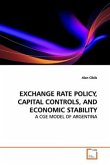
 EXCHANGE RATE POLICY, CAPITAL CONTROLS, AND ECONOMIC STABILITY52,99 €
 The International Political Economy of China's Exchange Rate Policy Making91,99 €
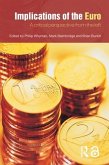
 Implications of the Euro70,99 €
 International Business Finance75,99 €

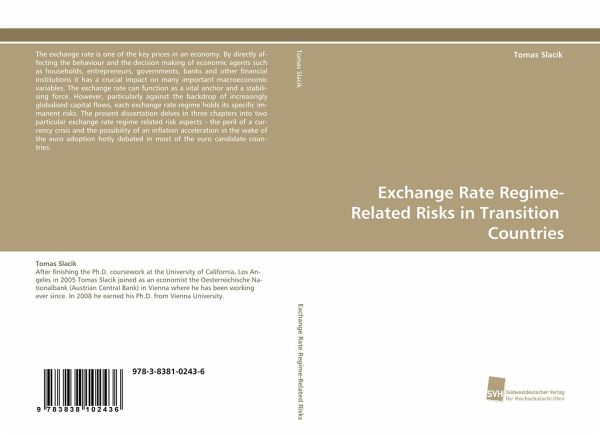
The exchange rate is one of the key prices in an
economy. By directly affecting the behaviour and the
decision making of economic agents such as
households, entrepreneurs, governments, banks and
other financial institutions it has a crucial
impact on many important macroeconomic variables.
The exchange rate can function as a vital anchor and
a stabilising force. However, particularly against
the backdrop of increasingly globalised capital
flows, each exchange rate regime holds its specific
immanent risks. The present dissertation delves in
three chapters into two particular exchange rate
regime related risk aspects - the peril of a
currency crisis and the possibility of an inflation
acceleration in the wake of the euro adoption hotly
debated in most of the euro candidate countries.
economy. By directly affecting the behaviour and the
decision making of economic agents such as
households, entrepreneurs, governments, banks and
other financial institutions it has a crucial
impact on many important macroeconomic variables.
The exchange rate can function as a vital anchor and
a stabilising force. However, particularly against
the backdrop of increasingly globalised capital
flows, each exchange rate regime holds its specific
immanent risks. The present dissertation delves in
three chapters into two particular exchange rate
regime related risk aspects - the peril of a
currency crisis and the possibility of an inflation
acceleration in the wake of the euro adoption hotly
debated in most of the euro candidate countries.