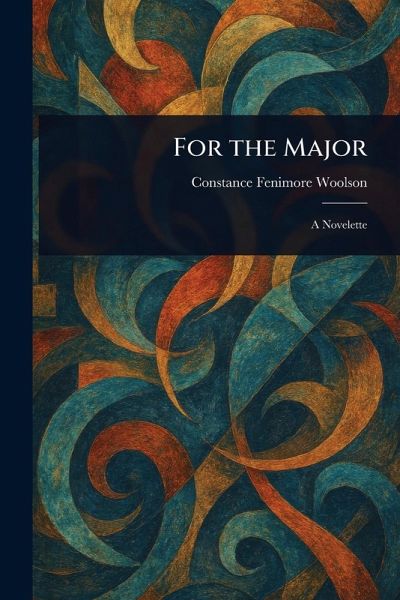
Set against the backdrop of the American Civil War's aftermath, Constance Fenimore Woolson's "For the Major: A Novelette" explores the complexities of Southern life during the Reconstruction era. This meticulously reproduced edition captures the nuances of 19th-century American social life and customs through a compelling narrative. Delving into the intricate tapestry of family relationships, the story offers a glimpse into a society grappling with profound change. Woolson's work stands as a testament to the enduring power of historical fiction, illuminating a pivotal period in American…mehr
Set against the backdrop of the American Civil War's aftermath, Constance Fenimore Woolson's "For the Major: A Novelette" explores the complexities of Southern life during the Reconstruction era. This meticulously reproduced edition captures the nuances of 19th-century American social life and customs through a compelling narrative. Delving into the intricate tapestry of family relationships, the story offers a glimpse into a society grappling with profound change. Woolson's work stands as a testament to the enduring power of historical fiction, illuminating a pivotal period in American history. Readers interested in the social dynamics of the post-war South and the challenges faced by its people will find this novelette a captivating and insightful read. A classic tale of love, loss, and resilience, "For the Major" offers a poignant portrayal of a nation rebuilding itself. This work has been selected by scholars as being culturally important, and is part of the knowledge base of civilization as we know it. This work is in the public domain in the United States of America, and possibly other nations. Within the United States, you may freely copy and distribute this work, as no entity (individual or corporate) has a copyright on the body of the work. Scholars believe, and we concur, that this work is important enough to be preserved, reproduced, and made generally available to the public. We appreciate your support of the preservation process, and thank you for being an important part of keeping this knowledge alive and relevant.
Constance Fenimore Woolson (1840-1894) was an American novelist, poet, and short story writer acclaimed for her nuanced descriptions of character and setting, influenced by her extensive travels. Born on March 5, 1840 in Claremont, New Hampshire, she was the grandniece of James Fenimore Cooper, the celebrated author of 'The Last of the Mohicans'. Woolson grew up in Cleveland, Ohio, where she began her literary career, writing poetry and stories for children. After her father's death, Woolson travelled throughout the United States and Europe, which infused her writing with rich geographic and social textures. Her first novel, 'Anne' (1882), drew attention to her talent for creating vivid female characters and her sensitive depiction of regional environments. In 1883, she published 'For the Major', a novella illustrating her characteristic themes, including the American Civil War's aftermath, and the tensions between regional identity and national unity. 'For the Major' showcases Woolson's nuanced understanding of human emotions and societal expectations. She is perhaps best known for her deft use of setting, seen in works like 'East Angels' (1886) and 'Jupiter Lights' (1889). Despite comparisons with contemporaries such as Henry James, with whom she had a notable friendship, Woolson's literary legacy has been somewhat overshadowed. Recent scholarship, however, has afforded greater recognition to her contributions to American literature. Her works, introspective and detailed, remain valuable for their portrayal of nineteenth-century American life and their pioneering exploration of women's experiences. Woolson's stories, marked by their psychological insight and regional fidelity, secure her a respected place in the pantheon of American writers. She passed away in Venice, Italy, in 1894, leaving behind a body of work that continues to resonate with readers and scholars alike.
Es gelten unsere Allgemeinen Geschäftsbedingungen: www.buecher.de/agb
Impressum
www.buecher.de ist ein Internetauftritt der buecher.de internetstores GmbH
Geschäftsführung: Monica Sawhney | Roland Kölbl | Günter Hilger
Sitz der Gesellschaft: Batheyer Straße 115 - 117, 58099 Hagen
Postanschrift: Bürgermeister-Wegele-Str. 12, 86167 Augsburg
Amtsgericht Hagen HRB 13257
Steuernummer: 321/5800/1497
USt-IdNr: DE450055826