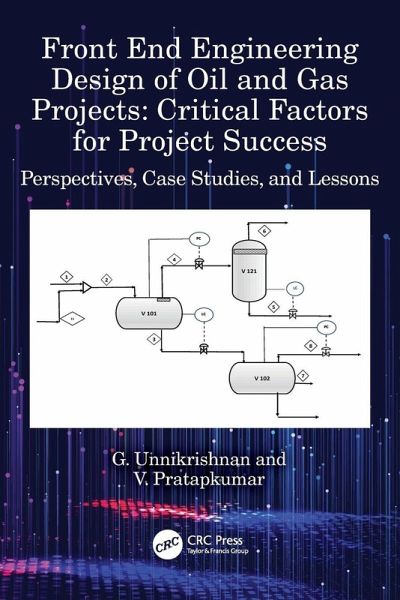
Engineering Management of oil and gas projects provides guidance on effective management of the design effort including detailed engineering review and approval processes between the owner companies and the Engineering, Procurement and Construction (EPC) contractorsies.
Engineering Management of oil and gas projects provides guidance on effective management of the design effort including detailed engineering review and approval processes between the owner companies and the Engineering, Procurement and Construction (EPC) contractorsies.
G. Unnikrishnan is currently working as a consultant to design and engineering companies in India and abroad. His expertise are mainly in process design and process safety and how process plant design and operations can be optimized to improve process safety. He is an active researcher in the area and is the author of a book on application of Bayesian network methodology to risk assessment of oil and gas equipment. He has also presented and published papers on process safety in several international conferences and technical journals. V. Pratapkumar is a chemical engineer with over 40 years of experience in project implementation in the oil and gas, petrochemical, and fertilizer industries. His predominant areas of experience are in project management followed by engineering and construction. He started his career as a Management Trainee with Fertilizers and Chemicals Travancore (FACT) and has subsequently held senior-level positions in UHDE (India), P.T. Polysindo Indonesia, Pipeline Engineering (India), and Petrofac Engineering & Construction, UAE.
Inhaltsangabe
Introduction 1. The Project Lifecycle 2. Stage 1: Identification 3. Stage 2: Feasibility and Statement of Requirements 4. Stage 3: Definition-Front End Engineering Design (FEED) 5. Stage 4: Construction 6. Quality of FEED: Measuring it and managing it 7. Overarching issues 8. Case Studies: What they tell us 9. The Baywater OPCU Project. A risk not worth taking 10. When pipe thickness went wrong 11. When compressor selection went wrong 12. The importance of FEED data in oil & gas projects 13. Iron Sulphide and project failure 14. Provisions for future and associated pitfalls 15. Heat Exchanger and a project almost gone wrong 16. Too many unknowns-FEED gone wrong and its impacts 17. When FEED is uncertain contracting strategy can help References
Introduction 1. The Project Lifecycle 2. Stage 1: Identification 3. Stage 2: Feasibility and Statement of Requirements 4. Stage 3: Definition-Front End Engineering Design (FEED) 5. Stage 4: Construction 6. Quality of FEED: Measuring it and managing it 7. Overarching issues 8. Case Studies: What they tell us 9. The Baywater OPCU Project. A risk not worth taking 10. When pipe thickness went wrong 11. When compressor selection went wrong 12. The importance of FEED data in oil & gas projects 13. Iron Sulphide and project failure 14. Provisions for future and associated pitfalls 15. Heat Exchanger and a project almost gone wrong 16. Too many unknowns-FEED gone wrong and its impacts 17. When FEED is uncertain contracting strategy can help References
Introduction 1. The Project Lifecycle 2. Stage 1: Identification 3. Stage 2: Feasibility and Statement of Requirements 4. Stage 3: Definition-Front End Engineering Design (FEED) 5. Stage 4: Construction 6. Quality of FEED: Measuring it and managing it 7. Overarching issues 8. Case Studies: What they tell us 9. The Baywater OPCU Project. A risk not worth taking 10. When pipe thickness went wrong 11. When compressor selection went wrong 12. The importance of FEED data in oil & gas projects 13. Iron Sulphide and project failure 14. Provisions for future and associated pitfalls 15. Heat Exchanger and a project almost gone wrong 16. Too many unknowns-FEED gone wrong and its impacts 17. When FEED is uncertain contracting strategy can help References
Introduction 1. The Project Lifecycle 2. Stage 1: Identification 3. Stage 2: Feasibility and Statement of Requirements 4. Stage 3: Definition-Front End Engineering Design (FEED) 5. Stage 4: Construction 6. Quality of FEED: Measuring it and managing it 7. Overarching issues 8. Case Studies: What they tell us 9. The Baywater OPCU Project. A risk not worth taking 10. When pipe thickness went wrong 11. When compressor selection went wrong 12. The importance of FEED data in oil & gas projects 13. Iron Sulphide and project failure 14. Provisions for future and associated pitfalls 15. Heat Exchanger and a project almost gone wrong 16. Too many unknowns-FEED gone wrong and its impacts 17. When FEED is uncertain contracting strategy can help References
Es gelten unsere Allgemeinen Geschäftsbedingungen: www.buecher.de/agb
Impressum
www.buecher.de ist ein Internetauftritt der buecher.de internetstores GmbH
Geschäftsführung: Monica Sawhney | Roland Kölbl | Günter Hilger
Sitz der Gesellschaft: Batheyer Straße 115 - 117, 58099 Hagen
Postanschrift: Bürgermeister-Wegele-Str. 12, 86167 Augsburg
Amtsgericht Hagen HRB 13257
Steuernummer: 321/5800/1497
USt-IdNr: DE450055826