Andreas Bieler
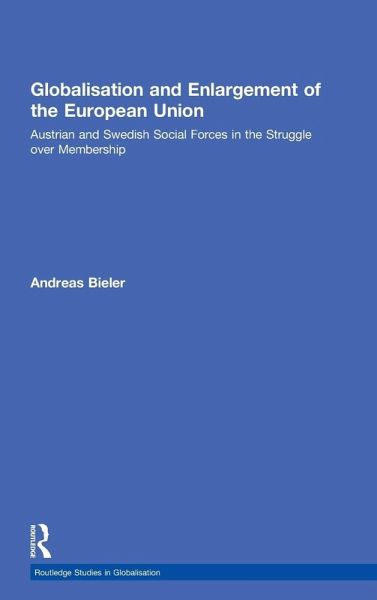
Globalisation and Enlargement of the European Union
Austrian and Swedish Social Forces in the Struggle over Membership
Andreas Bieler
Globalisation and Enlargement of the European Union
Austrian and Swedish Social Forces in the Struggle over Membership
- Gebundenes Buch
- Merkliste
- Auf die Merkliste
- Bewerten Bewerten
- Teilen
- Produkt teilen
- Produkterinnerung
- Produkterinnerung
On January 1 1995, Austria and Sweden joined the European Union. This book analyses why these two countries joined at such a moment when steps towards a Common Foreign and Security Policy threatened their neutrality.
Andere Kunden interessierten sich auch für
John O'BrennanThe Eastern Enlargement of the European Union196,99 €
Frank Schimmelfennig / Ulrich Sedelmeier (eds.)The Politics of European Union Enlargement179,99 €
Wolfram Kaiser / Jurgen Elvert (eds.)European Union Enlargement46,99 €
European Union Enlargement168,99 €
Thomas MehlhausenEuropean Union Enlargement177,99 €
Daniel SchmidtDoes an enlargement of the European Union inhibit the party establishment of a European party system? Case study of Turkey17,95 €
Boris KleemannBlueprints, Red Tape, and Shades of Gray. The Chromatics of Romania's accession to the European Union in economic and administrative perspective17,95 €-
-
-
On January 1 1995, Austria and Sweden joined the European Union. This book analyses why these two countries joined at such a moment when steps towards a Common Foreign and Security Policy threatened their neutrality.
Produktdetails
- Produktdetails
- Verlag: Routledge
- Seitenzahl: 210
- Erscheinungstermin: 18. Mai 2000
- Englisch
- Abmessung: 235mm x 157mm x 16mm
- Gewicht: 462g
- ISBN-13: 9780415213127
- ISBN-10: 0415213126
- Artikelnr.: 21684723
- Herstellerkennzeichnung
- Libri GmbH
- Europaallee 1
- 36244 Bad Hersfeld
- gpsr@libri.de
- Verlag: Routledge
- Seitenzahl: 210
- Erscheinungstermin: 18. Mai 2000
- Englisch
- Abmessung: 235mm x 157mm x 16mm
- Gewicht: 462g
- ISBN-13: 9780415213127
- ISBN-10: 0415213126
- Artikelnr.: 21684723
- Herstellerkennzeichnung
- Libri GmbH
- Europaallee 1
- 36244 Bad Hersfeld
- gpsr@libri.de
Andreas Bieler
1. Introduction: theories of integration and Austria's and Sweden's
accession to the European Union - a critique and alternativeSome
limitations of integration theories A neo-Gramscian alternative2. Austria
and Sweden in an era of global structural changeThe processes of
globalisation The post-war economic and political systems in Austria and
Sweden The impact of the processes of globalisation on Austria and
SwedenGlobalisation and the configuration of social forces in Austria and
Sweden3. Social forces and the struggle for application in Austria and
SwedenThe struggle over the Austrian application to the EUSweden and social
democratic hegemony: the struggle postponed4. The conflict over the EU
referenda in Austria and SwedenFrom the EEA via Maastricht and membership
negotiations to the referenda The referendum struggle in Austria A debate
at last: social forces mobilise in Sweden 5. Austria's and Sweden's
accession to the EU and the changing security structureNeo-realism, neutral
states and the end of the Cold War Austria: the silent redefinition of
neutrality Sweden: neutrality redefined as non-alignment 6. The future
enlargement of the EU towards Central and Eastern EuropeA neo-Gramscian
perspective on future EU enlargments Globalisation and the transformation
of Poland, the Czech Republic and Hungary Poland, the Czech Republic,
Hungary and the question of EU membership 7. Conclusions: globalisation, EU
enlargement and the limits of neo-liberalismA neo-Gramscian perspective as
an alternative approach to European integration Social Forces behind the
Austrian and Swedish accession to the EU The possibilities for a counter
neo-liberal project
accession to the European Union - a critique and alternativeSome
limitations of integration theories A neo-Gramscian alternative2. Austria
and Sweden in an era of global structural changeThe processes of
globalisation The post-war economic and political systems in Austria and
Sweden The impact of the processes of globalisation on Austria and
SwedenGlobalisation and the configuration of social forces in Austria and
Sweden3. Social forces and the struggle for application in Austria and
SwedenThe struggle over the Austrian application to the EUSweden and social
democratic hegemony: the struggle postponed4. The conflict over the EU
referenda in Austria and SwedenFrom the EEA via Maastricht and membership
negotiations to the referenda The referendum struggle in Austria A debate
at last: social forces mobilise in Sweden 5. Austria's and Sweden's
accession to the EU and the changing security structureNeo-realism, neutral
states and the end of the Cold War Austria: the silent redefinition of
neutrality Sweden: neutrality redefined as non-alignment 6. The future
enlargement of the EU towards Central and Eastern EuropeA neo-Gramscian
perspective on future EU enlargments Globalisation and the transformation
of Poland, the Czech Republic and Hungary Poland, the Czech Republic,
Hungary and the question of EU membership 7. Conclusions: globalisation, EU
enlargement and the limits of neo-liberalismA neo-Gramscian perspective as
an alternative approach to European integration Social Forces behind the
Austrian and Swedish accession to the EU The possibilities for a counter
neo-liberal project
1. Introduction: theories of integration and Austria's and Sweden's
accession to the European Union - a critique and alternativeSome
limitations of integration theories A neo-Gramscian alternative2. Austria
and Sweden in an era of global structural changeThe processes of
globalisation The post-war economic and political systems in Austria and
Sweden The impact of the processes of globalisation on Austria and
SwedenGlobalisation and the configuration of social forces in Austria and
Sweden3. Social forces and the struggle for application in Austria and
SwedenThe struggle over the Austrian application to the EUSweden and social
democratic hegemony: the struggle postponed4. The conflict over the EU
referenda in Austria and SwedenFrom the EEA via Maastricht and membership
negotiations to the referenda The referendum struggle in Austria A debate
at last: social forces mobilise in Sweden 5. Austria's and Sweden's
accession to the EU and the changing security structureNeo-realism, neutral
states and the end of the Cold War Austria: the silent redefinition of
neutrality Sweden: neutrality redefined as non-alignment 6. The future
enlargement of the EU towards Central and Eastern EuropeA neo-Gramscian
perspective on future EU enlargments Globalisation and the transformation
of Poland, the Czech Republic and Hungary Poland, the Czech Republic,
Hungary and the question of EU membership 7. Conclusions: globalisation, EU
enlargement and the limits of neo-liberalismA neo-Gramscian perspective as
an alternative approach to European integration Social Forces behind the
Austrian and Swedish accession to the EU The possibilities for a counter
neo-liberal project
accession to the European Union - a critique and alternativeSome
limitations of integration theories A neo-Gramscian alternative2. Austria
and Sweden in an era of global structural changeThe processes of
globalisation The post-war economic and political systems in Austria and
Sweden The impact of the processes of globalisation on Austria and
SwedenGlobalisation and the configuration of social forces in Austria and
Sweden3. Social forces and the struggle for application in Austria and
SwedenThe struggle over the Austrian application to the EUSweden and social
democratic hegemony: the struggle postponed4. The conflict over the EU
referenda in Austria and SwedenFrom the EEA via Maastricht and membership
negotiations to the referenda The referendum struggle in Austria A debate
at last: social forces mobilise in Sweden 5. Austria's and Sweden's
accession to the EU and the changing security structureNeo-realism, neutral
states and the end of the Cold War Austria: the silent redefinition of
neutrality Sweden: neutrality redefined as non-alignment 6. The future
enlargement of the EU towards Central and Eastern EuropeA neo-Gramscian
perspective on future EU enlargments Globalisation and the transformation
of Poland, the Czech Republic and Hungary Poland, the Czech Republic,
Hungary and the question of EU membership 7. Conclusions: globalisation, EU
enlargement and the limits of neo-liberalismA neo-Gramscian perspective as
an alternative approach to European integration Social Forces behind the
Austrian and Swedish accession to the EU The possibilities for a counter
neo-liberal project