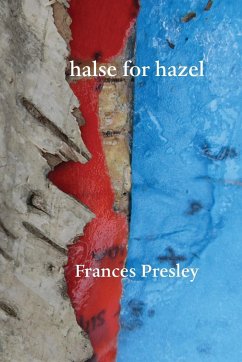
Halse is Exmoor dialect for hazel, as transcribed by local historian Hazel Eardley-Wilmot: a convergence of names which initiates a new poetic syntax of marginal trees and tongues. Halse for hazel has three sections, Halse, Col and Hassel: alternate and playful names for hazel, which map wide ranging geographic and linguistic areas, as well as political and environmental pressures. Halse begins with Exmoor tree names and ends with Lorna Doone, while Col moves from an irreverent Celtic tree alphabet to Atlantic woods in Scotland where hazel dominates. Hassel takes us from the devastation of Oak…mehr
Halse is Exmoor dialect for hazel, as transcribed by local historian Hazel Eardley-Wilmot: a convergence of names which initiates a new poetic syntax of marginal trees and tongues. Halse for hazel has three sections, Halse, Col and Hassel: alternate and playful names for hazel, which map wide ranging geographic and linguistic areas, as well as political and environmental pressures. Halse begins with Exmoor tree names and ends with Lorna Doone, while Col moves from an irreverent Celtic tree alphabet to Atlantic woods in Scotland where hazel dominates. Hassel takes us from the devastation of Oak Change, after WWI, to the naming of hidden whitebeams in Avon Gorge. Much of Halse for hazel, like Presley's earlier sequences, Myne and Lines of sight, is 'blind writing', when the eye and mind focus on the landscape rather than the page, although what we see and how we see are more at risk. The visual design of the text is shaped by the language of trees and their strange physical evolution, in dialogue with the images of Irma Irsara. The book also contains a recent collaboration with American poet and artist Julia Cohen, commissioned for Likestarlings.
Frances Presley was born in Derbyshire, grew up in Lincolnshire and Somerset, and lives in London. Her publications include Lines of Sight (Shearsman, 2009) which focused on Exmoor's Neolithic stone sites, and a collaboration with visual poet Tilla Brading, Stone Settings (Odyssey, 2010). An Alphabet for Alina, with artist Peterjon Skelt, exploits the lexical and visual possibilities of an alphabet for girls (Five Seasons, 2012). Halse for hazel (Shearsman, 2014) explored marginal trees and languages, and continued in Sallow, (Leafe, 2016), with images by Irma Irsara. It received an Arts council award. Ada Unseen (Shearsman, 2019) is about the life and work of Ada Lovelace, mathematician and computer visionary, who lived on Exmoor, and was also a collaboration with visual poet Tilla Brading, ADADADA (Odyssey, 2022). Presley's Collected Poems 1973-2020 were published in two volumes by Shearsman in 2022. Her latest project, Black Fens Viral began on a slow train through East Anglia's flat, agricultural, landscape of black peat, once marshland. 'Viral' refers both to Covid and to a text generator known as the Markov Chain, with its strange rearrangement of text which resembles a viral assault. The first poem was a Literary Pocket Book (2021) by Steven Hitchins, and the entire sequence was published this year by Shearsman. She has written many essays and reviews, especially on innovative British women poets. Her work is in anthologies including Infinite Difference (2010), Ground Aslant: radical landscape poetry (2011), Out of Everywhere2 (2015), Fractured Ecologies (2020), Arcadian Rustbelt (2025).
Es gelten unsere Allgemeinen Geschäftsbedingungen: www.buecher.de/agb
Impressum
www.buecher.de ist ein Internetauftritt der buecher.de internetstores GmbH
Geschäftsführung: Monica Sawhney | Roland Kölbl | Günter Hilger
Sitz der Gesellschaft: Batheyer Straße 115 - 117, 58099 Hagen
Postanschrift: Bürgermeister-Wegele-Str. 12, 86167 Augsburg
Amtsgericht Hagen HRB 13257
Steuernummer: 321/5800/1497
USt-IdNr: DE450055826