Nations often turn to international courts to help with overcoming collective-action problems associated with international relations. However, these courts generally cannot enforce their rulings, which begs the question: how effective are international courts? This book proposes a general theory of international courts that assumes a court has no direct power over national governments. Member states are free to ignore both the international agreement and the rulings by the court created to enforce that agreement. The theory demonstrates that such a court can, in fact, facilitate cooperation…mehr
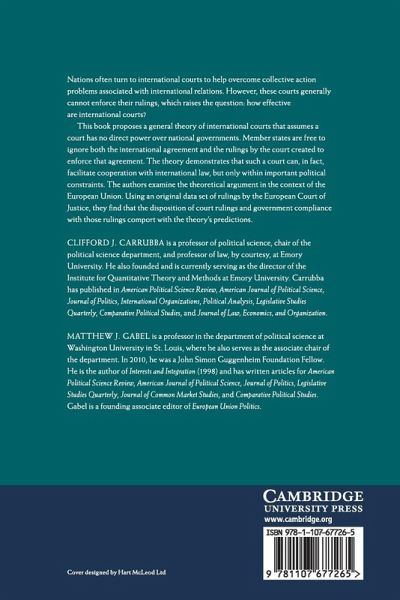
Nations often turn to international courts to help with overcoming collective-action problems associated with international relations. However, these courts generally cannot enforce their rulings, which begs the question: how effective are international courts? This book proposes a general theory of international courts that assumes a court has no direct power over national governments. Member states are free to ignore both the international agreement and the rulings by the court created to enforce that agreement. The theory demonstrates that such a court can, in fact, facilitate cooperation with international law, but only within important political constraints. The authors examine the theoretical argument in the context of the European Union. Using an original data set of rulings by the European Court of Justice, they find that the disposition of court rulings and government compliance with those rulings comport with the theory's predictions.
Clifford J. Carrubba is a Professor of Political Science, Chair of the Political Science Department, and Professor of Law, by courtesy, at Emory University, Atlanta. He also founded and is currently serving as the Director of the Institute for Quantitative Theory and Methods at Emory University. Carrubba has published in the American Political Science Review, the American Journal of Political Science, the Journal of Politics, International Organizations, Political Analysis, Legislative Studies Quarterly, Comparative Political Studies, and the Journal of Law, Economics, and Organization.
Inhaltsangabe
1. Introduction: international courts and compliance; 2. A theory of courts and compliance in international law; 3. The empirical relevance of the theoretical model: evaluating the hypotheses in the European Union context; 4. Preliminary considerations on testing the political-sensitivity hypothesis: designing a control for the legal merits; 5. A test of the political-sensitivity hypothesis; 6. A test of the conditional-effectiveness hypothesis: the European Court of Justice and economic integration; 7. Conclusion.
1. Introduction: international courts and compliance; 2. A theory of courts and compliance in international law; 3. The empirical relevance of the theoretical model: evaluating the hypotheses in the European Union context; 4. Preliminary considerations on testing the political-sensitivity hypothesis: designing a control for the legal merits; 5. A test of the political-sensitivity hypothesis; 6. A test of the conditional-effectiveness hypothesis: the European Court of Justice and economic integration; 7. Conclusion.
Es gelten unsere Allgemeinen Geschäftsbedingungen: www.buecher.de/agb
Impressum
www.buecher.de ist ein Internetauftritt der buecher.de internetstores GmbH
Geschäftsführung: Monica Sawhney | Roland Kölbl | Günter Hilger
Sitz der Gesellschaft: Batheyer Straße 115 - 117, 58099 Hagen
Postanschrift: Bürgermeister-Wegele-Str. 12, 86167 Augsburg
Amtsgericht Hagen HRB 13257
Steuernummer: 321/5800/1497
USt-IdNr: DE450055826