This two-set volume CCIS 2671 and 2672 book constitutes the proceedings of the 28th International Conference on Internet and Modern Society, IMS 2025, held in St. Petersburg, Russia, during June 23 25, 2025. The 44 full papers and 12 short papers included in these conference proceedings were carefully reviewed and selected from 135 submissions. They are categorized into the following topical sections: Part I: Computational Linguistics & Machine Learning (CompLing); Cyberpsychology & Post-AI Education (PsyAI); Digital Transformation in Governance and Society (DTGS). Part II: Art and…mehr
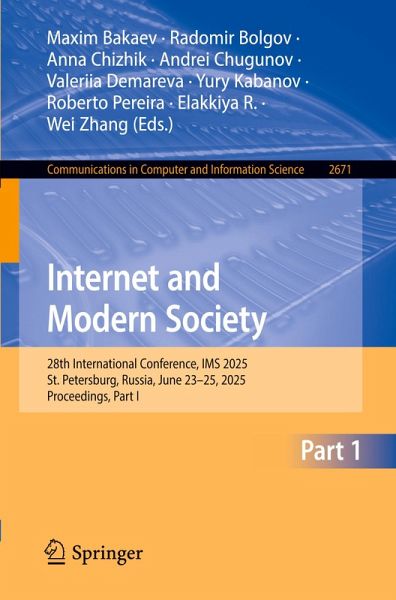
This two-set volume CCIS 2671 and 2672 book constitutes the proceedings of the 28th International Conference on Internet and Modern Society, IMS 2025, held in St. Petersburg, Russia, during June 23 25, 2025.
The 44 full papers and 12 short papers included in these conference proceedings were carefully reviewed and selected from 135 submissions. They are categorized into the following topical sections:
Part I: Computational Linguistics & Machine Learning (CompLing); Cyberpsychology & Post-AI Education (PsyAI); Digital Transformation in Governance and Society (DTGS).
Part II: Art and Innovation in Museums (AIMs); Interactive Systems & Information Society Technologies (InterSys).
Produktdetails
Produktdetails
Communications in Computer and Information Science 2671
Artikelnr. des Verlages: 89560183, 978-3-032-04957-5
Seitenzahl: 428
Erscheinungstermin: 20. Oktober 2025
Englisch
Abmessung: 235mm x 155mm x 24mm
Gewicht: 645g
ISBN-13: 9783032049575
ISBN-10: 3032049571
Artikelnr.: 75066404
Herstellerkennzeichnung
Springer-Verlag GmbH
Tiergartenstr. 17
69121 Heidelberg
ProductSafety@springernature.com
Inhaltsangabe
Computational Linguistics & Machine Learning: Mapping Effective Teaching with Topic Modeling.- Profiling the Corpus of Tutor Advertising Texts: A Statistical and Linguistic Analysis.- Measuring Public Satisfaction with Service Quality: Customer-Oriented Approach.- AI-Related Public Discourse Analysis via Emotion and Topic Modeling in Telegram Conversations.- What Officials Talk About? Extracting Topics from Russian Civil Servants Interviews with LDA and NMF.- Do LLMs Understand Why We Write Diaries? A Method for Purpose Extraction and Clustering.- Dialog Flow Analytics Toolkit for a Contact Center Platform.- Emotion-Sentiment Profiling of Customer Feedback through Cluster-Driven Analysis.- An Experimental Study of Automating Explanatory Dictionary Compilation with Language Models.- The Influence of Language Typological Features on Neural Summarization Performance.- Word Sense Disambiguation in Russian: A Generative LLM Approach.-Russian Neural Morpheme Segmentation: From Lemmata to Wordforms.- TL;DR: Text Normalization for Social Media Corpus.-Creating a Dataset for Automatic Detection of Vague Expressions in Russian Legal Texts. Cyberpsychology & Post-AI Education: Digital Pedagogy: Current State, Development Patterns, Prospects.-Understanding Player Experience: EyeTracking Insights into Cognitive Behaviour in Video Games.- Cognitive Complexity of User Inquiries in Digital Environments: Impact on Operator Response Quality.- Using Self-Created Video Tutorials to Enhance Self Regulated Learning Strategies for Adaptive Digital Language Learning.- AI-Enhanced Psychopedagogy for Esports Athletes: A Global Approach to Education, Well-Being, and Competitive Success. Digital Transformation in Governance and Society: From Disabilities to Additional Needs : Digital Transformation and the Changing Disability Paradigm.- Digital Infrastructure for Psychological Counseling Services in Higher Education: Opportunities and Prospects.- Determinants of Attitudes Toward COVID-19 Vaccination: A Survey-Based Analysis.- Accepting Artificial Intelligence at the Individual Level: Empirical Evidence from Russian Market.- Russian Portals of E-Participation on the Example of Solving the Ecological Problem of Invasive Plants in St. Petersburg and Leningrad Region.-Network Strategies of Tuareg Separatists: Media Communications of the Azawad Liberation Front on X.- How to Evaluate the Social Impact of Digital Urban Services? Testing the Methodology (Evidence from St. Petersburg).- User Dysfunctionality and Its Conditions in Online Completion of Typical Tasks.- Metaverses and Public Policy: Prospects for Virtual Civic Participation.- Peculiarities of Regulation and Functioning of Social Rating Systems of Russian Companies.
Computational Linguistics & Machine Learning: Mapping Effective Teaching with Topic Modeling.- Profiling the Corpus of Tutor Advertising Texts: A Statistical and Linguistic Analysis.- Measuring Public Satisfaction with Service Quality: Customer-Oriented Approach.- AI-Related Public Discourse Analysis via Emotion and Topic Modeling in Telegram Conversations.- What Officials Talk About? Extracting Topics from Russian Civil Servants Interviews with LDA and NMF.- Do LLMs Understand Why We Write Diaries? A Method for Purpose Extraction and Clustering.- Dialog Flow Analytics Toolkit for a Contact Center Platform.- Emotion-Sentiment Profiling of Customer Feedback through Cluster-Driven Analysis.- An Experimental Study of Automating Explanatory Dictionary Compilation with Language Models.- The Influence of Language Typological Features on Neural Summarization Performance.- Word Sense Disambiguation in Russian: A Generative LLM Approach.-Russian Neural Morpheme Segmentation: From Lemmata to Wordforms.- TL;DR: Text Normalization for Social Media Corpus.-Creating a Dataset for Automatic Detection of Vague Expressions in Russian Legal Texts. Cyberpsychology & Post-AI Education: Digital Pedagogy: Current State, Development Patterns, Prospects.-Understanding Player Experience: EyeTracking Insights into Cognitive Behaviour in Video Games.- Cognitive Complexity of User Inquiries in Digital Environments: Impact on Operator Response Quality.- Using Self-Created Video Tutorials to Enhance Self Regulated Learning Strategies for Adaptive Digital Language Learning.- AI-Enhanced Psychopedagogy for Esports Athletes: A Global Approach to Education, Well-Being, and Competitive Success. Digital Transformation in Governance and Society: From Disabilities to Additional Needs : Digital Transformation and the Changing Disability Paradigm.- Digital Infrastructure for Psychological Counseling Services in Higher Education: Opportunities and Prospects.- Determinants of Attitudes Toward COVID-19 Vaccination: A Survey-Based Analysis.- Accepting Artificial Intelligence at the Individual Level: Empirical Evidence from Russian Market.- Russian Portals of E-Participation on the Example of Solving the Ecological Problem of Invasive Plants in St. Petersburg and Leningrad Region.-Network Strategies of Tuareg Separatists: Media Communications of the Azawad Liberation Front on X.- How to Evaluate the Social Impact of Digital Urban Services? Testing the Methodology (Evidence from St. Petersburg).- User Dysfunctionality and Its Conditions in Online Completion of Typical Tasks.- Metaverses and Public Policy: Prospects for Virtual Civic Participation.- Peculiarities of Regulation and Functioning of Social Rating Systems of Russian Companies.
Es gelten unsere Allgemeinen Geschäftsbedingungen: www.buecher.de/agb
Impressum
www.buecher.de ist ein Internetauftritt der buecher.de internetstores GmbH
Geschäftsführung: Monica Sawhney | Roland Kölbl | Günter Hilger
Sitz der Gesellschaft: Batheyer Straße 115 - 117, 58099 Hagen
Postanschrift: Bürgermeister-Wegele-Str. 12, 86167 Augsburg
Amtsgericht Hagen HRB 13257
Steuernummer: 321/5800/1497
USt-IdNr: DE450055826