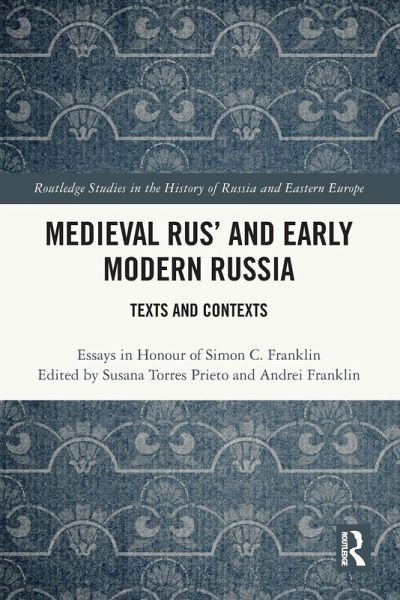
Research on the East Slavs in the medieval period has considerably changed since the collapse of the Soviet Union. The emergence of new states forced a rethinking of many aspects of the history and culture of the early East Slavs as the subject became increasingly disentangled from the umbrella of Byzantine studies and fruitful collaboration was fostered between scholars worldwide. This book, which brings together scholars from Russia, Ukraine, western Europe and North America, of several generations, presents a broad overview of the main results of the last three decades of research and…mehr
Research on the East Slavs in the medieval period has considerably changed since the collapse of the Soviet Union. The emergence of new states forced a rethinking of many aspects of the history and culture of the early East Slavs as the subject became increasingly disentangled from the umbrella of Byzantine studies and fruitful collaboration was fostered between scholars worldwide. This book, which brings together scholars from Russia, Ukraine, western Europe and North America, of several generations, presents a broad overview of the main results of the last three decades of research and mutual collaboration. This is important work, providing a much-needed counterbalance to studies of western Europe in the period, which has been the main focus of study, with the lands of the East Slavs relatively neglected.
Produktdetails
Produktdetails
Routledge Studies in the History of Russia and Eastern Europe
Susana Torres Prieto is an Associate Professor of Humanities at IE University, Madrid/Segovia Andrei Franklin is a freelance researcher, proofreader and translator
Inhaltsangabe
Section I: Use of Byzantine models and sources 1. Leo VI and the Transformation of Byzantine Strategic Thinking about the Rus' 2. Who Was 'Theodore the Rhos from a Family of Emperors', the Owner of the Stone from the Holy Sepulchre? 3. Cosmos, Calendars and Medical Advice in the Miscellanies of the Trinity Lavra of St. Sergius and their Late Byzantine Counterparts (14th-early 16th centuries) 4. Holy Foolishness and Gender Transgression in Russian Hagiography from the Middle Ages to Modernity Section II: Historiography and Construction of Historical Narratives 5. Some Unnoticed Greek Quotes in Old Russian Chronicles 6. Retranslating the Rus¿ Primary Chronicle: Perspectives on Horace Lunt's New Rendering 7. Two emperors of the princess Olga's visit to Constantinople: Constantine VII Porphyrogenitos versus John Tzimiskes in the copies of the Rus' Primary Chronicle 8. Patriarch Germanus II of Constantinople and the Slavic world 9. Thoughtful Agglomeration: Late Byzantine Sources for Muscovite Ceremonial 10. Boris Godunov and his family in the mirror of medieval Russian polyonymy Section III: Material Supports of Written Texts 11. "I must be cruel only to be kind": towards a literary history of Kyiv graffito No. 108 12. Muscovite Acquisition of Books from Poland in the Late 1640s-Early 1650s 13. The Codex in Early Rus' between the 11th-15th centuries: variations of form and variations of function Section IV: Social Repercussions of the Graphosphere 14. Sofiia Vitovtovna's Dance: The Wedding of Vasilii II in Russian Cultural Memory 15. Revolution in the Pictosphere: The Ukrainian Baroque and Muscovite Reception
Section I: Use of Byzantine models and sources 1. Leo VI and the Transformation of Byzantine Strategic Thinking about the Rus' 2. Who Was 'Theodore the Rhos from a Family of Emperors', the Owner of the Stone from the Holy Sepulchre? 3. Cosmos, Calendars and Medical Advice in the Miscellanies of the Trinity Lavra of St. Sergius and their Late Byzantine Counterparts (14th-early 16th centuries) 4. Holy Foolishness and Gender Transgression in Russian Hagiography from the Middle Ages to Modernity Section II: Historiography and Construction of Historical Narratives 5. Some Unnoticed Greek Quotes in Old Russian Chronicles 6. Retranslating the Rus¿ Primary Chronicle: Perspectives on Horace Lunt's New Rendering 7. Two emperors of the princess Olga's visit to Constantinople: Constantine VII Porphyrogenitos versus John Tzimiskes in the copies of the Rus' Primary Chronicle 8. Patriarch Germanus II of Constantinople and the Slavic world 9. Thoughtful Agglomeration: Late Byzantine Sources for Muscovite Ceremonial 10. Boris Godunov and his family in the mirror of medieval Russian polyonymy Section III: Material Supports of Written Texts 11. "I must be cruel only to be kind": towards a literary history of Kyiv graffito No. 108 12. Muscovite Acquisition of Books from Poland in the Late 1640s-Early 1650s 13. The Codex in Early Rus' between the 11th-15th centuries: variations of form and variations of function Section IV: Social Repercussions of the Graphosphere 14. Sofiia Vitovtovna's Dance: The Wedding of Vasilii II in Russian Cultural Memory 15. Revolution in the Pictosphere: The Ukrainian Baroque and Muscovite Reception
Es gelten unsere Allgemeinen Geschäftsbedingungen: www.buecher.de/agb
Impressum
www.buecher.de ist ein Internetauftritt der buecher.de internetstores GmbH
Geschäftsführung: Monica Sawhney | Roland Kölbl | Günter Hilger
Sitz der Gesellschaft: Batheyer Straße 115 - 117, 58099 Hagen
Postanschrift: Bürgermeister-Wegele-Str. 12, 86167 Augsburg
Amtsgericht Hagen HRB 13257
Steuernummer: 321/5800/1497
USt-IdNr: DE450055826