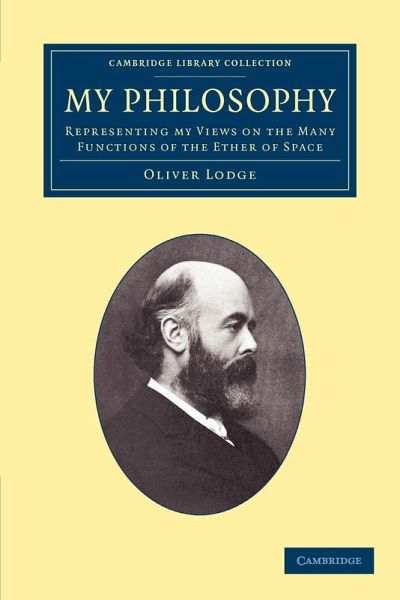

In his study of optics, Newton postulated that light, like sound, must be carried through a medium, and that this medium must exist even in a vacuum. By the late nineteenth century, this theoretical substance was known as the luminiferous ether. But the ether theory faced several problems. If the earth moved through ether, there would be ether wind, and light travelling against the flow would move more slowly than light travelling with it. That was soon disproven. Nor could the ether be stationary: by 1905, Einstein's work on relativity had disproven absolute motion. In this fascinating…mehr
In his study of optics, Newton postulated that light, like sound, must be carried through a medium, and that this medium must exist even in a vacuum. By the late nineteenth century, this theoretical substance was known as the luminiferous ether. But the ether theory faced several problems. If the earth moved through ether, there would be ether wind, and light travelling against the flow would move more slowly than light travelling with it. That was soon disproven. Nor could the ether be stationary: by 1905, Einstein's work on relativity had disproven absolute motion. In this fascinating advocacy of ether, first published in 1933, Sir Oliver Lodge (1851-1940) fiercely defends ether against the new physics, arguing for solid models over mathematical abstractions, and urging new ether experiments. With in-depth references to Einstein, Jeans and Eddington, this book is still relevant to students in the history of science.
Foreword Part I. An Elementary Survey of Physical Existence: 1. The constitution of things around us 2. The progress of physical science 3. Design and purpose in the universe 4. Religion and science 5. The organism and the control 6. The property of inertia 7. Summary of new knowledge 8. Machinery of guidance Part II. Evidence for and Controversies Concerning the Ether: 9. Matter, energy and the ether 10. The ether and the forms of energy 11. Faraday's conception of the ether 12. Modern gibes at the ether 13. The physical aspect of the universe 14. Views of Thomas Young, Newton and Fresnel 15. The ether and relativity 16. Magnetism and the ether, with suggestions for experiment 17. Summary of our present knowledge about the ether Part III. Introduction of Life and Mind: 18. The interaction of the psychical with the physical 19. Life and mechanism 20. A psychical function suggested for the ether of space 21. Ether and the soul Part IV. The Evidence for Survival and its Mechanism: 22. Evidence for and mechanism of survival 23. On the difficulty of proving individual survival 24. On the reasons for the non-recognition of psychical research by the majority of the scientific world 25. On the apparent element of caprice introduced by the spiritistic hypothesis 26. The whole organically considered 27. The spiritistic hypothesis 28. The bearing of the theory upon religions Index.
Es gelten unsere Allgemeinen Geschäftsbedingungen: www.buecher.de/agb
Impressum
www.buecher.de ist ein Internetauftritt der buecher.de internetstores GmbH
Geschäftsführung: Monica Sawhney | Roland Kölbl | Günter Hilger
Sitz der Gesellschaft: Batheyer Straße 115 - 117, 58099 Hagen
Postanschrift: Bürgermeister-Wegele-Str. 12, 86167 Augsburg
Amtsgericht Hagen HRB 13257
Steuernummer: 321/5800/1497
USt-IdNr: DE450055826