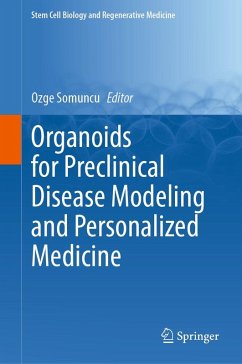
Organoid technologies are preclinical models in which drug responses or radiotherapies are determined very closely to patient response. While until the recent past there were no three-dimensional systems in which the entire cellular content of an organ could be reflected, we can now create the physiological and structural features of an organ in vitro and model a disease effectively. As these diseases may be developmental defects, chronic diseases can also be investigated in detail at the gene and protein level with these systems. In terms of developmental biology, thanks to the use of…mehr
Organoid technologies are preclinical models in which drug responses or radiotherapies are determined very closely to patient response. While until the recent past there were no three-dimensional systems in which the entire cellular content of an organ could be reflected, we can now create the physiological and structural features of an organ in vitro and model a disease effectively. As these diseases may be developmental defects, chronic diseases can also be investigated in detail at the gene and protein level with these systems. In terms of developmental biology, thanks to the use of organoids, it is possible to learn the physiological internal dynamics of organs and to model diseases other than cancer. Chapters include introductions to their respective topics, recent advancements and how future applications can be implemented to organoid models. Organoids for Preclinical Disease Modeling and Personalized Medicine serves as an aid to researchers working in this vital area of research.
Özge¿Sezin Somuncu is the Organoid Center Director and Senior Scientist in the Department of Radiation Oncology at DanäFarber Cancer Institute. Her research focuses on cancer biology, with special expertise in patient¿derived organoids, DNA damage and repair mechanisms (notably replication stress, USP1 and PARG pathways), and precision oncology. She earned her PhD from Yeditepe University and has held academic positions including Assistant Professor at Bahçe¿ehir University. Her recent work has concentrated on identifying functional biomarkers for drug sensitivity in ovarian cancer models. She has authored numerous peer¿reviewed publications, contributed to patent applications, and currently leads collaborative translational projects aimed at improving therapeutic strategies. She currently leads and supports organoid-based translational research, oversees collaborative studies between lab researchers and clinicians and helps integrate organoids into preclinical drug development pipelines.
Inhaltsangabe
Emerging roles of organoids in cancer research. University of Greenwich. Preclinical organoid models for modeling cancer. Dana Farber Cancer Institute. Prognostication of DNA repair inhibitor response in cancer organoids. Ramya Ravindranathan. Unraveling radiation response Insights from organoid systems. Zeinaf Muradova. Bladder organoids for healthy and diseased tissue modeling. Dilara Akbulut. Organoids to investigate immune functions immunological diseases and therapy. Alexander Cicala. Lymphoma organoid models for evaluating and targeting tumor immune microenvironment. Sahin Lacin. The use of organoids for modeling bone tumors and testing drugs. Doruk Somuncu. Lung organoids in disease modeling and treatment. Organoid technology for brain disease modeling. Deniz Altunsu Kurt. Investigating pediatric diseases with organoid systems. Fulden Aycan. Engineering transplantable organoids for children with pediatric disorder. Tansu Salman. Organoid technology in cardiology for disease modeling and treatment. Irem Turkmen. Gastrointestinal organoids from pluripotent stem cells Jose Guillermo Sanchez Arriola Cincinnati Children Hospital Medical Center. Brain organoids for unraveling human brain development and evolution. Organoids for modeling skin hair pigmentation. Proteomics applications on organoids to improve preclinical research.
Emerging roles of organoids in cancer research. University of Greenwich. Preclinical organoid models for modeling cancer. Dana Farber Cancer Institute. Prognostication of DNA repair inhibitor response in cancer organoids. Ramya Ravindranathan. Unraveling radiation response Insights from organoid systems. Zeinaf Muradova. Bladder organoids for healthy and diseased tissue modeling. Dilara Akbulut. Organoids to investigate immune functions immunological diseases and therapy. Alexander Cicala. Lymphoma organoid models for evaluating and targeting tumor immune microenvironment. Sahin Lacin. The use of organoids for modeling bone tumors and testing drugs. Doruk Somuncu. Lung organoids in disease modeling and treatment. Organoid technology for brain disease modeling. Deniz Altunsu Kurt. Investigating pediatric diseases with organoid systems. Fulden Aycan. Engineering transplantable organoids for children with pediatric disorder. Tansu Salman. Organoid technology in cardiology for disease modeling and treatment. Irem Turkmen. Gastrointestinal organoids from pluripotent stem cells Jose Guillermo Sanchez Arriola Cincinnati Children Hospital Medical Center. Brain organoids for unraveling human brain development and evolution. Organoids for modeling skin hair pigmentation. Proteomics applications on organoids to improve preclinical research.
Es gelten unsere Allgemeinen Geschäftsbedingungen: www.buecher.de/agb
Impressum
www.buecher.de ist ein Internetauftritt der buecher.de internetstores GmbH
Geschäftsführung: Monica Sawhney | Roland Kölbl | Günter Hilger
Sitz der Gesellschaft: Batheyer Straße 115 - 117, 58099 Hagen
Postanschrift: Bürgermeister-Wegele-Str. 12, 86167 Augsburg
Amtsgericht Hagen HRB 13257
Steuernummer: 321/5800/1497
USt-IdNr: DE450055826