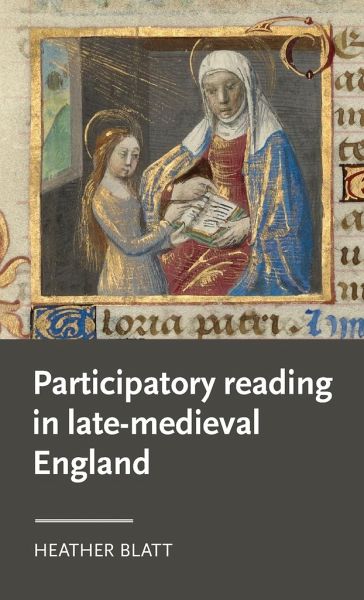

This book traces affinities across the digital-medieval divide to explore how reading functioned as a nexus for concerns about literacy, audiencesâ agency, literary culture and media formats. Interactive reading offered writers ways to make readers work to their benefit, even as these practices enabled audiences to make reading work for themselves. -- .
Heather Blatt is Associate Professor of English Literature at Florida International University
Inhaltsangabe
Introduction: participatory reading in late-medieval England Part I: Participatory discourse 1 Corrective reading: Geoffrey Chaucer's Troilus and Criseyde and John Lydgate's Troy Book 2 Nonlinear reading: the Orcherd of Syon, Titus and Vespasian, and Lydgate's Siege of Thebes Part II: Evoking participation 3 Reading materially: John Lydgate's 'Soteltes for the coronation banquet of Henry VI' 4 Reading architecturally: the wall texts of a Percy family manuscript and the Poulys Daunce of St. Paul's Cathedral 5 Reading temporally: Thomas of Erceldoune's prophecy, Eleanor Hull's Commentary on the Psalms, and Thomas Norton's Ordinal of alchemy Conclusion: nonreading in late-medieval England Index
Es gelten unsere Allgemeinen Geschäftsbedingungen: www.buecher.de/agb
Impressum
www.buecher.de ist ein Internetauftritt der buecher.de internetstores GmbH
Geschäftsführung: Monica Sawhney | Roland Kölbl | Günter Hilger
Sitz der Gesellschaft: Batheyer Straße 115 - 117, 58099 Hagen
Postanschrift: Bürgermeister-Wegele-Str. 12, 86167 Augsburg
Amtsgericht Hagen HRB 13257
Steuernummer: 321/5800/1497
USt-IdNr: DE450055826