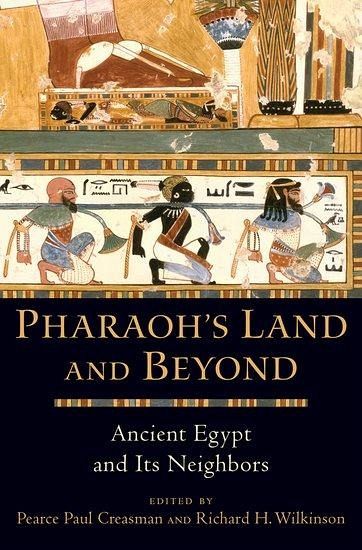
The concept of pharaonic Egypt as a unified, homogeneous, and isolated cultural entity is misleading. Ancient Egypt was a rich tapestry of social, religious, technological, and economic interconnections among numerous cultures from disparate lands. In fifteen chapters divided into five thematic groups, Pharaoh's Land and Beyond uniquely examines Egypt's relationship with its wider world. The first section details the geographical contexts of interconnections by examining ancient Egyptian exploration, maritime routes, and overland passages. In the next section, chapters address the human…mehr
The concept of pharaonic Egypt as a unified, homogeneous, and isolated cultural entity is misleading. Ancient Egypt was a rich tapestry of social, religious, technological, and economic interconnections among numerous cultures from disparate lands. In fifteen chapters divided into five thematic groups, Pharaoh's Land and Beyond uniquely examines Egypt's relationship with its wider world. The first section details the geographical contexts of interconnections by examining ancient Egyptian exploration, maritime routes, and overland passages. In the next section, chapters address the human principals of association: peoples, with the attendant difficulties of differentiating ethnic identities from the record; diplomatic actors, with their complex balances and presentations of power; and the military, with its evolving role in pharaonic expansion. Natural events, from droughts and floods to illness and epidemics, also played significant roles in this ancient world, as examined in the third section. The final two sections explore the physical manifestations of interconnections between pharaonic Egypt and its neighbors, first in the form of material objects and second, in the powerful exchange of ideas. Whether through diffusion and borrowing of knowledge and technology, through the flow of words by script and literature, or through exchanges in the religious sphere, the pharaonic Egypt that we know today was constantly changing--and changing the cultures around it. This illustrious work represents the first synthesis of these cultural relationships, unbounded by time, geography, or mode.
Pearce Paul Creasman is Associate Professor & Curator at the University of Arizona, author or co-author of fifty articles, and editor of Archaeological Research in the Valley of the Kings and Ancient Thebes. Richard H. Wilkinson is Regents' Professor Emeritus at the University of Arizona, author or editor of eleven books, including The Oxford Handbook of the Valley of the Kings.
Inhaltsangabe
* Table of Contents * List of Contributors 4 * Acknowledgments 6 * List of Figures and Plates 7 * Introduction 13 * Pearce Paul Creasman and Richard H. Wilkinson * SECTION I: Pathways * Chapter 1 Finding the Beyond: Exploration 16 * Thomas Schneider * Chapter 2 Paths in the Deep: Maritime Connections 31 * Pearce Paul Creasman and Noreen Doyle * Chapter 3 Pathways to Distant Kingdoms: Land Connections 52 * Gregory Mumford * SECTION II: People * Chapter 4 Children of Other Gods: Social Interactions 80 * Bettina Bader * Chapter 5 Between Brothers: Diplomatic Interactions 100 * Richard H. Wilkinson and Noreen Doyle * Chapter 6 The Armies of Re 118 * Anthony Spalinger * SECTION III: Objects * Chapter 7 The Long Arm of Merchantry: Trade Interactions 143 * Samuel Mark * Chapter 8 Artisans and Their Products: Interaction in Art and Architecture 166 * Stuart Tyson Smith * Chapter 9 Traded, Copied, and Kept: The Ubiquitous Appeal of Scarabs 186 * Vanessa Boschloos * SECTION IV: Ideas * Chapter 10 Technology in Transit: The Borrowing of Ideas in Science and Craftwork 206 * Ian Shaw * Chapter 11 The Flow of Words: Interaction in Writing and Literature during the Bronze Age * Part I: Writing Systems: Cuneiform and Hieroglyphs in the Bronze Age: Script Contact and the Creation of New Scripts 226 * Orly Goldwasser * Part II: Literature: Egyptian and Levantine Belles-Lettres-Links and Influences during the Bronze Age 238 * Noga Ayali-Darshan * Chapter 12 All Gods Are Our Gods: Religious Interaction * Part I: "From Bes to Baal": Religious Interconnections between Egypt and the East 254 * Izak Cornelius * Part II: Egypt and Nubia 264 * Kathryn Howley * Part III: Religious Interaction between Egypt and the Aegean in the 2nd Millennium BCE 275 * Nanno Marinatos * SECTION V: Events * Chapter 13 Violence in Earth, Water and Sky: Geological Hazards 284 * James A. Harrell * Chapter 14 The Fickle Nile: Effects of Droughts and Floods 300 * Judith Bunbury * Chapter 15 Illness from Afar: Epidemics and Their Aftermath 316 * Rosalie David * References and Further Reading 332 * Index 417
* Table of Contents * List of Contributors 4 * Acknowledgments 6 * List of Figures and Plates 7 * Introduction 13 * Pearce Paul Creasman and Richard H. Wilkinson * SECTION I: Pathways * Chapter 1 Finding the Beyond: Exploration 16 * Thomas Schneider * Chapter 2 Paths in the Deep: Maritime Connections 31 * Pearce Paul Creasman and Noreen Doyle * Chapter 3 Pathways to Distant Kingdoms: Land Connections 52 * Gregory Mumford * SECTION II: People * Chapter 4 Children of Other Gods: Social Interactions 80 * Bettina Bader * Chapter 5 Between Brothers: Diplomatic Interactions 100 * Richard H. Wilkinson and Noreen Doyle * Chapter 6 The Armies of Re 118 * Anthony Spalinger * SECTION III: Objects * Chapter 7 The Long Arm of Merchantry: Trade Interactions 143 * Samuel Mark * Chapter 8 Artisans and Their Products: Interaction in Art and Architecture 166 * Stuart Tyson Smith * Chapter 9 Traded, Copied, and Kept: The Ubiquitous Appeal of Scarabs 186 * Vanessa Boschloos * SECTION IV: Ideas * Chapter 10 Technology in Transit: The Borrowing of Ideas in Science and Craftwork 206 * Ian Shaw * Chapter 11 The Flow of Words: Interaction in Writing and Literature during the Bronze Age * Part I: Writing Systems: Cuneiform and Hieroglyphs in the Bronze Age: Script Contact and the Creation of New Scripts 226 * Orly Goldwasser * Part II: Literature: Egyptian and Levantine Belles-Lettres-Links and Influences during the Bronze Age 238 * Noga Ayali-Darshan * Chapter 12 All Gods Are Our Gods: Religious Interaction * Part I: "From Bes to Baal": Religious Interconnections between Egypt and the East 254 * Izak Cornelius * Part II: Egypt and Nubia 264 * Kathryn Howley * Part III: Religious Interaction between Egypt and the Aegean in the 2nd Millennium BCE 275 * Nanno Marinatos * SECTION V: Events * Chapter 13 Violence in Earth, Water and Sky: Geological Hazards 284 * James A. Harrell * Chapter 14 The Fickle Nile: Effects of Droughts and Floods 300 * Judith Bunbury * Chapter 15 Illness from Afar: Epidemics and Their Aftermath 316 * Rosalie David * References and Further Reading 332 * Index 417
Es gelten unsere Allgemeinen Geschäftsbedingungen: www.buecher.de/agb
Impressum
www.buecher.de ist ein Internetauftritt der buecher.de internetstores GmbH
Geschäftsführung: Monica Sawhney | Roland Kölbl | Günter Hilger
Sitz der Gesellschaft: Batheyer Straße 115 - 117, 58099 Hagen
Postanschrift: Bürgermeister-Wegele-Str. 12, 86167 Augsburg
Amtsgericht Hagen HRB 13257
Steuernummer: 321/5800/1497
USt-IdNr: DE450055826