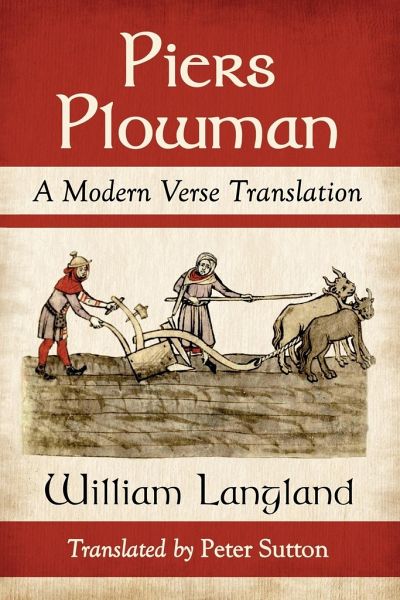
William Langland's 14th-century poem Piers Plowman, a disturbing and often humorous commentary on corruption and greed, remains meaningful today. The allegorical work revolves around the narrator's quest to live a good life, and takes the form of a series of dreams in which Piers, the honest plowman, appears in various guises. Characters such as Conscience, Fidelity and Charity, alongside Falsehood and Guile, are instantly recognizable as our present-day politicians and celebrities, friends and neighbors. Social issues are confronted, including governance, economic relations, criminal justice,…mehr
William Langland's 14th-century poem Piers Plowman, a disturbing and often humorous commentary on corruption and greed, remains meaningful today. The allegorical work revolves around the narrator's quest to live a good life, and takes the form of a series of dreams in which Piers, the honest plowman, appears in various guises. Characters such as Conscience, Fidelity and Charity, alongside Falsehood and Guile, are instantly recognizable as our present-day politicians and celebrities, friends and neighbors. Social issues are confronted, including governance, economic relations, criminal justice, marital relations and the limits of academic learning, as well as religious belief and the natural world. This new verse translation from the Middle English preserves the energy, imagery and intent of the original, and retains its alliterative style. Instructors considering this book for use in a course may request an examination copy here.
William Langland, born in 1332, is the presumed author of Piers Plowman, a seminal work of Middle English alliterative verse. His allegorical poem is rich in religious themes and was revolutionary in translating complex theological ideas into symbols and images that could be understood by the common people. Langland s work is considered a critical commentary on society, focusing on issues such as justice, morality, and the human condition, with an emphasis on the need for spiritual and social reform. Langland likely received his education at the Royal Grammar School, which contributed to his ability to write in the vernacular, making his work accessible to a wider audience. He lived during a period of significant social and political upheaval, and his writing reflects the concerns of the time, particularly regarding the church and its corruption. Langland passed away in 1386 at the age of 54. His legacy remains tied to his groundbreaking contributions to English literature and his ability to blend religious ideas with everyday life, influencing later writers and thinkers.
Inhaltsangabe
Table of Contents Acknowledgments deletev Introduction The Identity of the Author Prologue delete21 Step I delete28 Step II delete35 Step III delete42 Step IV delete53 Step V delete59 Step VI delete78 Step VII delete88 Step VIII delete96 Step IX delete100 Step X Step XI Step XII Step XIII Step XIV Step XV Step XVI Step XVII Step XVIII Step XIX Step XX Selected Bibliography Index
Table of Contents Acknowledgments deletev Introduction The Identity of the Author Prologue delete21 Step I delete28 Step II delete35 Step III delete42 Step IV delete53 Step V delete59 Step VI delete78 Step VII delete88 Step VIII delete96 Step IX delete100 Step X Step XI Step XII Step XIII Step XIV Step XV Step XVI Step XVII Step XVIII Step XIX Step XX Selected Bibliography Index
Es gelten unsere Allgemeinen Geschäftsbedingungen: www.buecher.de/agb
Impressum
www.buecher.de ist ein Internetauftritt der buecher.de internetstores GmbH
Geschäftsführung: Monica Sawhney | Roland Kölbl | Günter Hilger
Sitz der Gesellschaft: Batheyer Straße 115 - 117, 58099 Hagen
Postanschrift: Bürgermeister-Wegele-Str. 12, 86167 Augsburg
Amtsgericht Hagen HRB 13257
Steuernummer: 321/5800/1497
USt-IdNr: DE450055826