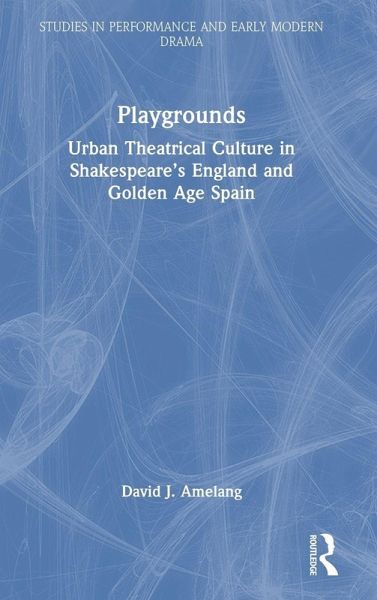
This book compares the theatrical cultures of early modern England and Spain and explores the causes and consequences not just of the remarkable similarities but also of the visible differences between them.
This book compares the theatrical cultures of early modern England and Spain and explores the causes and consequences not just of the remarkable similarities but also of the visible differences between them.
David J. Amelang is an assistant professor in English Literature at the Department of English Studies of the Universidad Autónoma de Madrid. He currently serves on the board of directors of the Madrid Institute for Advanced Study (MIAS) and of the Spanish and Portuguese Society for English Renaissance Studies (SEDERI).
Inhaltsangabe
List of Illustrations Acknowledgements Introduction Chapter One: Cities * England and Spain's Theatrical Capitals * Early Urban Theatre Districts * The Place of Theatres in English and Spanish Society * Playhouse Locations after Consolidation Chapter Two: Playhouses * Why did English and Spanish Theatres Look so much Alike? A Few Genealogical Conjectures * The Organic Corral vs the Immutable Theatre * Seeing and Hearing (and Being Seen) in England and Spain's Playhouses * Beyond the Bare Stage: Machines, Candles, Multi-Platforms Interlude 1: Why did Madrid Not Have a Blackfriars? Chapter Three: Players * Professional Playmakers in Early Modern Society * Company Models, Structure and Organisation * Touring Practices * Who Played the Female Roles? Women and Children on the Commercial Stage Chapter Four: Dramatists * The Making of a Professional Playwright * Verse, Prose and Polymetry * Dramatic Genre(s) * Quantities of Writing and Notions of Artistry Interlude 2: Professional Actresses: To Have and Have Not (and How it Made a Difference) Chapter Five: Playbooks * Playbook vs Play: Printing Theatre in England and Spain * Publication Strategies, Licensing and Censorship * The Playbook in the Literacy Marketplace * Other Documents of Performance Conclusion Works Cited Index
List of Illustrations
Acknowledgements
Introduction
Chapter One: Cities
England and Spain's Theatrical Capitals
Early Urban Theatre Districts
The Place of Theatres in English and Spanish Society
Playhouse Locations after Consolidation
Chapter Two: Playhouses
Why did English and Spanish Theatres Look so much Alike? A Few Genealogical Conjectures
The Organic Corral vs the Immutable Theatre
Seeing and Hearing (and Being Seen) in England and Spain's Playhouses
Beyond the Bare Stage: Machines, Candles, Multi-Platforms
Interlude 1: Why did Madrid Not Have a Blackfriars?
Chapter Three: Players
Professional Playmakers in Early Modern Society
Company Models, Structure and Organisation
Touring Practices
Who Played the Female Roles? Women and Children on the Commercial Stage
Chapter Four: Dramatists
The Making of a Professional Playwright
Verse, Prose and Polymetry
Dramatic Genre(s)
Quantities of Writing and Notions of Artistry
Interlude 2: Professional Actresses: To Have and Have Not (and How it Made a Difference)
Chapter Five: Playbooks
Playbook vs Play: Printing Theatre in England and Spain
List of Illustrations Acknowledgements Introduction Chapter One: Cities * England and Spain's Theatrical Capitals * Early Urban Theatre Districts * The Place of Theatres in English and Spanish Society * Playhouse Locations after Consolidation Chapter Two: Playhouses * Why did English and Spanish Theatres Look so much Alike? A Few Genealogical Conjectures * The Organic Corral vs the Immutable Theatre * Seeing and Hearing (and Being Seen) in England and Spain's Playhouses * Beyond the Bare Stage: Machines, Candles, Multi-Platforms Interlude 1: Why did Madrid Not Have a Blackfriars? Chapter Three: Players * Professional Playmakers in Early Modern Society * Company Models, Structure and Organisation * Touring Practices * Who Played the Female Roles? Women and Children on the Commercial Stage Chapter Four: Dramatists * The Making of a Professional Playwright * Verse, Prose and Polymetry * Dramatic Genre(s) * Quantities of Writing and Notions of Artistry Interlude 2: Professional Actresses: To Have and Have Not (and How it Made a Difference) Chapter Five: Playbooks * Playbook vs Play: Printing Theatre in England and Spain * Publication Strategies, Licensing and Censorship * The Playbook in the Literacy Marketplace * Other Documents of Performance Conclusion Works Cited Index
List of Illustrations
Acknowledgements
Introduction
Chapter One: Cities
England and Spain's Theatrical Capitals
Early Urban Theatre Districts
The Place of Theatres in English and Spanish Society
Playhouse Locations after Consolidation
Chapter Two: Playhouses
Why did English and Spanish Theatres Look so much Alike? A Few Genealogical Conjectures
The Organic Corral vs the Immutable Theatre
Seeing and Hearing (and Being Seen) in England and Spain's Playhouses
Beyond the Bare Stage: Machines, Candles, Multi-Platforms
Interlude 1: Why did Madrid Not Have a Blackfriars?
Chapter Three: Players
Professional Playmakers in Early Modern Society
Company Models, Structure and Organisation
Touring Practices
Who Played the Female Roles? Women and Children on the Commercial Stage
Chapter Four: Dramatists
The Making of a Professional Playwright
Verse, Prose and Polymetry
Dramatic Genre(s)
Quantities of Writing and Notions of Artistry
Interlude 2: Professional Actresses: To Have and Have Not (and How it Made a Difference)
Chapter Five: Playbooks
Playbook vs Play: Printing Theatre in England and Spain
Publication Strategies, Licensing and Censorship
The Playbook in the Literacy Marketplace
Other Documents of Performance
Conclusion
Works Cited
Index
Es gelten unsere Allgemeinen Geschäftsbedingungen: www.buecher.de/agb
Impressum
www.buecher.de ist ein Internetauftritt der buecher.de internetstores GmbH
Geschäftsführung: Monica Sawhney | Roland Kölbl | Günter Hilger
Sitz der Gesellschaft: Batheyer Straße 115 - 117, 58099 Hagen
Postanschrift: Bürgermeister-Wegele-Str. 12, 86167 Augsburg
Amtsgericht Hagen HRB 13257
Steuernummer: 321/5800/1497
USt-IdNr: DE450055826