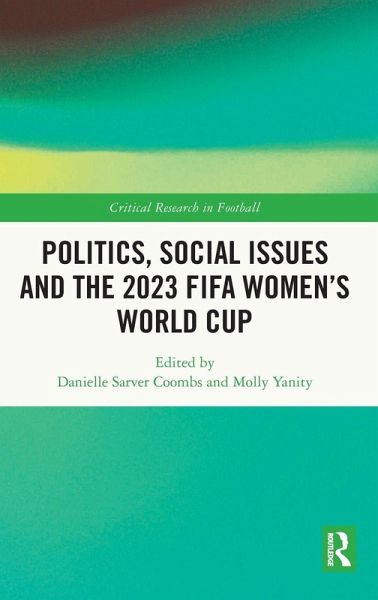
This book takes a close look at politics and social issues in the context of the 2023 FIFA Women's World Cup, one of the most attended women's sporting events in history. Featuring the work of leading researchers from around the world, the book is arranged into two thematic sections, with the first examining power structures and inequalities and the second exploring nationalism, identities, and experiencing the women's game. The book presents a series of important and fascinating cases - including campaigns for equal pay for players; governance, ethics and women's rights in Spanish…mehr
This book takes a close look at politics and social issues in the context of the 2023 FIFA Women's World Cup, one of the most attended women's sporting events in history. Featuring the work of leading researchers from around the world, the book is arranged into two thematic sections, with the first examining power structures and inequalities and the second exploring nationalism, identities, and experiencing the women's game.
The book presents a series of important and fascinating cases - including campaigns for equal pay for players; governance, ethics and women's rights in Spanish football; the legacies of the Australian Matildas; and the impact of fan spaces - that together form a multi-layered picture of a signature event in the history of women's sport.
This book is vital reading for anybody with an interest in women's sport, gender and sport, the sociology of sport, the politics of sport, event studies or sport business and management.
Danielle Sarver Coombs teaches advertising and branding at the University for the Creative Arts, UK. Her research interests center on politics, sports, and the politics of sport. She has authored and edited a number of books, including the Routledge Handbook of Sport Fans and Fandom (Routledge, 2022). She is the vice-chair of the International Communication Association's Sport Communication Interest Group. Molly Yanity is professor and director of the sports media and communication program at the University of Rhode Island, USA. A former sportswriter, Yanity also serves as a board member for the International Association for Communication and Sport.
Inhaltsangabe
Introduction: Considerations on the impact of women's soccer and the global game PART I On power structures inequalities and women's football 1. The evolution and politicization of the Women's World Cup 2. FIFA's relationship to indigeneity in the 2023 Women's World Cup and beyond. Coloniality or commitment? 3. Female soccer players on a mission to eliminate structural inequalities: Equal pay for equal play 4. The experiences (and challenges) of girls who want to play soccer in Burkina Faso 5. "Se Acabó": Spanish Women's Resistance to Patriarchy and the 2023 FIFA Women's World Cup6. Governance ethics and women's rights in Spain: Sporting success in turbulent times7. What does Carly Lloyd really want? A rhetorical analysis PART II On nationalism identities and experiencing the women's game 8. Interrogating representations and Colombian footballing narratives of nation around the Women's World Cup 2023: Of voids and (in)visibilities 9. The Filipinas writing World Cup 'herstory' in contestations on gender race and nationality in Philippine sport 10. Sexism homophobia and conservative backlash to the U.S. Women's National Team entering the 2023 World Cup: "The new woke queen(s)" 11. How does a national women's soccer team resonate with schoolchildren? The Republic of Ireland women's soccer team and the 2023 Women's World Cup 12. Emergence and divergence of Fan Zones at the 2023 Women's World Cup: Beyond the stadium 13. Examining new narratives of fandom at the 2023 Women's World Cup: Finding friendship and fun in the Fan Zone 14. "Til it's done": The Legacy of the 2023 FIFA Women's World Cup through insights from Australian and German Women's Football Fans
Introduction: Considerations on the impact of women's soccer and the global game PART I On power structures inequalities and women's football 1. The evolution and politicization of the Women's World Cup 2. FIFA's relationship to indigeneity in the 2023 Women's World Cup and beyond. Coloniality or commitment? 3. Female soccer players on a mission to eliminate structural inequalities: Equal pay for equal play 4. The experiences (and challenges) of girls who want to play soccer in Burkina Faso 5. "Se Acabó": Spanish Women's Resistance to Patriarchy and the 2023 FIFA Women's World Cup6. Governance ethics and women's rights in Spain: Sporting success in turbulent times7. What does Carly Lloyd really want? A rhetorical analysis PART II On nationalism identities and experiencing the women's game 8. Interrogating representations and Colombian footballing narratives of nation around the Women's World Cup 2023: Of voids and (in)visibilities 9. The Filipinas writing World Cup 'herstory' in contestations on gender race and nationality in Philippine sport 10. Sexism homophobia and conservative backlash to the U.S. Women's National Team entering the 2023 World Cup: "The new woke queen(s)" 11. How does a national women's soccer team resonate with schoolchildren? The Republic of Ireland women's soccer team and the 2023 Women's World Cup 12. Emergence and divergence of Fan Zones at the 2023 Women's World Cup: Beyond the stadium 13. Examining new narratives of fandom at the 2023 Women's World Cup: Finding friendship and fun in the Fan Zone 14. "Til it's done": The Legacy of the 2023 FIFA Women's World Cup through insights from Australian and German Women's Football Fans
Es gelten unsere Allgemeinen Geschäftsbedingungen: www.buecher.de/agb
Impressum
www.buecher.de ist ein Internetauftritt der buecher.de internetstores GmbH
Geschäftsführung: Monica Sawhney | Roland Kölbl | Günter Hilger
Sitz der Gesellschaft: Batheyer Straße 115 - 117, 58099 Hagen
Postanschrift: Bürgermeister-Wegele-Str. 12, 86167 Augsburg
Amtsgericht Hagen HRB 13257
Steuernummer: 321/5800/1497
USt-IdNr: DE450055826