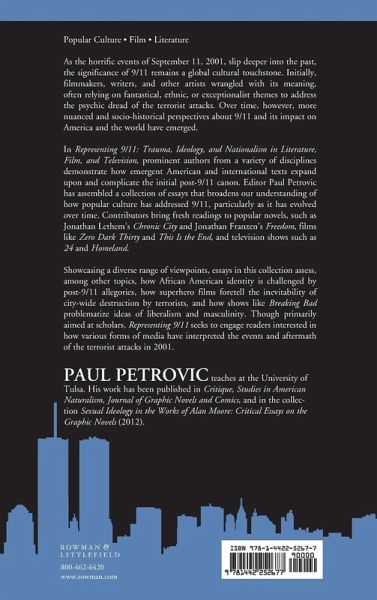
This diverse collection of essays analyzes popular culture texts-including novel, films, and television shows-that demonstrate a variety of attitudes in the wake of the September 11, 2001 attacks.
This diverse collection of essays analyzes popular culture texts-including novel, films, and television shows-that demonstrate a variety of attitudes in the wake of the September 11, 2001 attacks.
Paul Petrovic teaches at the University of Tulsa. His work has been published in Critique, Studies in American Naturalism, Journal of Graphic Novels and Comics, and in the collection Sexual Ideology in the Works of Alan Moore: Critical Essays on the Graphic Novels (2012).
Inhaltsangabe
Acknowledgments Introduction: Paul Petrovic COUNTER-REACTIONS AGAINST REALISM: Chapter 1: Jess Walter's The Zero: Satirizing the 'Desert of the Real' Marjorie Worthington Chapter 2: Memorializing Post-9/11 New York in Jonathan Lethem's Chronic City Jeffrey Severs Chapter 3: Never Give a Good Politician Time to Pray: Stephen King's Treatment of Political Power and Community Involvement in Under the Dome Tamara Watkins Chapter 4: Which Came First; Zombies or the Plague?: Colson Whitehead's Zone One as Post-9/11 Allegory Anne Canavan Chapter 5: A Eulogy of the Urban Superhero: The Everyday Destruction of Space in the Superhero Film James M. Gilmore PERCEPTION, IDEOLOGY AND COMMUNITY: Chapter 6: Paucity of Imagination: Stereotypes, Public Debates, and the Limits of Ideology in Amy Waldman's The Submission Amir Khadem Chapter 7: Strangers in a Homeland: Veterans and "Innocensus" in Billy Lynn's Long Halftime Walk and The Yellow Birds Damon Barta Chapter 8: "Our New Customer is the Bush Administration?": Questioning Cultural Identity and Governmental Surveillance in Allegra Goodman's The Cookbook Collector Paul Petrovic Chapter 9: "I'm the Motherfucker Who Found This Place": Locating Post-bin Laden America in Zero Dark Thirty Lloyd Isaac Vayo From 24 to Homeland: the Shift in America's Perception of Terrorism-Deborah Pless MASCULINITY, MARGINALIZATION, MELANCHOLY, AND HYPER-PROTECTION: Chapter 10: The Danger that Keeps Knocking: Representations of Post-9/11 Masculinity in Vince Gilligan's Breaking Bad Shana Kraynak Chapter 11: Post-Closet and Post-9/11: The Bromantic Imagination of Disaster in This Is the End and I'm So Excited! Ken Feil Chapter 12: The Human Barnyard: Rhetoric, Identification, and Symbolic Representation in Giannina Braschi's United States of Banana Elizabeth Lowry Chapter 13: The Pain and Prison of Post-9/11 Parenting in Jonathan Franzen's Freedom Megan Cannella Chapter 14: How to Get to 9/11: Teju Cole's Melancholic Fiction Ariela Freedman Chapter 15: Poetic Responses to 9/11 and Adrienne Rich's "The School Among the Ruins" Lin Knutson INTERNATIONAL RESPONSES: Chapter 16: 'Some sense of Bridge-making': Exploring the Relationship between America and Pakistan in Moshin Hamid's The Reluctant Fundamentalist and Mira Nair's Film Adaptation Laura Findlay Chapter 17: Haunting Cartographies: Mapping the Aftermath in Joachim Trier's Olso, 31st August Danica van de Velde Index About the Contributors
Acknowledgments Introduction: Paul Petrovic COUNTER-REACTIONS AGAINST REALISM: Chapter 1: Jess Walter's The Zero: Satirizing the 'Desert of the Real' Marjorie Worthington Chapter 2: Memorializing Post-9/11 New York in Jonathan Lethem's Chronic City Jeffrey Severs Chapter 3: Never Give a Good Politician Time to Pray: Stephen King's Treatment of Political Power and Community Involvement in Under the Dome Tamara Watkins Chapter 4: Which Came First; Zombies or the Plague?: Colson Whitehead's Zone One as Post-9/11 Allegory Anne Canavan Chapter 5: A Eulogy of the Urban Superhero: The Everyday Destruction of Space in the Superhero Film James M. Gilmore PERCEPTION, IDEOLOGY AND COMMUNITY: Chapter 6: Paucity of Imagination: Stereotypes, Public Debates, and the Limits of Ideology in Amy Waldman's The Submission Amir Khadem Chapter 7: Strangers in a Homeland: Veterans and "Innocensus" in Billy Lynn's Long Halftime Walk and The Yellow Birds Damon Barta Chapter 8: "Our New Customer is the Bush Administration?": Questioning Cultural Identity and Governmental Surveillance in Allegra Goodman's The Cookbook Collector Paul Petrovic Chapter 9: "I'm the Motherfucker Who Found This Place": Locating Post-bin Laden America in Zero Dark Thirty Lloyd Isaac Vayo From 24 to Homeland: the Shift in America's Perception of Terrorism-Deborah Pless MASCULINITY, MARGINALIZATION, MELANCHOLY, AND HYPER-PROTECTION: Chapter 10: The Danger that Keeps Knocking: Representations of Post-9/11 Masculinity in Vince Gilligan's Breaking Bad Shana Kraynak Chapter 11: Post-Closet and Post-9/11: The Bromantic Imagination of Disaster in This Is the End and I'm So Excited! Ken Feil Chapter 12: The Human Barnyard: Rhetoric, Identification, and Symbolic Representation in Giannina Braschi's United States of Banana Elizabeth Lowry Chapter 13: The Pain and Prison of Post-9/11 Parenting in Jonathan Franzen's Freedom Megan Cannella Chapter 14: How to Get to 9/11: Teju Cole's Melancholic Fiction Ariela Freedman Chapter 15: Poetic Responses to 9/11 and Adrienne Rich's "The School Among the Ruins" Lin Knutson INTERNATIONAL RESPONSES: Chapter 16: 'Some sense of Bridge-making': Exploring the Relationship between America and Pakistan in Moshin Hamid's The Reluctant Fundamentalist and Mira Nair's Film Adaptation Laura Findlay Chapter 17: Haunting Cartographies: Mapping the Aftermath in Joachim Trier's Olso, 31st August Danica van de Velde Index About the Contributors
Es gelten unsere Allgemeinen Geschäftsbedingungen: www.buecher.de/agb
Impressum
www.buecher.de ist ein Internetauftritt der buecher.de internetstores GmbH
Geschäftsführung: Monica Sawhney | Roland Kölbl | Günter Hilger
Sitz der Gesellschaft: Batheyer Straße 115 - 117, 58099 Hagen
Postanschrift: Bürgermeister-Wegele-Str. 12, 86167 Augsburg
Amtsgericht Hagen HRB 13257
Steuernummer: 321/5800/1497
USt-IdNr: DE450055826