

Andere Kunden interessierten sich auch für
 From Abyss to Glory89,95 €
 Jesus' response to Poverty in Luke: A Paradigm for Nigerian leadership53,99 €
 Christian Response as regards Poverty in the Nigerian Society29,99 €
 Mission, Migration, and Integration44,95 €
 The Sabbath Viewed in the Light of Reason, Revelation, and History40,90 €
 A Biblical Response to Open Theism52,99 €
 New Religions and State's Response to Religious Diversification in Contemporary Vietnam38,99 €






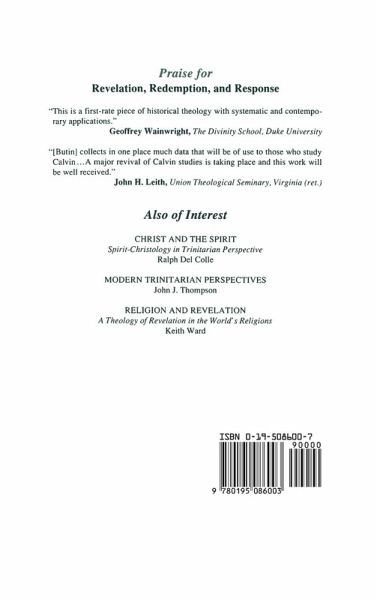
How does John Calvin understand and depict the relationship of God with humanity? Until this study, the most influential readings of Calvin have tended to assume a dialectical divine-human opposition as fundamental to his thought. In this fresh consideration of Calvin's Christian vision his consistent and pervasive appeal to the Trinity in understanding the divine-human relationship is delineated and imaginatively rendered. Tracing the trinitarian theme in its many dimensions throughout the reformer's work, Philip Butin offers a revised look at the vital role of the Trinity in Calvin's thought, in the process recovering Calvin as a significant historical source for contemporary trinitarian theological reflection.
How did John Calvin understand and depict God's relationship with humanity? Influential readings of Calvin have seen a dialectical divine-human opposition as fundamental to his thought. As a result, the importance of the doctrine of the Trinity in his understanding of the divine-human relationship has been largely overlooked. In this fresh consideration of Calvin's Christian vision, however, Philip Butin demonstrates Calvin's consistent and pervasive appeal to the Trinity as the basis, pattern, and dynamic of God's relationship with humanity. Butin examines the historical background, controversial context, and distinctive features of Calvin's Trinity doctrine. He then explores the trinitarian character of Calvin's doctrines concerning revelation, redemption, and human response to God. Finally, his consideration of Calvin's doctrines of the church, baptism, and the eucharist suggests the contextuality, comprehensiveness, and coherence of Calvin's trinitarian vision.
How did John Calvin understand and depict God's relationship with humanity? Influential readings of Calvin have seen a dialectical divine-human opposition as fundamental to his thought. As a result, the importance of the doctrine of the Trinity in his understanding of the divine-human relationship has been largely overlooked. In this fresh consideration of Calvin's Christian vision, however, Philip Butin demonstrates Calvin's consistent and pervasive appeal to the Trinity as the basis, pattern, and dynamic of God's relationship with humanity. Butin examines the historical background, controversial context, and distinctive features of Calvin's Trinity doctrine. He then explores the trinitarian character of Calvin's doctrines concerning revelation, redemption, and human response to God. Finally, his consideration of Calvin's doctrines of the church, baptism, and the eucharist suggests the contextuality, comprehensiveness, and coherence of Calvin's trinitarian vision.