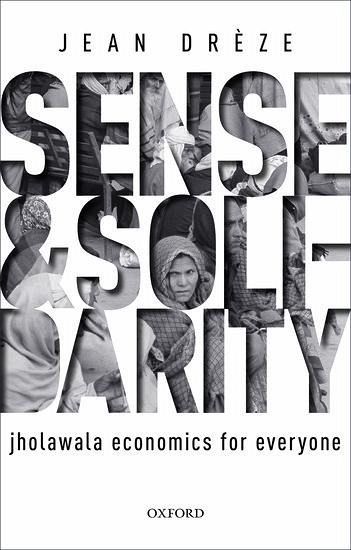
Jean Dreze has a rare and distinctive understanding of the Indian economy and its relationship with the social life of ordinary people. He has travelled widely in rural India and done fieldwork of a kind that few economists have attempted. In Sense and Solidarity Dreze offers unique insight on issues of hunger, inequality, conflict, and the evolution of social policy in India over roughly the past two decades. Historic legislations and initiatives of the period, relating for instance to the right to food and the right to work, are all scrutinised and explained, as are the fierce debates that…mehr
Jean Dreze has a rare and distinctive understanding of the Indian economy and its relationship with the social life of ordinary people. He has travelled widely in rural India and done fieldwork of a kind that few economists have attempted. In Sense and Solidarity Dreze offers unique insight on issues of hunger, inequality, conflict, and the evolution of social policy in India over roughly the past two decades. Historic legislations and initiatives of the period, relating for instance to the right to food and the right to work, are all scrutinised and explained, as are the fierce debates that often accompanied them. "Jholawala" has become a disparaging term for activists in the Indian business media. This book affirms the learning value of collective action combined with sound economic analysis. In his detailed introduction, the author argues for an approach to development economics where research and action are complementary and interconnected.Sense and Solidarity spans the gamut of critical social policies, from education and health to poverty, nutrition, child care, corruption, employment, and social security. There are also less predictable topics such as the caste system, corporate power, nuclear disarmament, the Gujarat model, the Kashmir conflict, and universal basic income. Sense and Solidarity enlarges the boundaries of social development towards a broad concern with the sort of society we want to create.
Jean Drèze, development economist, has taught at the London School of Economics and the Delhi School of Economics and is currently Visiting Professor at Ranchi University. He has made wide-ranging contributions to development economics and public policy, with special reference to India. He is co-author (with Amartya Sen) of Hunger and Public Action (Oxford University Press, 1989) and An Uncertain Glory: India and Its Contradictions (Penguin, 2013).
Inhaltsangabe
Introduction 1: Drought and Hunger Starving the Poor Fragile Lifelines, Robust Oppression The Right to Food and Public Accountability Memories of Kusumatand (with Bela Bhatia) The Dark Well of Hunger 2: Poverty The Poverty Trap On the Poverty Line Beyond Small Mercies Squaring the Poverty Circle (with Angus Deaton) 3: School Meals Hunger in the Classroom (with Vivek S.) Food for Equality Midday Meals and the Joy of Learning Caste, Class, and Eggs 4: Health Care Health Checkup India Leapfrogged Health at Sixty-six Small Leap Forward in Child Health Kerala Tops, Gujarat Flops, Bihar Hops (with Reetika Khera) 5: Child Development and Elementary Education Class Struggle (with the PROBE Team) The Welfare State in Tamil Nadu Children Under Six: Out of Focus Struggling to Learn (with Anuradha De, Meera Samson, and A.K. Shiva Kumar) Progress of Children Under Six 6: Employment Guarantee Employment as a Social Responsibility Employment Guarantee and Its Discontents Myths and Reality of Corruption (with Reetika Khera and Siddhartha) Employment Guarantee or Slave Labour? Guaranteeing Productive Work 7: Food Security and the Public Distribution System Food Security Act: Indecent Proposal? The PDS Turnaround in Chhattisgarh (with Reetika Khera) Rural Poverty and the Public Distribution System (with Reetika Khera) The Food Security Debate in India Poor States Catch Up 8: Corporate Power and Technocracy Glucose for the Lok Sabha? (with Reetika Khera) Nehruvian Budget in the Corporate Age Unique Identity Dilemma The Aadhaar Coup Dark Clouds over the PDS 9: War and Peace Nuclear Deterrence: From MAD to Worse The Future of War in Retrospect Kashmir: Manufacturing Ethnic Conflict The Warped Logic of Nuclear Gambles India and the Deal: Partner or Pawn? Kashmir's Hidden Uprising 10: Top-Up Rang de Basti (with Bela Bhatia) Voting in Maoist Land The Bribing Game The Quiet Grip of Caste The Gujarat Muddle On the Mythology of Social Policy The Bullet Train Syndrome The Mother of All Disruptions Decoding Universal Basic Income Development and Public-spiritedness
Es gelten unsere Allgemeinen Geschäftsbedingungen: www.buecher.de/agb
Impressum
www.buecher.de ist ein Internetauftritt der buecher.de internetstores GmbH
Geschäftsführung: Monica Sawhney | Roland Kölbl | Günter Hilger
Sitz der Gesellschaft: Batheyer Straße 115 - 117, 58099 Hagen
Postanschrift: Bürgermeister-Wegele-Str. 12, 86167 Augsburg
Amtsgericht Hagen HRB 13257
Steuernummer: 321/5800/1497
USt-IdNr: DE450055826