Over the past decade, the Democratic Republic of the Congo (DR Congo) and South Africa have attracted global attention for high rates of sexual and gender-based violence. Why is it that courts in eastern DR Congo prioritize gender crimes despite considerable logistical challenges, while courts in South Africa, home to a far stronger legal infrastructure and human rights record, have struggled to provide justice to victims of similar crimes? Lake shows that state fragility in DR Congo has created openings for human rights nongovernmental organizations (NGOs) to influence legal processes in ways…mehr
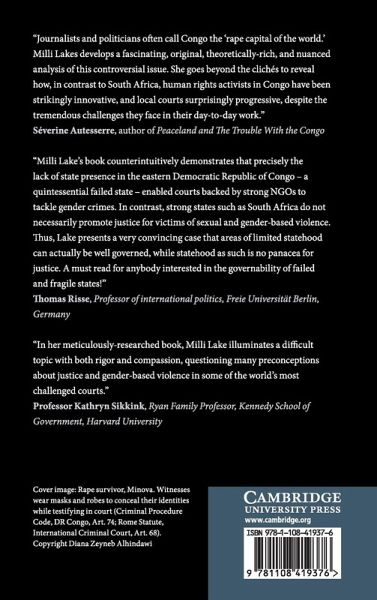
Over the past decade, the Democratic Republic of the Congo (DR Congo) and South Africa have attracted global attention for high rates of sexual and gender-based violence. Why is it that courts in eastern DR Congo prioritize gender crimes despite considerable logistical challenges, while courts in South Africa, home to a far stronger legal infrastructure and human rights record, have struggled to provide justice to victims of similar crimes? Lake shows that state fragility in DR Congo has created openings for human rights nongovernmental organizations (NGOs) to influence legal processes in ways that have proved impossible in countries like South Africa, where the state is stronger. Yet exploiting opportunities presented by state fragility to pursue narrow human rights goals invites a host of new challenges. Strong NGOs and Weak States documents the promises and pitfalls of human rights and rule of law advocacy undertaken by NGOs in strong and weak states alike.
Milli Lake is Assistant Professor at the International Relations Department at the London School of Economics and Political Science. Her work focuses on human rights, violence and state-building in weak, developing and post-conflict states. With over a decade of experience working on human rights and the rule of law in sub-Saharan Africa, she has worked or consulted in varying capacities for organisations including the International Bar Association, USAID, the World Bank, Save the Children, the Human Rights Center at Berkeley School of Law; and the International Law and Policy Institute. Her research appears in International Organization, Law and Society Review, International Studies Quarterly, and a number of other academic journals. She was the recipient of the American Political Science Association Comparative Democratization Section's 2014 'Best Fieldwork' award, and the 2014 University of Washington's Dean's Medal for the Social Sciences.
Inhaltsangabe
1. Law in unforeseen places 2. Researching violence and law in South Africa's Western Cape and DR Congo's Eastern provinces 3. Explaining state-level policy and practice 4. Local justice institutions and opportunities created by state fragility 5. Ordinary women in court: socialization and outreach from the ground up 6. Hard fought victories: assessing the human rights benefits felt by victims of violence in DR Congo 7. Justice for who? The unintended consequences of hard fought victories 8. Conclusion: NGOs and state (un)making Appendix A: decisions in the field Appendix B: interviews with victims of gender violence Appendix C: DR Congo's criminal justice system Appendix D: South Africa's criminal justice system.
1. Law in unforeseen places 2. Researching violence and law in South Africa's Western Cape and DR Congo's Eastern provinces 3. Explaining state-level policy and practice 4. Local justice institutions and opportunities created by state fragility 5. Ordinary women in court: socialization and outreach from the ground up 6. Hard fought victories: assessing the human rights benefits felt by victims of violence in DR Congo 7. Justice for who? The unintended consequences of hard fought victories 8. Conclusion: NGOs and state (un)making Appendix A: decisions in the field Appendix B: interviews with victims of gender violence Appendix C: DR Congo's criminal justice system Appendix D: South Africa's criminal justice system.
Es gelten unsere Allgemeinen Geschäftsbedingungen: www.buecher.de/agb
Impressum
www.buecher.de ist ein Internetauftritt der buecher.de internetstores GmbH
Geschäftsführung: Monica Sawhney | Roland Kölbl | Günter Hilger
Sitz der Gesellschaft: Batheyer Straße 115 - 117, 58099 Hagen
Postanschrift: Bürgermeister-Wegele-Str. 12, 86167 Augsburg
Amtsgericht Hagen HRB 13257
Steuernummer: 321/5800/1497
USt-IdNr: DE450055826