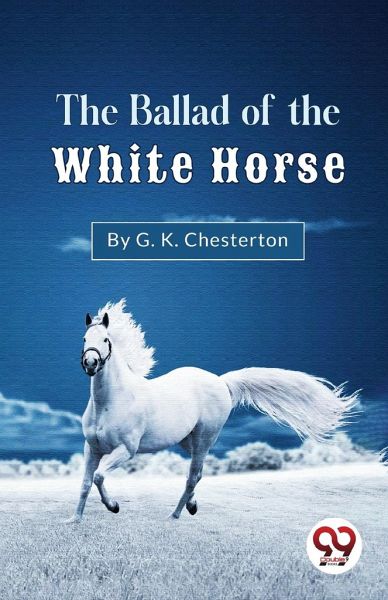
A poem by English author G. K. Chesterton called The Ballad of the White Horse describes the bravery of the Saxon King Alfred the Great in an idealized manner. The poem, a ballad, has been regarded as one of the last truly fantastic traditional epic poems ever composed in English. The poem describes how the Virgin Mary helped Alfred beat the Dane invaders in the Battle of Ethandun. Chesterton opted to include the Battle of Ethandune in the Valley of the White Horse even though there is no historical support for it in his poem. There are 2,684 lines of English verse throughout the entire poem.…mehr
A poem by English author G. K. Chesterton called The Ballad of the White Horse describes the bravery of the Saxon King Alfred the Great in an idealized manner. The poem, a ballad, has been regarded as one of the last truly fantastic traditional epic poems ever composed in English. The poem describes how the Virgin Mary helped Alfred beat the Dane invaders in the Battle of Ethandun. Chesterton opted to include the Battle of Ethandune in the Valley of the White Horse even though there is no historical support for it in his poem. There are 2,684 lines of English verse throughout the entire poem. They are broken up into stanzas, which normally include 4 to 6 lines each. The Ballad Of The White Horse has been deemed a classic and has been a great collection of ideas comprehended in a single draft to be read by readers of several age groups.
Gilbert Keith Chesterton KC*SG was an English author, philosopher, Christian defender, and literary and art reviewer who was born on May 29, 1874, and died on June 14, 1936. Chesterton wrote about theology and made up the character Father Brown, a priest-detective. Some people who don't agree with him have seen how popular books like Orthodoxy and The Everlasting Man are. Chesterton often called himself a "orthodox Christian," and this view became more and more similar to Catholicism until he finally left high church Anglicanism. Authors from the Victorian era like Matthew Arnold, Thomas Carlyle, John Henry Newman, and John Ruskin saw him as an heir. The "prince of paradox" has been used to describe him. A review in Time said this about Chesterton's writing style: "Whenever possible, Chesterton made his points with popular sayings, proverbs, and allegories-first carefully turning them inside out." His writings had an impact on Jorge Luis Borges, who said that his writings were like Edgar Allan Poe's. Chesterton was born in Campden Hill, Kensington, London. His father, Edward Chesterton (1841-1922), was an estate agent, and his mother, Marie Louise Grosjean, was from Switzerland and France. Chesterton was baptized into the Church of England when he was one month old, even though his family was a Unitarian and only sometimes followed their beliefs.
Es gelten unsere Allgemeinen Geschäftsbedingungen: www.buecher.de/agb
Impressum
www.buecher.de ist ein Internetauftritt der buecher.de internetstores GmbH
Geschäftsführung: Monica Sawhney | Roland Kölbl | Günter Hilger
Sitz der Gesellschaft: Batheyer Straße 115 - 117, 58099 Hagen
Postanschrift: Bürgermeister-Wegele-Str. 12, 86167 Augsburg
Amtsgericht Hagen HRB 13257
Steuernummer: 321/5800/1497
USt-IdNr: DE450055826