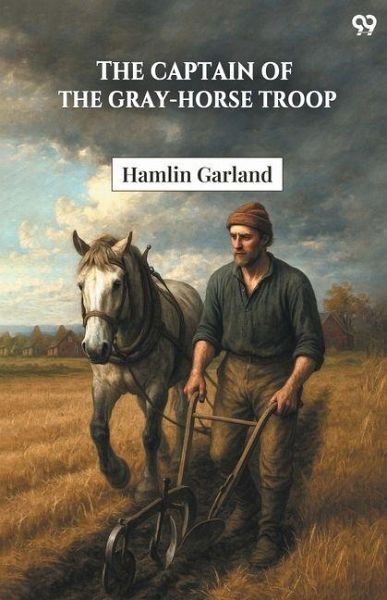
The captain of the gray-horse troop delves into the moral complexities of leadership, justice, and cultural conflict during a volatile chapter in American frontier history. The story follows a disciplined officer as he takes charge of a government post overseeing Native affairs, revealing the contradictions between national ideals and the realities of expansion. The novel opens in a frozen wilderness, where the officer s harsh journey through snow and danger introduces his commitment to duty and endurance. His arrival at Fort Smith marks a shift from physical to political hardship, as he is…mehr
The captain of the gray-horse troop delves into the moral complexities of leadership, justice, and cultural conflict during a volatile chapter in American frontier history. The story follows a disciplined officer as he takes charge of a government post overseeing Native affairs, revealing the contradictions between national ideals and the realities of expansion. The novel opens in a frozen wilderness, where the officer s harsh journey through snow and danger introduces his commitment to duty and endurance. His arrival at Fort Smith marks a shift from physical to political hardship, as he is appointed to an Indian agency fraught with distrust, corruption, and competing loyalties. The environment is tense, shaped by the discontent of the Tetong people and the assertiveness of white settlers. As the officer seeks fairness, his role becomes more than administrative it challenges him to reconcile his beliefs with the pressures of law and public opinion. The book offers a vivid portrait of frontier justice where compassion, authority, and integrity are constantly tested.
Hannibal Hamlin Garland was an American novelist, poet, essayist, short story author, Georgist, and psychical researcher. He is best known for his fiction about hardworking Midwestern farmers. Hannibal Hamlin Garland was born on a farm near West Salem, Wisconsin, on September 14, 1860, as the second of four children of Richard Garland of Maine and Charlotte Isabelle McClintock. The boy was named after Abraham Lincoln's vice president, Hannibal Hamlin. He grew up on numerous Midwestern farms before relocating to Boston, Massachusetts, in 1884 to pursue a writing career. He read diligently at the Boston Public Library. There he grew infatuated with Henry George's views and the Single Tax Movement. George's beliefs influenced several of his writings, including Main-Travelled Roads (1891), Prairie Folks (1892), and his novel Jason Edwards (1892). Main-Travelled Roads was his first big hit. It was a compilation of short stories inspired by his time on the farm. He serialized a biography of Ulysses S. Grant in McClure's Magazine before turning it into a book in 1898. The same year, Garland visited the Yukon to observe the Klondike Gold Rush, which inspired The Trail of the Gold Seekers (1899).
Es gelten unsere Allgemeinen Geschäftsbedingungen: www.buecher.de/agb
Impressum
www.buecher.de ist ein Internetauftritt der buecher.de internetstores GmbH
Geschäftsführung: Monica Sawhney | Roland Kölbl | Günter Hilger
Sitz der Gesellschaft: Batheyer Straße 115 - 117, 58099 Hagen
Postanschrift: Bürgermeister-Wegele-Str. 12, 86167 Augsburg
Amtsgericht Hagen HRB 13257
Steuernummer: 321/5800/1497
USt-IdNr: DE450055826