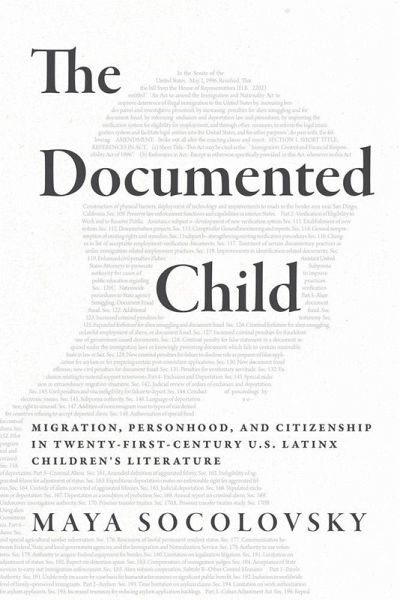
Looking at picture books and middle-grade and young adult literature written from 1997 to 2020, The Documented Child demonstrates how the portrayal of Latinx children has dramatically shifted and discusses how these shifts map onto broader changes in immigration policy and discourse in the United States.
Looking at picture books and middle-grade and young adult literature written from 1997 to 2020, The Documented Child demonstrates how the portrayal of Latinx children has dramatically shifted and discusses how these shifts map onto broader changes in immigration policy and discourse in the United States.
Maya Socolovsky is an associate professor of English and Latinx literature at the University of North Carolina at Charlotte. She is a contributor to numerous journals, and the author of Troubling Nationhood in U.S. Latina Literature.
Inhaltsangabe
Acknowledgments Introduction: Documenting Latinx Children 1. Material Literacies: Migration and Border Crossings in Pat Mora’s TomÁs and the Library Lady, Luis J. Rodriguez’s AmÉrica Is Her Name, and Amada Irma PÉrez’s My Diary from Here to There 2. “What Should We American Farmers Be Without the Distinct Possession of That Soil?” Homesteading and the Cultivation of Citizenship in Cynthia DeFelice’s Under the Same Sky and Julia Alvarez’s Return to Sender 3. Narratives of Shame and Healing: Tourism, Consumerism, and Solidarity in MalÍn AlegrÍa’s Sofi Mendoza’s Guide to Getting Lost in Mexico 4. Borderland Ethics, Migrant Personhood, and the Critique of State Sovereignty in Jairo Buitrago’s Two White Rabbits and JosÉ Manuel Mateo’s Migrant: The Journey of a Mexican Worker 5. Disappearance, Documentation, and Sovereignty in Alexandra Diaz’s The Only Road and The Crossroads 6. The Dreamer Brand: Immigration, Storytelling, and Commodification in Alberto Ledesma’s Diary of a Reluctant Dreamer: Undocumented Vignettes from a Pre-American Life and Maria Andreu’s The Secret Side of Empty Conclusion Notes Works Cited
Acknowledgments Introduction: Documenting Latinx Children 1. Material Literacies: Migration and Border Crossings in Pat Mora’s TomÁs and the Library Lady, Luis J. Rodriguez’s AmÉrica Is Her Name, and Amada Irma PÉrez’s My Diary from Here to There 2. “What Should We American Farmers Be Without the Distinct Possession of That Soil?” Homesteading and the Cultivation of Citizenship in Cynthia DeFelice’s Under the Same Sky and Julia Alvarez’s Return to Sender 3. Narratives of Shame and Healing: Tourism, Consumerism, and Solidarity in MalÍn AlegrÍa’s Sofi Mendoza’s Guide to Getting Lost in Mexico 4. Borderland Ethics, Migrant Personhood, and the Critique of State Sovereignty in Jairo Buitrago’s Two White Rabbits and JosÉ Manuel Mateo’s Migrant: The Journey of a Mexican Worker 5. Disappearance, Documentation, and Sovereignty in Alexandra Diaz’s The Only Road and The Crossroads 6. The Dreamer Brand: Immigration, Storytelling, and Commodification in Alberto Ledesma’s Diary of a Reluctant Dreamer: Undocumented Vignettes from a Pre-American Life and Maria Andreu’s The Secret Side of Empty Conclusion Notes Works Cited
Es gelten unsere Allgemeinen Geschäftsbedingungen: www.buecher.de/agb
Impressum
www.buecher.de ist ein Internetauftritt der buecher.de internetstores GmbH
Geschäftsführung: Monica Sawhney | Roland Kölbl | Günter Hilger
Sitz der Gesellschaft: Batheyer Straße 115 - 117, 58099 Hagen
Postanschrift: Bürgermeister-Wegele-Str. 12, 86167 Augsburg
Amtsgericht Hagen HRB 13257
Steuernummer: 321/5800/1497
USt-IdNr: DE450055826