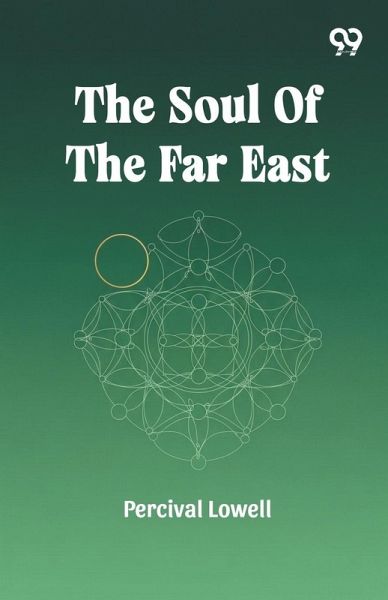
The soul of the far east offers an enhanced reflection on the contrasts between Eastern and Western worldviews, focusing on the ways cultural values shape human experience. The book examines how notions of harmony, community, and social order in the Far East influence the collective identity, often taking precedence over individual desires or personal expression. It presents a study of how these values create a civilization that prioritizes stability and cohesion over the assertion of self. Through careful observations of customs, rituals, and social interactions, the work reveals how deeply…mehr
The soul of the far east offers an enhanced reflection on the contrasts between Eastern and Western worldviews, focusing on the ways cultural values shape human experience. The book examines how notions of harmony, community, and social order in the Far East influence the collective identity, often taking precedence over individual desires or personal expression. It presents a study of how these values create a civilization that prioritizes stability and cohesion over the assertion of self. Through careful observations of customs, rituals, and social interactions, the work reveals how deeply embedded traditions guide everyday life and foster a sense of belonging that transcends the individual. The narrative enriches the understanding of how these cultural priorities challenge the assumptions of Western thought, especially regarding freedom and identity. It highlights the quiet strength of collective purpose in contrast to the more fragmented pursuit of personal ambition. The book offers a thoughtful inquiry into the deeper forces that shape societies and their ideals.
Percival Lowell was born on March 13, 1855, in Boston, Massachusetts, to Augustus Lowell and Katherine Bigelow Lowell. He came from a prominent family with a strong intellectual and political background. His siblings included Amy Lowell, the poet, and A. Lawrence Lowell, who later became president of Harvard University. After graduating from Harvard in 1876, Lowell spent several years traveling in the Far East, where he developed a keen interest in Japanese culture, eventually writing books such as Noto: An Unexplored Corner of Japan. Though initially involved in business and diplomacy, he later shifted to scientific pursuits and became widely known for his work in astronomy. In the 1890s, he founded the Lowell Observatory in Flagstaff, Arizona, where he championed the controversial theory of canals on Mars, proposing they were evidence of intelligent life. He also initiated the search for a ninth planet, which would ultimately lead to the discovery of Pluto after his death. His speculative ideas sparked both popular interest and scientific debate. Lowell's contributions helped lay the groundwork for planetary science in the United States. He died on November 12, 1916, in Flagstaff, leaving behind a legacy that bridged literature, travel, and astronomical inquiry.
Es gelten unsere Allgemeinen Geschäftsbedingungen: www.buecher.de/agb
Impressum
www.buecher.de ist ein Internetauftritt der buecher.de internetstores GmbH
Geschäftsführung: Monica Sawhney | Roland Kölbl | Günter Hilger
Sitz der Gesellschaft: Batheyer Straße 115 - 117, 58099 Hagen
Postanschrift: Bürgermeister-Wegele-Str. 12, 86167 Augsburg
Amtsgericht Hagen HRB 13257
Steuernummer: 321/5800/1497
USt-IdNr: DE450055826