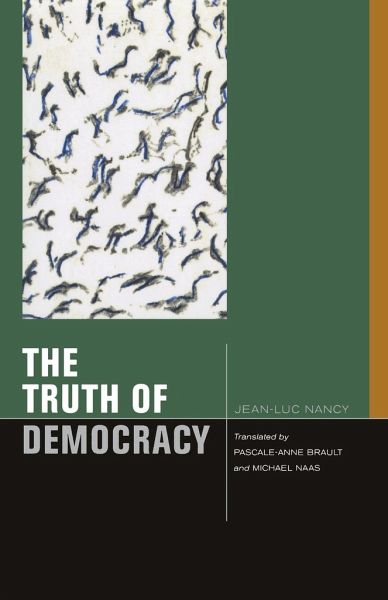
The initial provocation for The Truth of Democracy was the fortieth anniversary of May '68 and the recent criticism (some by French President Nicolas Sarkozy himself) leveled against the ideals and actors at the center of this important but still misunderstood moment in French history. Nancy here defends what he calls simply "68" without apology or equivocation, calling it an essential stage in the search for the "truth of democracy." Less a period within time than a critical moment or interruption of time, 68 needs to be understood, Nancy argues, as an "event" that provided a glimpse into the…mehr
The initial provocation for The Truth of Democracy was the fortieth anniversary of May '68 and the recent criticism (some by French President Nicolas Sarkozy himself) leveled against the ideals and actors at the center of this important but still misunderstood moment in French history. Nancy here defends what he calls simply "68" without apology or equivocation, calling it an essential stage in the search for the "truth of democracy." Less a period within time than a critical moment or interruption of time, 68 needs to be understood, Nancy argues, as an "event" that provided a glimpse into the very "spirit of democracy," a spirit that is linked not to some common vision, idea, or desire (such as the nation, the republic, the people, or humanity) but to an incommensurability (the infinity of man or man's exceeding of himself ) at the origin of democracy. Written in a direct and accessible, almost manifesto-like style, The Truth of Democracy presents a forceful plea that we rethink democracy not as one political regime or form among others but as that which opens up the very experience of being in common. By rearticulating many of the themes and terms he has developed elsewhere (from community and being in common to the singular plural) in relationship to an original analysis of what was and still is at stake in May '68, The Truth of Democracy is at once an eloquent summary of much of Nancy's work and a significant development of it. It is as if, forty years after being first scrawled across university walls and storefronts in France, one of the most famous slogans of May '68 has received in The Truth of Democracy its most eloquent and poignant theoretical elaboration: "Be realistic, demand the impossible!"
Jean-Luc Nancy (1940-2021) was Distinguished Professor of Philosophy at the Université de Strasbourg and one of the late twentieth and early twenty-first century's foremost thinkers of politics, art, and the body. His wide-ranging thought runs through many books, including Being Singular Plural, The Ground of the Image, Corpus, The Disavowed Community, and Sexistence. His book The Intruder was adapted into an acclaimed film by Claire Denis. Pascale-Anne Brault is Professor of French at DePaul University. She is the co-translator of several works of Jacques Derrida's, most recently For Strasbourg: Conversations of Friendship and Philosophy (Fordham). Michael Naas is Professor of Philosophy at DePaul University. He is the author of Class Acts: Derrida on the Public Stage (2022), Apocalyptic Ruin and Everyday Wonder in Don DeLillo's America (2022), Don DeLillo, American Original: Drugs, Weapons, Erotica, and Other Literary Contraband (2020), Plato and the Invention of Life (2018), The End of the World and Other Teachable Moments: Jacques Derrida's Final Seminar (2015), Miracle and Machine: Jacques Derrida and the Two Sources of Religion, Science, and the Media (2012), Derrida From Now On (2008), Taking on the Tradition: Jacques Derrida and the Legacies of Deconstruction (2003), and Turning: From Persuasion to Philosophy (1994). He is co-translator of a number of books by Jacques Derrida, including Life Death (2020), and is a member of the Derrida Seminars Editorial Team.
Es gelten unsere Allgemeinen Geschäftsbedingungen: www.buecher.de/agb
Impressum
www.buecher.de ist ein Internetauftritt der buecher.de internetstores GmbH
Geschäftsführung: Monica Sawhney | Roland Kölbl | Günter Hilger
Sitz der Gesellschaft: Batheyer Straße 115 - 117, 58099 Hagen
Postanschrift: Bürgermeister-Wegele-Str. 12, 86167 Augsburg
Amtsgericht Hagen HRB 13257
Steuernummer: 321/5800/1497
USt-IdNr: DE450055826