

Andere Kunden interessierten sich auch für
 The U.S. Labor Movement in the 20th and Early 21st Century98,99 €
 The U.S. Labor Movement in the 20th and Early 21st Century98,99 €
 Decisions to Have Children in Late 20th and Early 21st Century Australia39,99 €
 The Global Rise of Authoritarianism in the 21st Century50,99 €
 Women and Inequality in the 21st Century222,99 €
 The Formation of Critical Realism218,99 €
 Post-Truth Society167,99 €


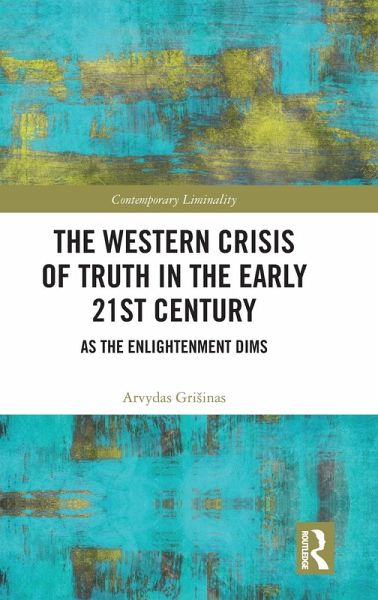
The Western Crisis of Truth in the Early 21st Century explores the symbolic, experiential, and associative side of contemporary political culture, arguing that phenomena such as 'post-truth', digitalization, mediatization, propaganda, illiberalism, or populism, far from being curiosities, have in fact come to represent a uniform aspect of political culture - a challenge to the 'enlightened', 'developed', and 'progressive' world that we believed ourselves to be inhabiting.
Through analyses of visual and textual material such as internet memes, academic discourse, news articles, videos, and other media, it considers truth-making in the epoch of Russia's war in Ukraine, Donald Trump, the hyper-rationalist ritualism of managing the COVID-19 pandemic and the shifting realities on the Eastern border of the West, in order to shed light on the transfiguration of the western intellectual tradition by the global political, technological, and intellectual dynamics of a world thatis far from approaching the end of history. Asking what is to be done in the face of this new reality, The Western Crisis of Truth in the Early 21st Century considers whether the dissident literature of Central and Eastern Europe, which has already lived through a period of disenlightenment under the Soviet Union, as well as other Eastern European movements of dignity and independence might offer answers.
A study of the dimming of the Enlightenment, this volume will appeal to scholars of social and political theory and political anthropology.
Through analyses of visual and textual material such as internet memes, academic discourse, news articles, videos, and other media, it considers truth-making in the epoch of Russia's war in Ukraine, Donald Trump, the hyper-rationalist ritualism of managing the COVID-19 pandemic and the shifting realities on the Eastern border of the West, in order to shed light on the transfiguration of the western intellectual tradition by the global political, technological, and intellectual dynamics of a world thatis far from approaching the end of history. Asking what is to be done in the face of this new reality, The Western Crisis of Truth in the Early 21st Century considers whether the dissident literature of Central and Eastern Europe, which has already lived through a period of disenlightenment under the Soviet Union, as well as other Eastern European movements of dignity and independence might offer answers.
A study of the dimming of the Enlightenment, this volume will appeal to scholars of social and political theory and political anthropology.
"Arvydas Grisnas has written a 21st century revisiting of the dialectic of Enlightenment. In The Western Crisis of Truth in the Early 21st Century, he illuminates Eastern Europe as the epistemologically privileged site that reveals the nature of post-truth. Now not only has science produced a Frankenstein that can victimize its creator, but the technology produced by rationalist science has undermined the very understanding of truth as what is empirically verifiable. Our pathological political reality cannot be understood in the absence of what Grisnas explains as the reality of the not-real." - Marci Shore, Yale University, USA