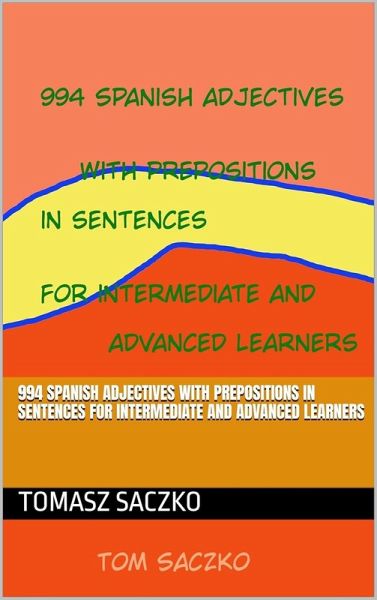
7,99 €
7,99 €
inkl. MwSt.
Sofort per Download lieferbar

0 °P sammeln
7,99 €
Als Download kaufen
7,99 €
inkl. MwSt.
Sofort per Download lieferbar
0 °P sammeln
Jetzt verschenken
Alle Infos zum eBook verschenken
7,99 €
inkl. MwSt.
Sofort per Download lieferbar
Alle Infos zum eBook verschenken
0 °P sammeln

Andere Kunden interessierten sich auch für
") 1300 Spanish adjectives with prepositions for all learners (eBook, ePUB)8,49 €
1300 Spanish adjectives with prepositions for all learners (eBook, ePUB)8,49 €") 950 French adjectives with prepositions for all learners (eBook, ePUB)7,99 €
950 French adjectives with prepositions for all learners (eBook, ePUB)7,99 €") 2000 French adjectives with prepositions in sentences for English speakers (eBook, ePUB)8,49 €
2000 French adjectives with prepositions in sentences for English speakers (eBook, ePUB)8,49 €") 650 Italian Verbs With Prepositions In Sentences For All Learners (eBook, ePUB)8,49 €
650 Italian Verbs With Prepositions In Sentences For All Learners (eBook, ePUB)8,49 €") 1428 French Descriptive Adjectives In Sentences For All Learners (eBook, ePUB)6,99 €
1428 French Descriptive Adjectives In Sentences For All Learners (eBook, ePUB)6,99 €") 370 French Adjectives In Sentences For All Learners (eBook, ePUB)6,49 €
370 French Adjectives In Sentences For All Learners (eBook, ePUB)6,49 € 100 Words - Adjectives (eBook, ePUB)") Spanish ( Easy Spanish ) 100 Words - Adjectives (eBook, ePUB)1,99 €
Spanish ( Easy Spanish ) 100 Words - Adjectives (eBook, ePUB)1,99 €




Understanding how to correctly use adjectives with prepositions in Spanish is crucial for expressing yourself naturally and accurately. Unlike English, where many adjectives can be followed directly by their object, Spanish often requires specific prepositions to connect adjectives with the words they modify or relate to.
This guide will help you master the intricate relationship between Spanish adjectives and their corresponding prepositions. Whether you're a beginner just starting your Spanish journey or an advanced learner aiming for greater precision in your expression, knowing these combinations will significantly enhance your communication skills.
### Why Are Prepositions Important with Adjectives?
In Spanish, prepositions serve as essential bridges between adjectives and the rest of the sentence. For example:
- When you're "proud of" something in English, in Spanish you must say "orgulloso de"
- If you're "good at" something in English, in Spanish it becomes "bueno para"
- Being "afraid of" translates to "asustado de"
Using the wrong preposition or omitting one altogether can change the meaning of your sentence or make it grammatically incorrect. Native Spanish speakers will immediately notice these errors, as these combinations are deeply ingrained in the language's structure.
### How to Use This Guide
As you progress through this guide, you'll find:
- Common adjective-preposition combinations
- Example sentences showing proper usage
- Notes on regional variations where applicable
- Practice exercises to reinforce learning
Learning these combinations requires practice and patience. We recommend focusing on the most frequently used pairs first, gradually expanding your knowledge as you become more comfortable with the basics.
Remember: While memorization plays a role, the best way to internalize these combinations is through consistent practice in real-world contexts - reading, writing, speaking, and
listening to authentic Spanish content.
Let's begin our journey into mastering Spanish adjectives with prepositions, an essential skill for achieving fluency in Spanish
This guide will help you master the intricate relationship between Spanish adjectives and their corresponding prepositions. Whether you're a beginner just starting your Spanish journey or an advanced learner aiming for greater precision in your expression, knowing these combinations will significantly enhance your communication skills.
### Why Are Prepositions Important with Adjectives?
In Spanish, prepositions serve as essential bridges between adjectives and the rest of the sentence. For example:
- When you're "proud of" something in English, in Spanish you must say "orgulloso de"
- If you're "good at" something in English, in Spanish it becomes "bueno para"
- Being "afraid of" translates to "asustado de"
Using the wrong preposition or omitting one altogether can change the meaning of your sentence or make it grammatically incorrect. Native Spanish speakers will immediately notice these errors, as these combinations are deeply ingrained in the language's structure.
### How to Use This Guide
As you progress through this guide, you'll find:
- Common adjective-preposition combinations
- Example sentences showing proper usage
- Notes on regional variations where applicable
- Practice exercises to reinforce learning
Learning these combinations requires practice and patience. We recommend focusing on the most frequently used pairs first, gradually expanding your knowledge as you become more comfortable with the basics.
Remember: While memorization plays a role, the best way to internalize these combinations is through consistent practice in real-world contexts - reading, writing, speaking, and
listening to authentic Spanish content.
Let's begin our journey into mastering Spanish adjectives with prepositions, an essential skill for achieving fluency in Spanish
Dieser Download kann aus rechtlichen Gründen nur mit Rechnungsadresse in A, B, CY, CZ, D, DK, EW, E, FIN, F, GR, H, IRL, I, LT, L, LR, M, NL, PL, P, R, S, SLO, SK ausgeliefert werden.