202,95 €
202,95 €
inkl. MwSt.
Sofort per Download lieferbar

101 °P sammeln
202,95 €
Als Download kaufen
202,95 €
inkl. MwSt.
Sofort per Download lieferbar
101 °P sammeln
Jetzt verschenken
Alle Infos zum eBook verschenken
202,95 €
inkl. MwSt.
Sofort per Download lieferbar
Alle Infos zum eBook verschenken
101 °P sammeln

Andere Kunden interessierten sich auch für
") A Grammar of Mian (eBook, PDF)146,95 €
A Grammar of Mian (eBook, PDF)146,95 €") A Grammar of Vaeakau-Taumako (eBook, PDF)181,95 €
A Grammar of Vaeakau-Taumako (eBook, PDF)181,95 €") A Grammar of Warrongo (eBook, PDF)146,95 €
A Grammar of Warrongo (eBook, PDF)146,95 €") A Grammar of Madurese (eBook, PDF)202,95 €
A Grammar of Madurese (eBook, PDF)202,95 €") A Grammar of Goemai (eBook, PDF)195,95 €
A Grammar of Goemai (eBook, PDF)195,95 €") Language Diversity Endangered (eBook, PDF)35,95 €
Language Diversity Endangered (eBook, PDF)35,95 €") The Trobriand Islanders' Ways of Speaking (eBook, PDF)223,95 €
The Trobriand Islanders' Ways of Speaking (eBook, PDF)223,95 €
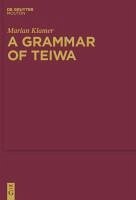
Teiwa is a non-Austronesian ('Papuan') language spoken on the island of Pantar, in eastern Indonesia, located just north of Timor island. It has approx. 4,000 speakers and is highly endangered. While the non-Austronesian languages of the Alor-Pantar archipelago are clearly related to each other, as indicated by the many apparent cognates and the very similar pronominal paradigms found across the group, their genetic relationship to other Papuan languages remains controversial. Located some 1,000 km from their putative Papuan neighbors on the New Guinea mainland, the Alor-Pantar languages are the most distant westerly Papuan outliers. A grammar of Teiwa presents a grammatical description of one of these 'outlier' languages.
The book is structured as a reference grammar: after a general introduction on the language, it speakers and the linguistic situation on Alor and Pantar, the grammar builds up from a description of the language's phonology and word classes to its larger grammatical constituents and their mutual relations: nominal phrases, serial verb constructions, clauses, clause combinations, and information structure. While many Papuan languages are morphologically complex, Teiwa is almost analytic: it has only one paradigm of object marking prefixes, and one verbal suffix marking realis status. Other typologically interesting features of the language include: (i) the presence of uvular fricatives and stops, which is atypical for languages of eastern Indonesia; (ii) the absence of trivalent verbs: transitive verbs select a single (animate or inanimate) object, while the additional participant is expressed with a separate predicate; and (iii) the absence of morpho-syntactically encoded embedded clauses. A grammar of Teiwa is based on primary field data, collected by the author in 2003-2007. A selection of glossed and translated Teiwa texts of various genres and word lists (Teiwa-English / English-Teiwa) are included.
The book is structured as a reference grammar: after a general introduction on the language, it speakers and the linguistic situation on Alor and Pantar, the grammar builds up from a description of the language's phonology and word classes to its larger grammatical constituents and their mutual relations: nominal phrases, serial verb constructions, clauses, clause combinations, and information structure. While many Papuan languages are morphologically complex, Teiwa is almost analytic: it has only one paradigm of object marking prefixes, and one verbal suffix marking realis status. Other typologically interesting features of the language include: (i) the presence of uvular fricatives and stops, which is atypical for languages of eastern Indonesia; (ii) the absence of trivalent verbs: transitive verbs select a single (animate or inanimate) object, while the additional participant is expressed with a separate predicate; and (iii) the absence of morpho-syntactically encoded embedded clauses. A grammar of Teiwa is based on primary field data, collected by the author in 2003-2007. A selection of glossed and translated Teiwa texts of various genres and word lists (Teiwa-English / English-Teiwa) are included.
Dieser Download kann aus rechtlichen Gründen nur mit Rechnungsadresse in A, B, BG, CY, CZ, D, DK, EW, E, FIN, F, GR, HR, H, IRL, I, LT, L, LR, M, NL, PL, P, R, S, SLO, SK ausgeliefert werden.
"[...] this grammar is a most enjoyable read. While some areas of the grammar remain underexplored, Klamer does an excellent job of describing enough of the language in sufficient detail to allow further investigation based on the available texts. Open questions and underexplored areas are acknowledged as such. Despite the relatively short time the author spent in the field, she demonstrates deep knowledge of the language. This book will become an important resource for scholars working on Papuan languages and Alor-Pantar languages in particular. The data and analyses provided will be valuable to linguists more generally, especially typologists interested in topics as diverse as grammatical relations, serial verb constructions, verbal morphology (e.g. reality status marking), as well as demonstratives and spatial deixis."
Nicholas Williams in: Linguist List 22.3994
Nicholas Williams in: Linguist List 22.3994