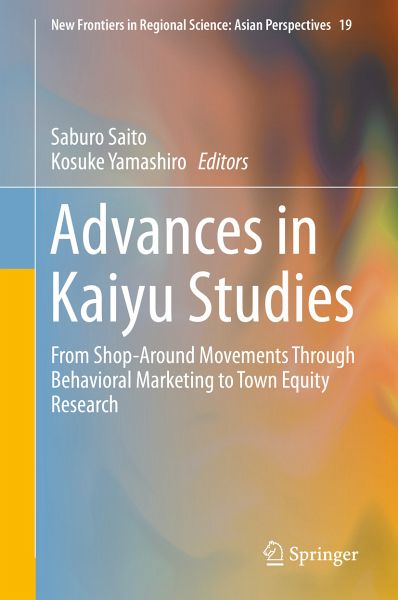
Advances in Kaiyu Studies (eBook, PDF)
From Shop-Around Movements Through Behavioral Marketing to Town Equity Research
Redaktion: Saito, Saburo; Yamashiro, Kosuke
96,95 €
96,95 €
inkl. MwSt.
Sofort per Download lieferbar

48 °P sammeln
96,95 €
Als Download kaufen
96,95 €
inkl. MwSt.
Sofort per Download lieferbar
48 °P sammeln
Jetzt verschenken
Alle Infos zum eBook verschenken
96,95 €
inkl. MwSt.
Sofort per Download lieferbar
Alle Infos zum eBook verschenken
48 °P sammeln

Advances in Kaiyu Studies (eBook, PDF)
From Shop-Around Movements Through Behavioral Marketing to Town Equity Research
Redaktion: Saito, Saburo; Yamashiro, Kosuke
- Format: PDF
- Merkliste
- Auf die Merkliste
- Bewerten Bewerten
- Teilen
- Produkt teilen
- Produkterinnerung
- Produkterinnerung

Bitte loggen Sie sich zunächst in Ihr Kundenkonto ein oder registrieren Sie sich bei
bücher.de, um das eBook-Abo tolino select nutzen zu können.
Hier können Sie sich einloggen
Sie sind bereits eingeloggt. Klicken Sie auf 2. tolino select Abo, um fortzufahren.

Bitte loggen Sie sich zunächst in Ihr Kundenkonto ein oder registrieren Sie sich bei bücher.de, um das eBook-Abo tolino select nutzen zu können.
Defines Kaiyu as consumers' simultaneous choices about destination, purpose, and consumption and reveals relationships among spatial shop-around movements and money flows
Provides a unified framework to evaluate various urban policies from hard to soft by consumer shop-around behaviors
Presents many empirical facts to reveal how specific facilities and functions contribute to the value of the whole town from Kaiyu surveys
- Geräte: PC
- ohne Kopierschutz
- eBook Hilfe
- Größe: 16.86MB
Andere Kunden interessierten sich auch für
Recent Advances in Modeling and Forecasting Kaiyu (eBook, PDF)120,95 €
Intelligent Transport Systems for Everyone's Mobility (eBook, PDF)88,95 €
Attila ChikánInventories in National Economies (eBook, PDF)60,95 €
Jun TanimotoEvolutionary Games with Sociophysics (eBook, PDF)96,95 €
Bangzhu ZhuPricing and Forecasting Carbon Markets (eBook, PDF)72,95 €
Collaborative Value Co-creation in the Platform Economy (eBook, PDF)96,95 €
Dynamics of Big Internet Industry Groups and Future Trends (eBook, PDF)40,95 €-
-
-
Defines Kaiyu as consumers' simultaneous choices about destination, purpose, and consumption and reveals relationships among spatial shop-around movements and money flows
Provides a unified framework to evaluate various urban policies from hard to soft by consumer shop-around behaviors
Presents many empirical facts to reveal how specific facilities and functions contribute to the value of the whole town from Kaiyu surveys
Provides a unified framework to evaluate various urban policies from hard to soft by consumer shop-around behaviors
Presents many empirical facts to reveal how specific facilities and functions contribute to the value of the whole town from Kaiyu surveys
Dieser Download kann aus rechtlichen Gründen nur mit Rechnungsadresse in A, B, BG, CY, CZ, D, DK, EW, E, FIN, F, GR, HR, H, IRL, I, LT, L, LR, M, NL, PL, P, R, S, SLO, SK ausgeliefert werden.
Produktdetails
- Produktdetails
- Verlag: Springer Nature Singapore
- Seitenzahl: 467
- Erscheinungstermin: 30. Januar 2019
- Englisch
- ISBN-13: 9789811317392
- Artikelnr.: 56792281
- Verlag: Springer Nature Singapore
- Seitenzahl: 467
- Erscheinungstermin: 30. Januar 2019
- Englisch
- ISBN-13: 9789811317392
- Artikelnr.: 56792281
- Herstellerkennzeichnung Die Herstellerinformationen sind derzeit nicht verfügbar.
Saburo Saito, Fukuoka University Kosuke Yamashiro, Fukuoka University
Chapter 1. Introduction: Some meta-theoretic consideration of consumer shop-around studies.- Part I Policy evaluation from Kaiyu movements.- Chapter 2. How did the large scale city center retail redevelopment change consumer shop-around behaviors: A case of city center of Fukuoka city, Japan.- Chapter 3. Evaluating municipal tourism policy from how visitors walk around historical heritage area.- Chapter 4. How did the extension of underground shopping mall change Kaiyu.- Part II Some characteristics of Kaiyu.- Chapter 5. On the occurrence order of purposes on the way of shop-around.- Chapter 6. The staying time for shopping at city center retail environment.- Chapter 7. The factors determining staying time in city center.- Chapter 8. Little's formula and parking behavior.- Part III Economic effects by accelerating Kaiyu.- Chapter 9. The economic effects of city center 1 dollar circular bus.- Chapter 10. The value of time for shopping.- Chapter 11. The economic impacts of city center coffee shops.- Part IV Economic effects by increasing visitors.- Chapter 12. The economic impacts of opening new subway line.- Chapter 13. Did an introduction of new subway line increase the frequency of visits to city center?.- Chapter 14. To what extent did the woodwork festival attract people?.- Chapter 15. How did the effects of festival held on main street spread over other districts within a city center.- Part V Kaiyu marketing and value of visit to city center.- Chapter 16. Did the grand renewal opening of department store enhance the visit value of customers?.- Chapter 17. A new entry of large variety shop increases value of city center?.- Part VI Emerging view of goal of town development.- Chapter 18. The concept of town equity and goal of town development.- Chapter 19. City center parking policy: a business model approach.- Part VII Information and consumer shop-around behaviors.- Chapter 20. Experimental study on consumer information processing behaviors in the middle ofshop-around.- Chapter 21. Consumer's visit value and shop category choice.- Part VIII Urban policy and consumer welfare.- Chapter 22. Travel demand function of Korean tourists to Kyushu.- Chapter 23. Econometric approach to estimate welfare change brought by a new subway line.- Chapter 24. Conclusion and further remarks on further research.