51,95 €
51,95 €
inkl. MwSt.
Sofort per Download lieferbar

26 °P sammeln
51,95 €
Als Download kaufen
51,95 €
inkl. MwSt.
Sofort per Download lieferbar
26 °P sammeln
Jetzt verschenken
Alle Infos zum eBook verschenken
51,95 €
inkl. MwSt.
Sofort per Download lieferbar
Alle Infos zum eBook verschenken
26 °P sammeln

Andere Kunden interessierten sich auch für
") Redefining the Market-State Relationship (eBook, ePUB)45,95 €
Redefining the Market-State Relationship (eBook, ePUB)45,95 €") Ownership, Financial Accountability and the Law (eBook, ePUB)41,95 €
Ownership, Financial Accountability and the Law (eBook, ePUB)41,95 €") The Internationalisation of Competition Rules (eBook, ePUB)45,95 €
The Internationalisation of Competition Rules (eBook, ePUB)45,95 €") The Foundations and Future of Financial Regulation (eBook, ePUB)61,95 €
The Foundations and Future of Financial Regulation (eBook, ePUB)61,95 €") Financing for Sustainable Development in International Investment Law (eBook, ePUB)39,95 €
Financing for Sustainable Development in International Investment Law (eBook, ePUB)39,95 €") Regulation and Supervision of the OTC Derivatives Market (eBook, ePUB)43,95 €
Regulation and Supervision of the OTC Derivatives Market (eBook, ePUB)43,95 €") Institutional Structure of Financial Regulation (eBook, ePUB)51,95 €
Institutional Structure of Financial Regulation (eBook, ePUB)51,95 €







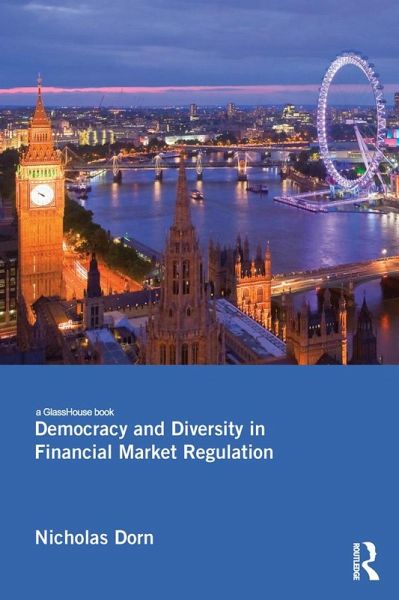
Financial markets have become acknowledged as a source of crisis, and discussion of them has shifted from economics, through legal and regulatory studies, to politics. Events from 2008 onwards raise important, cross-disciplinary questions: must financial markets drive states into political and existential crisis, must public finances take over private losses, must citizens endure austerity? This book argues that there is an alternative. If the financial system were less 'connected', contagion within the market would be reduced and crises would become more localised and intermittent, less global and pervasive. The question then becomes how to reduce connectedness within financial markets.
This book argues that the democratic direction of financial market policies can deliver this. Politicising financial market policies - taking discussion of these issues out of the sphere of the 'technical' and putting it into the same democratically contested space as, for example, health and welfare policies - would encourage differing policies to emerge in different countries. Diversity of regulatory regimes would result in some business models being attracted to some jurisdictions, others to others. The resulting heterogeneity, when viewed from a global perspective, would be a reversal of recent and current tendencies towards one single/global 'level playing field', within which all financial firms and sectors have become closely connected and across which contagion inevitably reigns.
No doubt the democratisation of financial market policy would be opposed by big firms - their interests being served by regulatory convergence - and considered macabre by some financial regulators and central bankers, who are coalescing into an elite community. However, everyone else, Nicholas Dorn argues here, would be better off in a financial world characterised by greater diversity.
This book argues that the democratic direction of financial market policies can deliver this. Politicising financial market policies - taking discussion of these issues out of the sphere of the 'technical' and putting it into the same democratically contested space as, for example, health and welfare policies - would encourage differing policies to emerge in different countries. Diversity of regulatory regimes would result in some business models being attracted to some jurisdictions, others to others. The resulting heterogeneity, when viewed from a global perspective, would be a reversal of recent and current tendencies towards one single/global 'level playing field', within which all financial firms and sectors have become closely connected and across which contagion inevitably reigns.
No doubt the democratisation of financial market policy would be opposed by big firms - their interests being served by regulatory convergence - and considered macabre by some financial regulators and central bankers, who are coalescing into an elite community. However, everyone else, Nicholas Dorn argues here, would be better off in a financial world characterised by greater diversity.
Dieser Download kann aus rechtlichen Gründen nur mit Rechnungsadresse in A, B, BG, CY, CZ, D, DK, EW, E, FIN, F, GR, HR, H, IRL, I, LT, L, LR, M, NL, PL, P, R, S, SLO, SK ausgeliefert werden.