Sie sind bereits eingeloggt. Klicken Sie auf 2. tolino select Abo, um fortzufahren.
Bitte loggen Sie sich zunächst in Ihr Kundenkonto ein oder registrieren Sie sich bei bücher.de, um das eBook-Abo tolino select nutzen zu können.
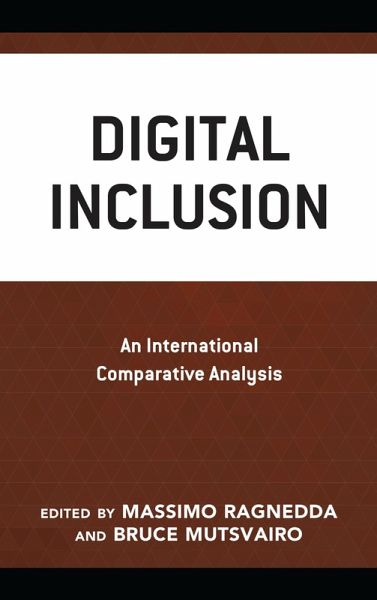
The volume examines the risks and opportunities of a digital society characterized by the increasing importance of knowledge and by the incessant rise and pervasiveness of information and communication technologies (ICTs). At a global level, the pivotal role of ICTs has made it necessary to rethink ways to avoid forms of digital exclusion or digital discrimination. This edited collection comprises of chapters written by respected scholars from a variety of countries, and brings together new scholarship addressing what the process of digital inclusion means for individuals and places in the…mehr
The volume examines the risks and opportunities of a digital society characterized by the increasing importance of knowledge and by the incessant rise and pervasiveness of information and communication technologies (ICTs). At a global level, the pivotal role of ICTs has made it necessary to rethink ways to avoid forms of digital exclusion or digital discrimination. This edited collection comprises of chapters written by respected scholars from a variety of countries, and brings together new scholarship addressing what the process of digital inclusion means for individuals and places in the countries analyzed. Each country has its own strategy to guarantee that people can access and enjoy the benefits of the information society. While this book does not presume to map all the countries in the world, it does shed light into these strategies, underlining what each country is doing in order to reduce digital inequalities and to guarantee that socially disadvantaged people (in terms of disabilities, availability of resources, age, geographic location, lack of education, or ethnicity) are digitally included.
Die Herstellerinformationen sind derzeit nicht verfügbar.
Autorenporträt
Massimo Ragnedda is senior lecturer of mass communication at Northumbria University. Bruce Mutsvairo is associate professor in the School of Communication of the University of Technology Sydney.
Inhaltsangabe
Introduction: Digital Inclusion: Empowering People through Information and Communication Technologies (ICTs), Massimo Ragnedda and Bruce Mutsvairo Part I: Digital Inclusion in Advanced Countries Chapter 1: Reducing and Preventing Digital Discrimination: Digital Inclusion Strategies in Europe, Massimo Ragnedda Chapter 2: Not So Ubiquitous: Digital Inclusion and Older Adults in Australia, Sue Malta and Raelene Wilding Chapter 3: Digital Inclusion in International Perspective: An Asset-Based Approach to Digital Inclusion Research in the US Context, Bianca C. Reisdorf and Colin Rhinesmith Part II: Digital Inclusion in BRICS Countries Chapter 4: From Access to Proficiency: Reconceptualising Digital Inclusion in a Rural Area in South Africa, Lorenzo Dalvit Chapter 5: Mapping the Evolutive Trajectories of China's Digital Divide: A Longitudinal Observation, Jianbin Jin, Fanxin Meng, Anfan Chen, Lin Shi, and Tao Wang Chapter 6: Changes in Knowledge Acquisition According to the Proximity with Digital Media Networks, Andrea Limberto Part III: Digital Inclusion in the Middle East Chapter 7: Digital Inclusion in Jordan: Opportunities and Hurdles, Hanna Kreitem Chapter 8: An Explanatory Analysis of Facebook's Effect on Social Cohesion in Iran, Hamid Abdollahyan and Mahin Sheikh Ansari Chapter 9: "Nothing Is Ever Truly New": The Persisting Digital Exclusion in Israel, 2002-2013, Amit M. Schejter, Orit Ben-Harush, and Noam Tirosh Part IV: Digital Inclusion in Africa Chapter 10: ICT and Development: Narrowing the Digital Divide and the Knowledge Gap of ICT Users in Cameroon and Ghana, Kehbuma Langmia and Christiana Hammond Chapter 11: Kenya's Digital Divide: Challenged, Evolving, and Persistent, Norbert Wildermuth Afterword, Why Digital Inclusion Now? Gerard Goggin
Es gelten unsere Allgemeinen Geschäftsbedingungen: www.buecher.de/agb
Impressum
www.buecher.de ist ein Internetauftritt der buecher.de internetstores GmbH
Geschäftsführung: Monica Sawhney | Roland Kölbl | Günter Hilger
Sitz der Gesellschaft: Batheyer Straße 115 - 117, 58099 Hagen
Postanschrift: Bürgermeister-Wegele-Str. 12, 86167 Augsburg
Amtsgericht Hagen HRB 13257
Steuernummer: 321/5800/1497
USt-IdNr: DE450055826