45,95 €
45,95 €
inkl. MwSt.
Sofort per Download lieferbar

23 °P sammeln
45,95 €
Als Download kaufen
45,95 €
inkl. MwSt.
Sofort per Download lieferbar
23 °P sammeln
Jetzt verschenken
Alle Infos zum eBook verschenken
45,95 €
inkl. MwSt.
Sofort per Download lieferbar
Alle Infos zum eBook verschenken
23 °P sammeln

Andere Kunden interessierten sich auch für
") Food Sovereignty, Agroecology and Biocultural Diversity (eBook, ePUB)45,95 €
Food Sovereignty, Agroecology and Biocultural Diversity (eBook, ePUB)45,95 €") Transforming Food Systems (eBook, PDF)38,95 €
Transforming Food Systems (eBook, PDF)38,95 €") Evaluating Sustainable Food System Innovations (eBook, PDF)0,00 €
Evaluating Sustainable Food System Innovations (eBook, PDF)0,00 €") Home Gardens for Improved Food Security and Livelihoods (eBook, PDF)41,95 €
Home Gardens for Improved Food Security and Livelihoods (eBook, PDF)41,95 €") Nature's Matrix (eBook, PDF)41,95 €
Nature's Matrix (eBook, PDF)41,95 €") Food Policy in the United Kingdom (eBook, PDF)36,95 €
Food Policy in the United Kingdom (eBook, PDF)36,95 €") Climate Neutral and Resilient Farming Systems (eBook, PDF)0,00 €
Climate Neutral and Resilient Farming Systems (eBook, PDF)0,00 €
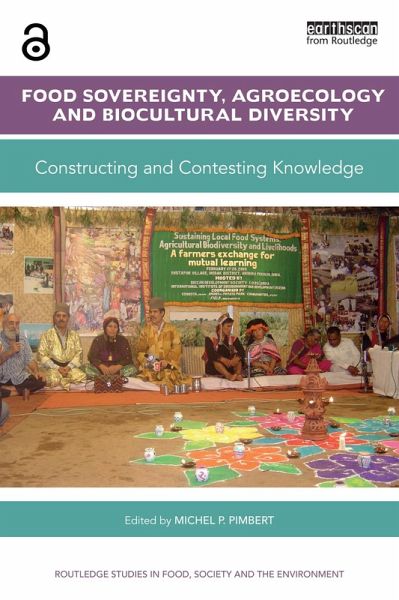
Contestations over knowledge - and who controls its production - are a key focus of social movements and other actors that promote food sovereignty, agroecology and biocultural diversity. This book critically examines the kinds of knowledge and ways of knowing needed for food sovereignty, agroecology and biocultural diversity.
'Food sovereignty' is understood here as a transformative process that seeks to recreate the democratic realm and regenerate a diversity of autonomous food systems based on agroecology, biocultural diversity, equity, social justice and ecological sustainability. It is shown that alternatives to the current model of development require radically different knowledges and epistemologies from those on offer today in mainstream institutions (including universities, policy think tanks and donor organizations). To achieve food sovereignty, agroecology and biocultural diversity, there is a need to re-imagine and construct knowledge for diversity, decentralisation, dynamic adaptation and democracy.
The authors critically explore the changes in organizations, research paradigms and professional practice that could help transform and co-create knowledge for a new modernity based on plural definitions of wellbeing. Particular attention is given to institutional, pedagogical and methodological innovations that can enhance cognitive justice by giving hitherto excluded citizens more power and agency in the construction of knowledge. The book thus contributes to the democratization of knowledge and power in the domain of food, environment and society.
Chapters 1 and 8 of this book are freely available as downloadable Open Access PDFs at http://www.taylorfrancis.com under a Creative Commons Attribution-Non Commercial-No Derivatives (CC-BY-NC-ND) 4.0 license.
'Food sovereignty' is understood here as a transformative process that seeks to recreate the democratic realm and regenerate a diversity of autonomous food systems based on agroecology, biocultural diversity, equity, social justice and ecological sustainability. It is shown that alternatives to the current model of development require radically different knowledges and epistemologies from those on offer today in mainstream institutions (including universities, policy think tanks and donor organizations). To achieve food sovereignty, agroecology and biocultural diversity, there is a need to re-imagine and construct knowledge for diversity, decentralisation, dynamic adaptation and democracy.
The authors critically explore the changes in organizations, research paradigms and professional practice that could help transform and co-create knowledge for a new modernity based on plural definitions of wellbeing. Particular attention is given to institutional, pedagogical and methodological innovations that can enhance cognitive justice by giving hitherto excluded citizens more power and agency in the construction of knowledge. The book thus contributes to the democratization of knowledge and power in the domain of food, environment and society.
Chapters 1 and 8 of this book are freely available as downloadable Open Access PDFs at http://www.taylorfrancis.com under a Creative Commons Attribution-Non Commercial-No Derivatives (CC-BY-NC-ND) 4.0 license.
Dieser Download kann aus rechtlichen Gründen nur mit Rechnungsadresse in A, B, BG, CY, CZ, D, DK, EW, E, FIN, F, GR, HR, H, IRL, I, LT, L, LR, M, NL, PL, P, R, S, SLO, SK ausgeliefert werden.