87,95 €
87,95 €
inkl. MwSt.
Sofort per Download lieferbar

44 °P sammeln
87,95 €
Als Download kaufen
87,95 €
inkl. MwSt.
Sofort per Download lieferbar
44 °P sammeln
Jetzt verschenken
Alle Infos zum eBook verschenken
87,95 €
inkl. MwSt.
Sofort per Download lieferbar
Alle Infos zum eBook verschenken
44 °P sammeln

Andere Kunden interessierten sich auch für
") Hostile Takeovers of Large Jewish Companies, 1933-1935 (eBook, ePUB)87,95 €
Hostile Takeovers of Large Jewish Companies, 1933-1935 (eBook, ePUB)87,95 €") The Stolen Narrative of the Bulgarian Jews and the Holocaust (eBook, PDF)29,95 €
The Stolen Narrative of the Bulgarian Jews and the Holocaust (eBook, PDF)29,95 €") The Archaeology of the Holocaust (eBook, PDF)26,95 €
The Archaeology of the Holocaust (eBook, PDF)26,95 €") Jewish Responses to Persecution, 1933-1946 (eBook, PDF)21,95 €
Jewish Responses to Persecution, 1933-1946 (eBook, PDF)21,95 €") Talking Until Nightfall (eBook, PDF)9,95 €
Talking Until Nightfall (eBook, PDF)9,95 €") A History of Catholic Antisemitism (eBook, PDF)44,95 €
A History of Catholic Antisemitism (eBook, PDF)44,95 €") Prelude to Catastrophe (eBook, PDF)17,95 €
Prelude to Catastrophe (eBook, PDF)17,95 €







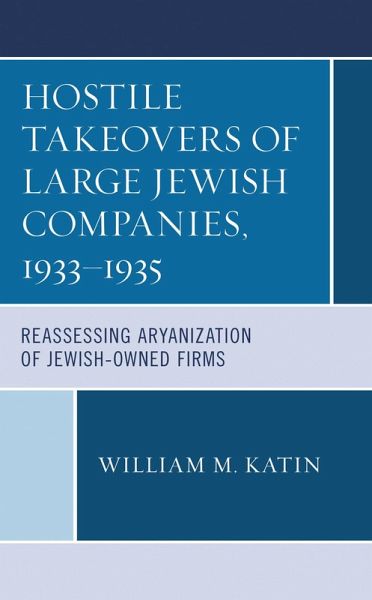
Opportunism combined with anti-Semitism led non-Nazi businessmen to acquire the largest German-Jewish companies in the period 1933-1935. These hostile takeovers were made possible by the Deutsche Bank and Dresdner Bank, which recalled loans previously extended to Jewish firms. Thereby Germany's largest banks obtained new loan fees, new supervisory board seats and became the house banks for the new Gentile-owned firms. The German judiciary did not defend Jewish property rights, because judges shared the same conservative mindset. Scholarship has previously not discovered this 1933-1935 paradigm because of a focus on Berlin government or Nazi Party actions, instead of the Jewish companies. In addition, a failure to distinguish between multi-million dollar enterprises and tiny shops caused scholars to emphasize the year 1938, when thousands of mom-and-pop shops became bankrupt.