52,95 €
52,95 €
inkl. MwSt.
Sofort per Download lieferbar

26 °P sammeln
52,95 €
Als Download kaufen
52,95 €
inkl. MwSt.
Sofort per Download lieferbar
26 °P sammeln
Jetzt verschenken
Alle Infos zum eBook verschenken
52,95 €
inkl. MwSt.
Sofort per Download lieferbar
Alle Infos zum eBook verschenken
26 °P sammeln

Andere Kunden interessierten sich auch für
") Human Factors in the U.S. Railroad Industry (eBook, PDF)52,95 €
Human Factors in the U.S. Railroad Industry (eBook, PDF)52,95 €") Lighting for Driving: Roads, Vehicles, Signs, and Signals, Second Edition (eBook, ePUB)142,95 €
Lighting for Driving: Roads, Vehicles, Signs, and Signals, Second Edition (eBook, ePUB)142,95 €") Approaches to Road Safety (eBook, ePUB)81,95 €
Approaches to Road Safety (eBook, ePUB)81,95 €") Seven Bad Habits of Safety Management (eBook, ePUB)47,95 €
Seven Bad Habits of Safety Management (eBook, ePUB)47,95 €") Safety at Height (eBook, ePUB)52,95 €
Safety at Height (eBook, ePUB)52,95 €") A Practical Guide to Effective Workplace Accident Investigation (eBook, ePUB)46,95 €
A Practical Guide to Effective Workplace Accident Investigation (eBook, ePUB)46,95 €") Risk Management (eBook, ePUB)51,95 €
Risk Management (eBook, ePUB)51,95 €






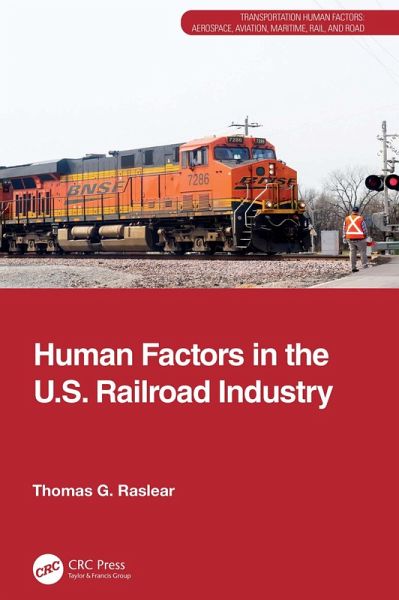
At the heart of the U.S. Railroad Industry are human operators who continue to make it work and operate. However, humans are susceptible to error, fatigue, and risky behaviors. Understanding how these impact the safety of the industry remains a crucial topic to be studied. Human Factors in the U.S. Railroad Industry investigates the human factor behind one of the world's biggest railway networks and synthesizes the body of research that has been produced by the Federal Railroad Administration (FRA) on Human Factors in the Railroad industry since 1993.
During that time, over 120 FRA reports were published on topics such as accident analysis, grade crossing safety and trespassing, working conditions and ergonomics, employee fatigue, safety culture, and track inspection. This book organizes this body of work into topic areas that correspond to Moray's Sociotechnical System (2006) to provide a comprehensive way to understand the relationship between policy, organizational culture, and system safety. It discusses tools such as risk exposure, signal detection theory, and program evaluation that have been applied to railroad projects and can be used to improve future railroad and transportation research. It provides a synthesis of the reports across topic areas such as fatigue, ergonomics, and safety culture that are currently important within the wider human factors transportation research community. The reader will develop an understanding of a "human-centered systems" approach to the railroad industry, which focuses on human capabilities and limitations with respect to human/system interfaces, operations, system integration, and organizational influences on safety.
Human Factors in the U.S. Railroad Industry will appeal to researchers, academics, students, and professionals interested in human factors, railway engineering, civil engineering, and industrial engineering.
During that time, over 120 FRA reports were published on topics such as accident analysis, grade crossing safety and trespassing, working conditions and ergonomics, employee fatigue, safety culture, and track inspection. This book organizes this body of work into topic areas that correspond to Moray's Sociotechnical System (2006) to provide a comprehensive way to understand the relationship between policy, organizational culture, and system safety. It discusses tools such as risk exposure, signal detection theory, and program evaluation that have been applied to railroad projects and can be used to improve future railroad and transportation research. It provides a synthesis of the reports across topic areas such as fatigue, ergonomics, and safety culture that are currently important within the wider human factors transportation research community. The reader will develop an understanding of a "human-centered systems" approach to the railroad industry, which focuses on human capabilities and limitations with respect to human/system interfaces, operations, system integration, and organizational influences on safety.
Human Factors in the U.S. Railroad Industry will appeal to researchers, academics, students, and professionals interested in human factors, railway engineering, civil engineering, and industrial engineering.
Dieser Download kann aus rechtlichen Gründen nur mit Rechnungsadresse in A, B, BG, CY, CZ, D, DK, EW, E, FIN, F, GR, HR, H, IRL, I, LT, L, LR, M, NL, PL, P, R, S, SLO, SK ausgeliefert werden.