45,95 €
45,95 €
inkl. MwSt.
Sofort per Download lieferbar

23 °P sammeln
45,95 €
Als Download kaufen
45,95 €
inkl. MwSt.
Sofort per Download lieferbar
23 °P sammeln
Jetzt verschenken
Alle Infos zum eBook verschenken
45,95 €
inkl. MwSt.
Sofort per Download lieferbar
Alle Infos zum eBook verschenken
23 °P sammeln

Andere Kunden interessierten sich auch für
") Israeli Statecraft (eBook, PDF)45,95 €
Israeli Statecraft (eBook, PDF)45,95 €") Moral Responsibility, Statecraft and Humanitarian Intervention (eBook, PDF)41,95 €
Moral Responsibility, Statecraft and Humanitarian Intervention (eBook, PDF)41,95 €") The Foundations of Modern Arms Control (eBook, PDF)42,95 €
The Foundations of Modern Arms Control (eBook, PDF)42,95 €") Economic Statecraft and Foreign Policy (eBook, PDF)45,95 €
Economic Statecraft and Foreign Policy (eBook, PDF)45,95 €") Terrorism, Democracy, and Human Security (eBook, PDF)38,95 €
Terrorism, Democracy, and Human Security (eBook, PDF)38,95 €") Rethinking the Security-Development Nexus (eBook, PDF)42,95 €
Rethinking the Security-Development Nexus (eBook, PDF)42,95 €") Women, Peace and Security (eBook, PDF)38,95 €
Women, Peace and Security (eBook, PDF)38,95 €


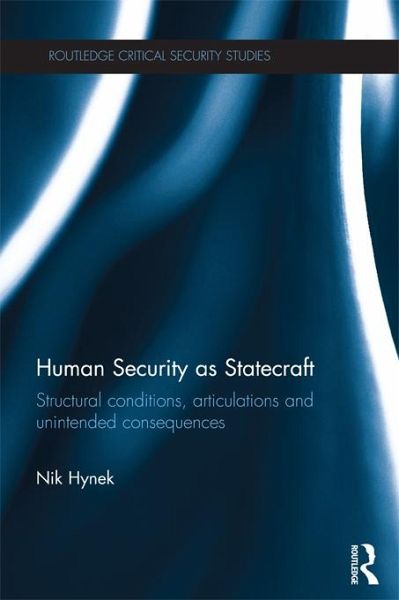
This book critically investigates the discourses and practices of human security and aims to delve below the stereotypical imageries representing them.
Drawing on Foucault and Deleuze, the author approaches human security from a new perspective, with the aim of ascertaining what has been behind and underneath a certain spatio-temporal articulation of human security, and with what political implications and consequences. Each human security assemblage is composed of messy discourses and practices which are loosely related and sometimes even disconnected. This book examines the Canadian and Japanese articulations of human security and establishes the kinds of structural terrains have enabled, shaped, or blocked the unfolding of these versions of human security. The pivotal contention of the book is that Canadian and Japanese articulations of human security have been different because they have grown from completely different domestic economies of power governing the relationship between the state apparatus and the non-profit and voluntary sector. While the Canadian human security assemblage has been shaped by transformations in the country's advanced liberal model of government, the Japanese has been shaped by the continuities of Japan's bureaucratic authoritarianism. A novel approach is employed for the related process-tracing: a general series linking structural conditions with actual articulations of the human security projects, and their further development, including analysis of their unintended consequences.
This book will be of much interest to students of Critical Security Studies, human security, global governance, foreign policy and IR/Security studies.
Drawing on Foucault and Deleuze, the author approaches human security from a new perspective, with the aim of ascertaining what has been behind and underneath a certain spatio-temporal articulation of human security, and with what political implications and consequences. Each human security assemblage is composed of messy discourses and practices which are loosely related and sometimes even disconnected. This book examines the Canadian and Japanese articulations of human security and establishes the kinds of structural terrains have enabled, shaped, or blocked the unfolding of these versions of human security. The pivotal contention of the book is that Canadian and Japanese articulations of human security have been different because they have grown from completely different domestic economies of power governing the relationship between the state apparatus and the non-profit and voluntary sector. While the Canadian human security assemblage has been shaped by transformations in the country's advanced liberal model of government, the Japanese has been shaped by the continuities of Japan's bureaucratic authoritarianism. A novel approach is employed for the related process-tracing: a general series linking structural conditions with actual articulations of the human security projects, and their further development, including analysis of their unintended consequences.
This book will be of much interest to students of Critical Security Studies, human security, global governance, foreign policy and IR/Security studies.
Dieser Download kann aus rechtlichen Gründen nur mit Rechnungsadresse in A, B, BG, CY, CZ, D, DK, EW, E, FIN, F, GR, HR, H, IRL, I, LT, L, LR, M, NL, PL, P, R, S, SLO, SK ausgeliefert werden.