160,95 €
160,95 €
inkl. MwSt.
Sofort per Download lieferbar

80 °P sammeln
160,95 €
Als Download kaufen
160,95 €
inkl. MwSt.
Sofort per Download lieferbar
80 °P sammeln
Jetzt verschenken
Alle Infos zum eBook verschenken
160,95 €
inkl. MwSt.
Sofort per Download lieferbar
Alle Infos zum eBook verschenken
80 °P sammeln

Andere Kunden interessierten sich auch für
") Statistical Image Processing Techniques for Noisy Images (eBook, PDF)40,95 €
Statistical Image Processing Techniques for Noisy Images (eBook, PDF)40,95 €") Precision Landmark Location for Machine Vision and Photogrammetry (eBook, PDF)72,95 €
Precision Landmark Location for Machine Vision and Photogrammetry (eBook, PDF)72,95 €") Digital Mapping of Soil Landscape Parameters (eBook, PDF)112,95 €
Digital Mapping of Soil Landscape Parameters (eBook, PDF)112,95 €") Hyperspectral Image Analysis (eBook, PDF)112,95 €
Hyperspectral Image Analysis (eBook, PDF)112,95 €") Information Theory and Network Coding (eBook, PDF)52,95 €
Information Theory and Network Coding (eBook, PDF)52,95 €") Spatial Data Mining (eBook, PDF)64,95 €
Spatial Data Mining (eBook, PDF)64,95 €") Semantic Kriging for Spatio-temporal Prediction (eBook, PDF)72,95 €
Semantic Kriging for Spatio-temporal Prediction (eBook, PDF)72,95 €






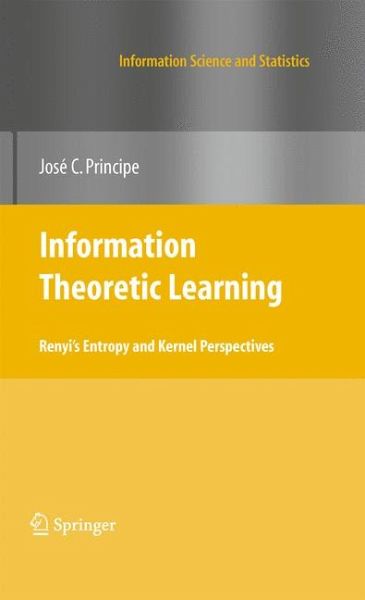
This bookisan outgrowthoften yearsof researchatthe Universityof Florida Computational NeuroEngineering Laboratory (CNEL) in the general area of statistical signal processing and machine learning. One of the goals of writing the book is exactly to bridge the two ?elds that share so many common problems and techniques but are not yet e?ectively collaborating. Unlikeotherbooks thatcoverthe state ofthe artinagiven?eld,this book cuts across engineering (signal processing) and statistics (machine learning) withacommontheme:learningseenfromthepointofviewofinformationt- orywithanemphasisonRenyi'sde?nitionofinformation.Thebasicapproach is to utilize the information theory descriptors of entropy and divergence as nonparametric cost functions for the design of adaptive systems in unsup- vised or supervised training modes. Hence the title: Information-Theoretic Learning (ITL). In the course of these studies, we discovered that the main idea enabling a synergistic view as well as algorithmic implementations, does not involve the conventional central moments of the data (mean and covariance). Rather, the core concept is the ?-norm of the PDF, in part- ular its expected value (? = 2), which we call the information potential. This operator and related nonparametric estimators link information theory, optimization of adaptive systems, and reproducing kernel Hilbert spaces in a simple and unconventional way.
Dieser Download kann aus rechtlichen Gründen nur mit Rechnungsadresse in A, B, BG, CY, CZ, D, DK, EW, E, FIN, F, GR, HR, H, IRL, I, LT, L, LR, M, NL, PL, P, R, S, SLO, SK ausgeliefert werden.
From the book reviews:
"The book is remarkable in various ways in the information it presents on the concept and use of entropy functions and their applications in signal processing and solution of statistical problems such as M-estimation, classification, and clustering. Students of engineering and statistics will greatly benefit by reading it." (C. R. Rao, Technometrics, Vol. 55 (1), February, 2013)
"The book is remarkable in various ways in the information it presents on the concept and use of entropy functions and their applications in signal processing and solution of statistical problems such as M-estimation, classification, and clustering. Students of engineering and statistics will greatly benefit by reading it." (C. R. Rao, Technometrics, Vol. 55 (1), February, 2013)