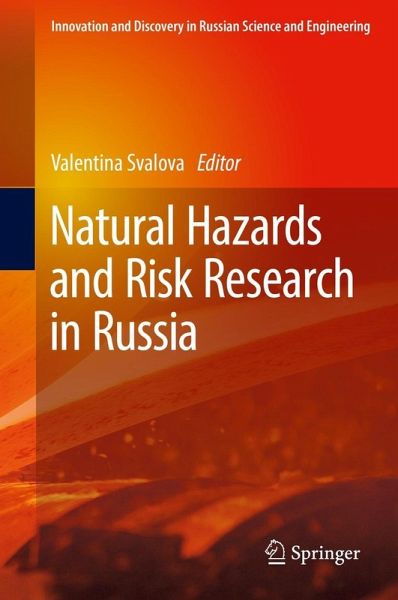
Natural Hazards and Risk Research in Russia (eBook, PDF)
Redaktion: Svalova, Valentina
72,95 €
72,95 €
inkl. MwSt.
Sofort per Download lieferbar

36 °P sammeln
72,95 €
Als Download kaufen
72,95 €
inkl. MwSt.
Sofort per Download lieferbar
36 °P sammeln
Jetzt verschenken
Alle Infos zum eBook verschenken
72,95 €
inkl. MwSt.
Sofort per Download lieferbar
Alle Infos zum eBook verschenken
36 °P sammeln

Natural Hazards and Risk Research in Russia (eBook, PDF)
Redaktion: Svalova, Valentina
- Format: PDF
- Merkliste
- Auf die Merkliste
- Bewerten Bewerten
- Teilen
- Produkt teilen
- Produkterinnerung
- Produkterinnerung

Bitte loggen Sie sich zunächst in Ihr Kundenkonto ein oder registrieren Sie sich bei
bücher.de, um das eBook-Abo tolino select nutzen zu können.
Hier können Sie sich einloggen
Sie sind bereits eingeloggt. Klicken Sie auf 2. tolino select Abo, um fortzufahren.

Bitte loggen Sie sich zunächst in Ihr Kundenkonto ein oder registrieren Sie sich bei bücher.de, um das eBook-Abo tolino select nutzen zu können.
Maximizes reader understanding of natural hazards research and risk analysis in Russia
Explains relevance and application of primary tools and practices in risk study
Clarifies similarities and differences in fundamental concepts and principles across the discipline
Directs geologists, engineers, architects, planners, teachers, students, and others to authoritative sources
- Geräte: PC
- ohne Kopierschutz
- eBook Hilfe
- Größe: 20.9MB
Andere Kunden interessierten sich auch für
Vladimir N. BashkinGeoecological Risk Management in Polar Areas (eBook, PDF)72,95 €
Jianwei ChengExplosions in Underground Coal Mines (eBook, PDF)72,95 €
Sustainable Risk Management (eBook, PDF)136,95 €
Ulrich RankeNatural Disaster Risk Management (eBook, PDF)64,95 €
Integrated Risk Governance (eBook, PDF)72,95 €
Natural Disasters in China (eBook, PDF)72,95 €
Integrated Catastrophe Risk Modeling (eBook, PDF)72,95 €-
-
-
Maximizes reader understanding of natural hazards research and risk analysis in Russia
Explains relevance and application of primary tools and practices in risk study
Clarifies similarities and differences in fundamental concepts and principles across the discipline
Directs geologists, engineers, architects, planners, teachers, students, and others to authoritative sources
Explains relevance and application of primary tools and practices in risk study
Clarifies similarities and differences in fundamental concepts and principles across the discipline
Directs geologists, engineers, architects, planners, teachers, students, and others to authoritative sources
Dieser Download kann aus rechtlichen Gründen nur mit Rechnungsadresse in A, B, BG, CY, CZ, D, DK, EW, E, FIN, F, GR, HR, H, IRL, I, LT, L, LR, M, NL, PL, P, R, S, SLO, SK ausgeliefert werden.
Produktdetails
- Produktdetails
- Verlag: Springer International Publishing
- Seitenzahl: 399
- Erscheinungstermin: 14. Juli 2018
- Englisch
- ISBN-13: 9783319918334
- Artikelnr.: 56792555
- Verlag: Springer International Publishing
- Seitenzahl: 399
- Erscheinungstermin: 14. Juli 2018
- Englisch
- ISBN-13: 9783319918334
- Artikelnr.: 56792555
- Herstellerkennzeichnung Die Herstellerinformationen sind derzeit nicht verfügbar.
Dr. ¿Valentina Svalova is Leading Scientist of the Sergeev Institute of Environmental Geoscience, Russian Academy of Sciences (IEG RAS)
Chapter1: Technogenesis and natural disasters.- Chapter2: Complications and Prospects of the Hydrogeological Substantiation of Drainage in Deep Tunnels.- Chapter3: Probabilistic Approach to Forecast of the Risk Caused by Groundwater Contamination.- Chapter4: Landslide and Seismic Monitoring Systems.- Chapter5: Early-Warning Landslide Monitoring System.- Chapter6: Problems in forecasting dangerous processes and phenomena on the base of the Earth Remote sensing data.- Chapter7: Assessment and mapping geological risk for the future subsurface linear construction in Moscow.- Chapter8: Deep extrusive landslides. peculiarities of formation, development and protection.- Chapter9: The research of surface runoff in engineering-geological zoning.- Chapter10: Assessment of Seismic Hazards for Extractive Installations of the Oil and Gas Complex on the Caspian Sea Shelf.- Chapter11: Geodinamic stability of territories with specially important engineering objects.- Chapter12: Combined measures on providing safety of technogenic objects within the mined territories of potassium deposits in Perm region, Russia.- Chapter13: Geo-Environmental Sustainability of Arctic Area of The Russian Federation.- Chapter14: Geo-Environmental Zoning for Urban Planning and Design.- Chapter15: Objective methods for compiling integral maps.- Chapter16: Suture zones as upper crustal seismogenerating structures.- Chapter17: Stochastic modelling of human-induced thermokarst and natural risk assessment for existing and planned engineering structures.- Chapter18: Stochastic modelling of natural lacustrine thermokarst under stable and unstable climate.- Chapter19: Seismo - ecological monitoring of seismic and special - hazard object.- Chapter20: Landslide Risk Assessment, Management and Reduction for City Territories.- Chapter21: Mechanical-Mathematical Modeling for Landslide Processes.- Chapter22: Structural transformations of perennial frozen rocks during the Yamal Crater formation.-Chapter23: Landslide activity and landslide hazard in Geyser valley (Kamchatka peninsula, Russia).- Chapter24: The History of Slope Evolution as Primary Cause of Modern Landslide Deformations (on the example of a landslide "Vorobyovy Gory", Moscow).- Chapter25: Application of Fractal Theory Methods for Seismogram Analysis.- Chapter26: The new method of the potentially hazardous geodynamic active zones mapping.