127,95 €
127,95 €
inkl. MwSt.
Sofort per Download lieferbar

64 °P sammeln
127,95 €
Als Download kaufen
127,95 €
inkl. MwSt.
Sofort per Download lieferbar
64 °P sammeln
Jetzt verschenken
Alle Infos zum eBook verschenken
127,95 €
inkl. MwSt.
Sofort per Download lieferbar
Alle Infos zum eBook verschenken
64 °P sammeln

Andere Kunden interessierten sich auch für
") Cell Press Reviews: Core Concepts in Cell Biology (eBook, ePUB)15,95 €
Cell Press Reviews: Core Concepts in Cell Biology (eBook, ePUB)15,95 €") An Introduction to Biological Membranes (eBook, ePUB)55,95 €
An Introduction to Biological Membranes (eBook, ePUB)55,95 €") International Review of Cell and Molecular Biology (eBook, ePUB)146,95 €
International Review of Cell and Molecular Biology (eBook, ePUB)146,95 €") Cholecystokinin (eBook, ePUB)119,95 €
Cholecystokinin (eBook, ePUB)119,95 €") Cell Biology Assays (eBook, ePUB)59,95 €
Cell Biology Assays (eBook, ePUB)59,95 €") Revealing Uncharted Biology with Single Cell Multiplex Proteomic Technologies (eBook, ePUB)103,95 €
Revealing Uncharted Biology with Single Cell Multiplex Proteomic Technologies (eBook, ePUB)103,95 €") Nongenetic Information and Evolution (eBook, ePUB)124,95 €
Nongenetic Information and Evolution (eBook, ePUB)124,95 €







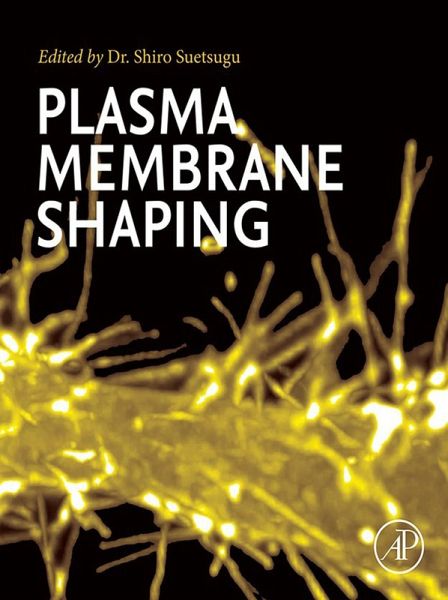
Plasma Membrane Shaping summarizes current knowledge on how cells shape their membrane. Organized in four sections, the book opens with a broad overview of the plasma membrane, its composition, usual shapes and substructures, Actin/WASP/arp2/3 structures, BAR domains, and Ankyrin repeat domains, dynamin, and phospholipid signaling. Other sections cover the shaping of the plasma membrane for transport processes, discussions on exosomes, microvesicles, and endosomes, clathrin-coated pits, caveolae, and other endocytic pits, membrane deformation for cell movement, and some of the most current dry and wet lab research techniques to investigate cellular membrane shaping. This is an ideal resource for new researchers coming into this area as well as for graduate students. The methods section will be of interest to both microscopists and computer scientists dedicated to the visualization, data collection, and analysis of plasma membrane shaping experiments. - Covers membrane shaping for both cytosis and cell movement - Includes dry and wet lab research methods of plasma membrane shaping - Describes the molecular machinery involved with protein and lipid balance in the plasma membrane - Presents the coordination of cellular structures involved in cell deformation and motion
Dieser Download kann aus rechtlichen Gründen nur mit Rechnungsadresse in A, B, BG, CY, CZ, D, DK, EW, E, FIN, F, GR, HR, H, IRL, I, LT, L, LR, M, NL, PL, P, R, S, SLO, SK ausgeliefert werden.