48,95 €
48,95 €
inkl. MwSt.
Sofort per Download lieferbar

24 °P sammeln
48,95 €
Als Download kaufen
48,95 €
inkl. MwSt.
Sofort per Download lieferbar
24 °P sammeln
Jetzt verschenken
Alle Infos zum eBook verschenken
48,95 €
inkl. MwSt.
Sofort per Download lieferbar
Alle Infos zum eBook verschenken
24 °P sammeln

Andere Kunden interessierten sich auch für
") What is Enlightenment? (eBook, ePUB)38,95 €
What is Enlightenment? (eBook, ePUB)38,95 €") Embodied Emotions (eBook, ePUB)46,95 €
Embodied Emotions (eBook, ePUB)46,95 €") Transparency and Apperception (eBook, ePUB)39,95 €
Transparency and Apperception (eBook, ePUB)39,95 €") Moral Disagreement (eBook, ePUB)33,95 €
Moral Disagreement (eBook, ePUB)33,95 €") The Routledge Handbook of Philosophy of Friendship (eBook, ePUB)43,95 €
The Routledge Handbook of Philosophy of Friendship (eBook, ePUB)43,95 €") The Ethics of Need (eBook, ePUB)54,95 €
The Ethics of Need (eBook, ePUB)54,95 €") Respect and Power (eBook, ePUB)42,95 €
Respect and Power (eBook, ePUB)42,95 €

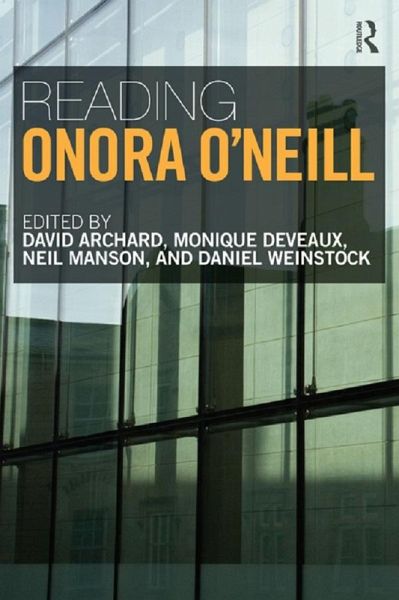
Onora O'Neill is one of the foremost moral philosophers writing today. Her work on ethics and bioethics, political philosophy and the philosophy of Kant is extremely influential. Her landmark Reith Lectures on trust did much to establish the subject not only on the philosophical and political agenda but in the world of media, business and law more widely.
Reading Onora O'Neill is the first book to examine and critically appraise the work of this important thinker. It includes specially commissioned chapters by leading international philosophers in ethics, Kantian philosophy and political philosophy. The following aspects of O'Neill's work are examined:
Featuring a substantial reply to her critics at the end of the book, Reading Onora O'Neill is essential reading for students and scholars of ethics and political philosophy.
Reading Onora O'Neill is the first book to examine and critically appraise the work of this important thinker. It includes specially commissioned chapters by leading international philosophers in ethics, Kantian philosophy and political philosophy. The following aspects of O'Neill's work are examined:
- global justice
- Kant
- the ethics of the family
- bioethics
- consent
- trust.
Featuring a substantial reply to her critics at the end of the book, Reading Onora O'Neill is essential reading for students and scholars of ethics and political philosophy.
Dieser Download kann aus rechtlichen Gründen nur mit Rechnungsadresse in A, B, BG, CY, CZ, D, DK, EW, E, FIN, F, GR, HR, H, IRL, I, LT, L, LR, M, NL, PL, P, R, S, SLO, SK ausgeliefert werden.
"... this volume provides a wide-ranging and high quality overview of O'Neill's contributions to moral philosophy. The essays are also of considerable philosophical interest in their own right. I commend the volume to anyone with interest in O'Neill's work, or in broader issues of Kantianism, constructivism, autonomy, consent, and trust." - Anna Stilz, Notre Dame Philosophical Reviews
"Lucid and timely, these essays honour the arguments of this exceptional moral philosopher, not by meekly accepting them, but by challenging them, and taking them in new directions. The breadth of their topics reflects the range of O'Neill's reflective engagement: what autonomy, consent and independence mean for fallible agents, and why these matter; whether moral norms are in some sense constructed; whether we have a right to have children; what hope means for Kant's account of ethics and religion. Especially timely are responses to O'Neill's work on trust and communication, looking at testimony in contexts rife with prejudice. In their own way, these essays offer answers to Kant's famous trio of questions: What can I know? What must I do? What may I hope? The answers they propose are sometimes more realistic than Kant's own, since, following O'Neill's lead, they do better justice to our vulnerabilities and limitations, as knowers and agents living in social circumstances that are far from ideal-and in so doing, they offer eloquent proof of O'Neill's continuing power to inspire and engage." - Rae Langton, Massachusetts Institute of Technology, USA
"Lucid and timely, these essays honour the arguments of this exceptional moral philosopher, not by meekly accepting them, but by challenging them, and taking them in new directions. The breadth of their topics reflects the range of O'Neill's reflective engagement: what autonomy, consent and independence mean for fallible agents, and why these matter; whether moral norms are in some sense constructed; whether we have a right to have children; what hope means for Kant's account of ethics and religion. Especially timely are responses to O'Neill's work on trust and communication, looking at testimony in contexts rife with prejudice. In their own way, these essays offer answers to Kant's famous trio of questions: What can I know? What must I do? What may I hope? The answers they propose are sometimes more realistic than Kant's own, since, following O'Neill's lead, they do better justice to our vulnerabilities and limitations, as knowers and agents living in social circumstances that are far from ideal-and in so doing, they offer eloquent proof of O'Neill's continuing power to inspire and engage." - Rae Langton, Massachusetts Institute of Technology, USA