59,95 €
59,95 €
inkl. MwSt.
Erscheint vor. 12.12.25

30 °P sammeln
59,95 €
Als Download kaufen
59,95 €
inkl. MwSt.
Erscheint vor. 12.12.25
30 °P sammeln
Jetzt verschenken
Alle Infos zum eBook verschenken
59,95 €
inkl. MwSt.
Erscheint vor. 12.12.25
Alle Infos zum eBook verschenken
30 °P sammeln

Andere Kunden interessierten sich auch für
") Dynamics of Soils and Their Engineering Applications (eBook, ePUB)51,95 €
Dynamics of Soils and Their Engineering Applications (eBook, ePUB)51,95 €") Loess and Loess Geohazards in China (eBook, ePUB)49,95 €
Loess and Loess Geohazards in China (eBook, ePUB)49,95 €") Fundamentals of Sedimentology (eBook, ePUB)109,95 €
Fundamentals of Sedimentology (eBook, ePUB)109,95 €") Laboratory Tests for Unsaturated Soils (eBook, ePUB)73,95 €
Laboratory Tests for Unsaturated Soils (eBook, ePUB)73,95 €") Plant-Soil Slope Interaction (eBook, ePUB)47,95 €
Plant-Soil Slope Interaction (eBook, ePUB)47,95 €") Soils and Geotechnology in Construction (eBook, ePUB)113,95 €
Soils and Geotechnology in Construction (eBook, ePUB)113,95 €") Effective Stress and Equilibrium Equation for Soil Mechanics (eBook, ePUB)48,95 €
Effective Stress and Equilibrium Equation for Soil Mechanics (eBook, ePUB)48,95 €



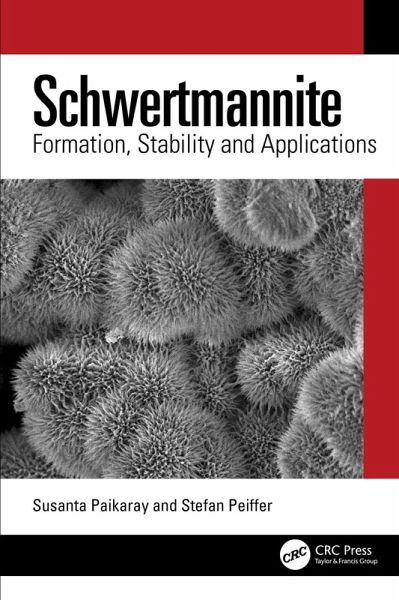
This book offers a comprehensive overview of the structure and solubility of the mineral schwertmannite, while also delving into characterization methods and techniques, environmental stability, and the potential to retain pollutants.
Using examples from the 1990s, when the mineral was first discovered, Schwertmannite compiles years of research in this supplementary guide. Chapter 1 explains its occurrence in various environmental settings, the conditions of its formation, and its association with other secondary precipitates. Chapter 2 discusses its solubility, structure, and iron-sulphur coordination, while Chapter 3 delves into synthesizing approaches such as dialysis techniques, oxidation pathways, and urea hydrolysis. Chapter 4 explores how schwertmannite came to be characterized based on colour, composition, morphology, and crystallinity. The last two chapters deal with the mineral's interaction with contaminants, its binding mechanisms, its metastability with respect to other iron oxyhydroxides, and the factors controlling transformation processes.
This book will benefit a large community of scientists and researchers working in acid mine drainage, since schwertmannite is the most abundant mineral in these sulphate-rich environments. It will be a valuable body of knowledge for research organizations and mining companies, as well as those teaching courses on mining, mineral chemistry, wastewater treatment, acid sulphate soils, soil geochemistry, and mine reclamation.
Using examples from the 1990s, when the mineral was first discovered, Schwertmannite compiles years of research in this supplementary guide. Chapter 1 explains its occurrence in various environmental settings, the conditions of its formation, and its association with other secondary precipitates. Chapter 2 discusses its solubility, structure, and iron-sulphur coordination, while Chapter 3 delves into synthesizing approaches such as dialysis techniques, oxidation pathways, and urea hydrolysis. Chapter 4 explores how schwertmannite came to be characterized based on colour, composition, morphology, and crystallinity. The last two chapters deal with the mineral's interaction with contaminants, its binding mechanisms, its metastability with respect to other iron oxyhydroxides, and the factors controlling transformation processes.
This book will benefit a large community of scientists and researchers working in acid mine drainage, since schwertmannite is the most abundant mineral in these sulphate-rich environments. It will be a valuable body of knowledge for research organizations and mining companies, as well as those teaching courses on mining, mineral chemistry, wastewater treatment, acid sulphate soils, soil geochemistry, and mine reclamation.
Dieser Download kann aus rechtlichen Gründen nur mit Rechnungsadresse in A, B, BG, CY, CZ, D, DK, EW, E, FIN, F, GR, HR, H, IRL, I, LT, L, LR, M, NL, PL, P, R, S, SLO, SK ausgeliefert werden.