8,99 €
8,99 €
inkl. MwSt.
Sofort per Download lieferbar

0 °P sammeln
8,99 €
Als Download kaufen
8,99 €
inkl. MwSt.
Sofort per Download lieferbar
0 °P sammeln
Jetzt verschenken
Alle Infos zum eBook verschenken
8,99 €
inkl. MwSt.
Sofort per Download lieferbar
Alle Infos zum eBook verschenken
0 °P sammeln

BOOK DESCRIPTION
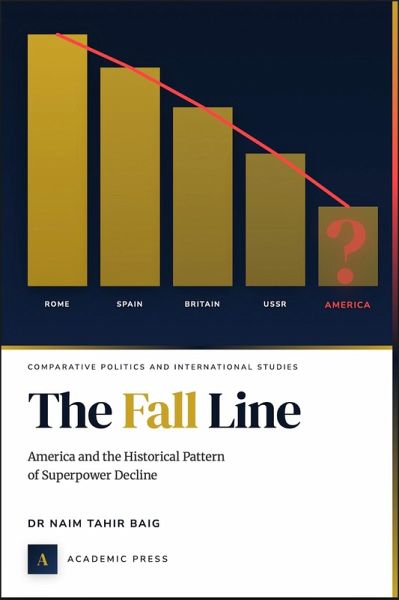
The Fall Line: America and the Historical Pattern of Superpower Decline is a historical analysis that confronts the question Americans refuse to ask: Is the United States following the same trajectory as every fallen superpower before it? Drawing on meticulous research spanning six major empiresRome, Spain, Britain, the Soviet Union, Qing China, and the Ottoman EmpireDr. Naim Tahir Baig identifies eight universal patterns of decline that have proven fatal to every dominant power in history.
With unflinching clarity and data-driven analysis, this book presents the uncomfortable evidence that five of these eight patterns are now clearly present in contemporary America: economic exhaustion marked by $36-38 trillion in national debt and a debt-to-GDP ratio exceeding 120%; military overextension across 750+ bases in 80 countries with defense spending of $877 billion annually; political dysfunction evidenced by trust in government plummeting from 73% in 1958 to just 22% in 2024; social fracture reflected in unprecedented polarization; and rising challengers as China's economy reaches $18.7 trillion, representing 17.65% of global GDP while America's share has declined from 40% in 1960 to 26% today.
Yet The Fall Line is neither a prophecy of doom nor a partisan screed. Instead, it offers a rigorous framework for understanding decline itselfrevealing that the critical question is not whether America is declining from its post-Cold War unipolarity (it demonstrably is), but rather how Americans will manage this transition. Through comparative analysis of how Rome collapsed, Spain bankrupted itself despite endless silver, Britain exhausted itself through pyrrhic victories, and the Soviet Union disintegrated in a mere six years, Baig presents four possible scenarios for America's future, each grounded in historical precedent.
This book arrives at a pivotal moment when denial has become the defining feature of American political discourse. With clarity that cuts through ideological bias, Dr. Baig demonstrates that every declining superpower believed itself exceptionaluntil it wasn't. The patterns are consistent. The evidence is overwhelming. The only variable that remains is whether Americans will choose managed adaptation, chaotic collapse, genuine renewal, or slow erosion. The window for choice, Baig argues, is measured not in generations but in years.
Written for citizens, policymakers, students of history, and anyone concerned about America's trajectory, The Fall Linecombines the narrative sweep of popular history with the analytical rigor of academic research. It is essential reading for understanding the most important question of our time: not whether empires decline, but whether this one can learn from history before it's too late.
The Fall Line: America and the Historical Pattern of Superpower Decline is a historical analysis that confronts the question Americans refuse to ask: Is the United States following the same trajectory as every fallen superpower before it? Drawing on meticulous research spanning six major empiresRome, Spain, Britain, the Soviet Union, Qing China, and the Ottoman EmpireDr. Naim Tahir Baig identifies eight universal patterns of decline that have proven fatal to every dominant power in history.
With unflinching clarity and data-driven analysis, this book presents the uncomfortable evidence that five of these eight patterns are now clearly present in contemporary America: economic exhaustion marked by $36-38 trillion in national debt and a debt-to-GDP ratio exceeding 120%; military overextension across 750+ bases in 80 countries with defense spending of $877 billion annually; political dysfunction evidenced by trust in government plummeting from 73% in 1958 to just 22% in 2024; social fracture reflected in unprecedented polarization; and rising challengers as China's economy reaches $18.7 trillion, representing 17.65% of global GDP while America's share has declined from 40% in 1960 to 26% today.
Yet The Fall Line is neither a prophecy of doom nor a partisan screed. Instead, it offers a rigorous framework for understanding decline itselfrevealing that the critical question is not whether America is declining from its post-Cold War unipolarity (it demonstrably is), but rather how Americans will manage this transition. Through comparative analysis of how Rome collapsed, Spain bankrupted itself despite endless silver, Britain exhausted itself through pyrrhic victories, and the Soviet Union disintegrated in a mere six years, Baig presents four possible scenarios for America's future, each grounded in historical precedent.
This book arrives at a pivotal moment when denial has become the defining feature of American political discourse. With clarity that cuts through ideological bias, Dr. Baig demonstrates that every declining superpower believed itself exceptionaluntil it wasn't. The patterns are consistent. The evidence is overwhelming. The only variable that remains is whether Americans will choose managed adaptation, chaotic collapse, genuine renewal, or slow erosion. The window for choice, Baig argues, is measured not in generations but in years.
Written for citizens, policymakers, students of history, and anyone concerned about America's trajectory, The Fall Linecombines the narrative sweep of popular history with the analytical rigor of academic research. It is essential reading for understanding the most important question of our time: not whether empires decline, but whether this one can learn from history before it's too late.
Dieser Download kann aus rechtlichen Gründen nur mit Rechnungsadresse in A, B, CY, CZ, D, DK, EW, E, FIN, F, GR, H, IRL, I, LT, L, LR, M, NL, PL, P, R, S, SLO, SK ausgeliefert werden.